Most agencies are built on projects. A client needs a website, a campaign or a rebrand, you deliver it, send the invoice and start looking for the next one. It works, but it means every month starts close to zero, and income depends on how many new deals you closed recently.
Recurring revenue changes that. When clients pay a monthly retainer or subscription for a service or a piece of software they keep using, income carries over from one month to the next, and growth comes from adding clients on top of the ones you already have rather than replacing them.
This guide is for agency owners, consultants and solo operators who want to make that move. It looks at why project work is hard to grow, why so many agencies struggle to change, a practical path for the switch, and how white label software can help clients stay with you for longer.
Why Project Work Is Hard to Grow
The main problem with project income is that it has to be won again and again. Function Point's 2025 industry survey found that 58% of agency owners said their number one daily challenge was growing and maintaining revenue. That matters because an agency that is always chasing the next project has little time left to improve its service or its margins.
Winning new work has also become harder. The same survey found that 80% of agencies named new customer acquisition as their main revenue driver in 2023, but only 36% did so in 2024. When new clients are harder to find, income that renews automatically from existing clients becomes far more valuable.
Small, loosely scoped work adds to the pressure. Ignition's 2025 Agency Pricing and Cash Flow Report, a survey of 273 US agency leaders, found that 78% of agencies rarely or only sometimes charge for out-of-scope work. The same survey found that 57% of agencies lose $1,000 to $5,000 every month on unbilled projects and tasks, and that 28% still bill by the hour.
Freelancers face the same pattern on a smaller scale. Upwork's Freelance Forward data shows that full-time freelancers have ten clients in a given six month period on average. Payoneer's 2023 Freelancer Report found that finding new clients is a challenge for 73% of freelancers. When each client buys a small, loosely defined piece of work, income depends on a long client list that keeps changing.
Benefits of Recurring Income for Digital Agencies
Agency recurring revenue makes a business easier to plan and less exposed to quiet months. You know roughly what will come in next month, so you can hire, invest and price with more confidence.
Growth also gets easier. Instead of replacing every finished project, you grow by keeping clients, adding new services to their plan and winning referrals from clients who are happy with an ongoing service.
It also improves the return on the money you spend winning clients. A common way to measure this is the ratio between what a customer is worth over their lifetime and what it cost to acquire them. Shopify explains that SaaS businesses aim for a ratio of at least 3:1, meaning each customer brings in at least three times what it cost to win them. A client who pays every month for years is far more likely to reach that level than one who buys a single project.
That does not mean projects should disappear. Promethean Research's 2025 Digital Agency Industry Report found that 88% of agencies offered both projects and retainers, and that fast-growing agencies completed more projects than average. The aim is a stable base of recurring income with projects on top, not a choice between the two.
Choosing a Recurring Revenue Model
Agencies usually build recurring income from one or more of a few models. Client Growth Engine, an agency growth consultancy, gives these indicative price and margin ranges, which are best treated as a rough guide rather than a benchmark.
| Model | What it is | Typical monthly price | Typical margin |
|---|---|---|---|
| Service retainers | A fixed monthly fee for ongoing work such as SEO, content or support; growth is limited by how many people you can hire | $1,000 to $10,000 | 30% to 50% |
| Productised services | A standard package with the same deliverables for every client, easier to delegate and automate | $500 to $2,500 | 40% to 60% |
| White label software | A branded platform you resell on subscription, maintained by the vendor | $197 to $997 | 50% to 70% |
| Hybrid bundles | Software plus services in one package | $997 to $2,997 | 40% to 55% |
Most digital agencies end up combining these revenue streams, for example a website care retainer that includes hosting, reporting and a client portal.
Software That Fits a Monthly Offer
Many types of white label software map naturally onto services clients pay for every month.
Web hosting: Every client website needs reliable hosting, backups and maintenance after launch. You can compare reseller options in the web hosting platforms category.
SSL certificates: Certificate issuance and renewals sit naturally alongside hosting and care plans. You can browse options in the SSL reseller platforms category. Our review of white label SSL reseller programmes for hosts and agencies compares ten providers in detail.
Reporting and analytics: Clients on monthly retainers want clear proof of what their spend is achieving. You can explore tools in the reporting and analytics category.
Client portals: A dedicated portal gives clients one branded login for files, messages, invoices and service requests every month. Browse the client portal builders category.
Appointment scheduling: Booking tools are used every day by service businesses, which makes them easy to keep paying for. Browse the appointment scheduling category. For a closer comparison of individual platforms, see our guide to white label appointment scheduling and booking software.
Digital signage: Screens in shops, clinics, restaurants and offices need content updates and scheduling every month. You can compare tools in the digital signage category. Our guide to white label digital signage platforms for resellers reviews 18 options and how their partner models work.
Video surveillance: IT providers and managed service providers looking after physical sites can turn camera installations into monthly monitoring plans. See the video surveillance solutions category.
Specialist agencies apply the same monthly model in sector-specific niches. Telecoms and travel brands can launch mobile data plans through the eSIM solutions category. Agencies serving independent labels and artists can run release and royalty portals from the music distribution platforms category.
Why Agencies Find the Move Hard
If recurring revenue is so useful, why do so many agencies stay with projects? The barriers tend to fall into a few areas.
Cash flow: A project brings in a large sum at once, while a monthly fee starts small. During the switch, income can dip before the recurring base builds up.
Packaging: Many agencies sell custom work and have never defined a standard service that can be sold the same way to many clients each month. Promethean Research found that pure value-based pricing is used by only 2% of agencies, with most combining time and materials, fixed bids and retainers. Ignition reports that 28% of agencies have moved to productised or subscription service packages or tiered bundles, so most agencies still sell hours, projects or retainers instead.
Client habits: Clients who are used to paying for projects may need a clear reason to sign up for an ongoing fee.
Delivery: Recurring services need to be delivered reliably every month, which calls for processes and tools rather than one-off effort.
Technology: Offering software as a service sounds like it requires building software, which most agencies have neither the budget nor the team for.
A Practical Path From Projects to Subscriptions
The switch works well in stages, so that recurring revenue builds up while projects keep paying the bills. It also takes time: InMotion Hosting notes that building recurring service products takes three to six months of structure, pricing and client conversations before the first invoice goes out, so it is worth starting before a quiet month forces the issue.
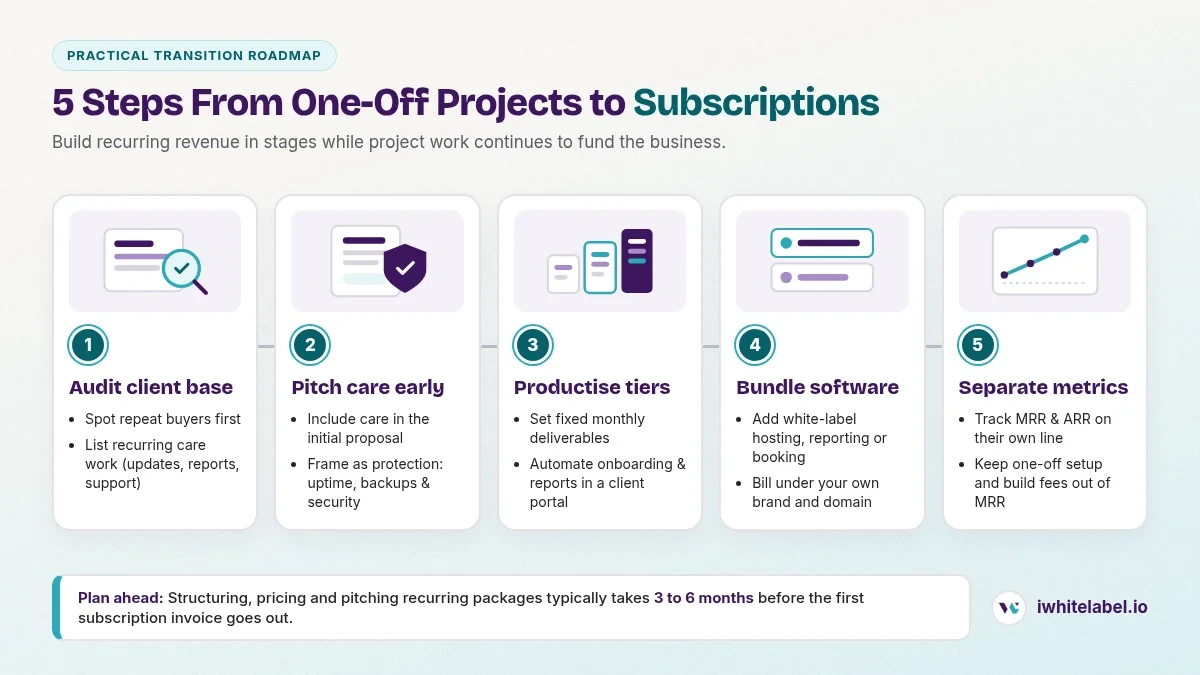
Five steps to move an agency from one-off project work to monthly subscriptions while projects continue to fund the business.
Step 1, audit your client base: Start with the clients who have bought from you repeatedly, because they already trust your work and are the most likely to convert. Then review past project files for natural maintenance tails: a website build needs updates and hosting, an app launch needs support and fixes, and a rebrand needs ongoing content and assets. List the work you already repeat for clients, such as support, updates, hosting, reporting and content, because each item is a candidate for a recurring service.
Step 2, pitch the care plan before the project closes: Delicious Brains advises that "Presenting recurring services during the initial proposal is arguably the most effective strategy." Put the maintenance plan in the original proposal and frame it as protection for the client's investment: security monitoring, uptime, updates and backups that let you recover quickly if something goes wrong. A one-time build without care is a risk the client carries alone.
Step 3, productise and standardise delivery: Define fixed monthly deliverables for each tier so clients know exactly what they get and your team can deliver it the same way every time. For example, an entry tier might cover web hosting, SSL certificates and a client portal; a middle tier could add online booking and automated reporting; and a top tier could add managed digital signage for physical locations. Use a branded client portal to automate onboarding, billing reminders and monthly reports, so the work scales without adding staff. A fixed scope also makes out-of-scope requests easier to spot and price, because each tier states what is included. Promethean Research links this kind of focus to pricing power, noting that for specialist agencies "clients aren’t just buying hours or deliverables, they’re buying expertise."
Step 4, bundle infrastructure you can resell: Hosting is often the easiest recurring service to add to a care plan. InMotion Hosting is one example of a provider whose reseller plans let agencies bill hosting under their own brand. You can compare it with other providers in our guide to white label web hosting and reseller hosting providers.
Step 5, protect your metrics: Keep recurring and non-recurring revenue in separate lines from day one. Gainsight warns that "Blending recurring, reoccurring, and non-recurring revenue inflates ARR and hides churn risk." One-time setup fees and project invoices belong outside your MRR, even when they come from the same client.
How White Label Software Helps
White label software is a product built by a vendor that you can sell or deliver under your own brand. If the idea is new to you, our guide on what white labelling is explains how it works.
For agencies, it solves the technology barrier. Instead of building a reporting tool, a booking system or a client portal, you license one, put your logo and domain on it and charge clients a monthly fee. You keep the client relationship and set your own price, while the vendor maintains the software.
Reporting is a common starting point. AgencyAnalytics is one example of a white label reporting platform. On its white label page, the vendor says you can "Host client dashboards on a custom domain and your own branded web app to increase professionalism". You can compare 41 tools in our guide to white label reporting and analytics software.
Client portals are another natural fit, because they give clients one branded place to see files, invoices and progress. For a closer look at individual platforms, see our guide to white label client portal software for agencies and freelancers.
Not every product described as white label lets you brand it fully or manage many clients, which is why finding the right white label software is so difficult. Our overview of the best white label software by category and buyer fit shows how to narrow the shortlist to tools built for agencies and resellers. The White Label Capability Framework sets out what to check, from branding and custom domains to multi-client management. For unfamiliar terms, the iwhitelabel glossary explains them in plain language.
Turning Promises Into Proof
Hiring an agency feels risky to many clients. They pay up front for work they cannot see yet, and they often only find out how it is going when the agency sends an update.
That is still how most agencies communicate. Function Point reports that 55% of agencies use phone calls and emails to communicate with clients, which can mean slow replies and issues only raised when the agency thinks to mention them.
A branded platform changes that. Instead of pushing reports out and waiting for questions, you give clients a place they can log in to at any time and see their results, files and progress for themselves. Something they can see and use every day is easier to trust than a promise, and it makes a monthly fee easier to justify.
It also changes how you present your offer. Rather than selling a list of tasks you will do, you can present the platform as the system that runs the client's marketing or operations, with your services as the expertise that gets more out of it. A good branded client portal usually includes:
Your brand throughout: Your logo, colours and a custom domain, such as clients.youragency.com.
Live dashboards: Real-time results so clients do not have to wait for a monthly report.
One place for everything: Projects, files, invoices and messages together rather than spread across email threads.
Automated reporting and alerts: Regular reports and notifications sent without manual work each month.
When choosing a provider, check three things: how fully you can brand the platform, how reliable its hosting and infrastructure are, and what support the vendor gives you and your clients. Our guide to white label SaaS drawbacks and how providers can fix them covers the main risks to check before you sign, from brand leakage in system emails to data export and uptime.
Why Ownership Makes Clients Stay
There is a well-researched reason why clients who use your branded tools every day are less likely to leave. It is called the endowment effect: people tend to value something more once it feels like theirs.
It builds on a wider finding called loss aversion. In their 1979 paper on prospect theory, Daniel Kahneman and Amos Tversky wrote that "The aggravation that one experiences in losing a sum of money appears to be greater than the pleasure associated with gaining the same amount". Put simply, losing something tends to feel worse than gaining the same thing feels good.
The economist Richard Thaler named the endowment effect in 1980. The scientific background to his 2017 Nobel prize explains that he "coined the term endowment effect for the tendency of individuals to value items more just because they own them".
The most widely cited test came in 1990, when Daniel Kahneman, Jack Knetsch and Thaler gave coffee mugs to half the people in an experiment and let them trade with the other half. In one version, they reported that "The median selling price of $5.75 was over twice the median buying price of $2.25". In other words, simply owning the mug made people want more than twice as much to give it up as others were willing to pay for it.
Related research shows that effort adds to this feeling. Michael Norton, Daniel Mochon and Dan Ariely found that people valued things they had assembled themselves, such as IKEA boxes and Lego sets, more highly than identical items built by someone else. They called this the IKEA effect, and found it only held when people successfully finished what they built.
User experience researchers have applied the same idea to software. In a Nielsen Norman Group video on the topic, the presenter says of the endowment effect: "When used thoughtfully, it can increase user engagement, retention, and loyalty." The video points to customisation, such as choosing a theme or setting up shortcuts, and to the history people build up, giving the example that cloud storage tools may remind you of what you are losing when you cancel.
For an agency, this happens naturally once clients use your branded platform. Their reports, data, settings and history build up in a tool that carries your name, and the effort they have put into setting it up makes it feel like theirs. Leaving would mean giving that up, which is a real reason to stay as long as the service keeps delivering value.
The same video adds a warning: "it is crucial to be honest." Clients should stay because the service is useful, not because leaving is made difficult. Let clients export their data, keep pricing clear and focus on delivering results, because trust is what keeps a recurring relationship going.
How to Calculate MRR and ARR
The two core numbers are monthly recurring revenue (MRR) and annual recurring revenue (ARR). MRR is the monthly value of all active recurring contracts, with annual contracts divided by 12 so every client is counted on the same monthly basis. ARR is simply MRR multiplied by 12.
Here is a simple worked example. Suppose 12 clients each pay a $400 monthly retainer, which gives $4,800 of MRR. One more client pays $6,000 a year upfront for a white label platform, which counts as $500 a month, so total MRR is $5,300 and ARR is $63,600. A $3,000 website build for a new client that month is non-recurring revenue and stays out of both figures.
The same arithmetic shows how price per client shapes the size of the client list. The table below is illustrative: it divides a $10,000 MRR target by monthly prices taken from the models table above, rounding up to whole clients.
| Monthly price per client | Where it sits in the models table | Clients needed for $10,000 MRR |
|---|---|---|
| $197 | Low end of white label software | 51 |
| $500 | Low end of productised services | 20 |
| $997 | High end of white label software, low end of hybrid bundles | 11 |
| $2,997 | High end of hybrid bundles | 4 |
Every extra client brings another onboarding, another stream of requests and another renewal to secure. A clearly scoped package at a higher price, such as a branded white label platform bundled with setup, support and reporting, reaches the same target with a far smaller client list.
Net revenue retention (NRR) shows whether your existing clients are growing or shrinking. Gainsight defines it as renewed revenue plus expansion, divided by the revenue that was up for renewal. If $5,000 of monthly recurring revenue is up for renewal, $4,500 renews and clients add $800 through upsells, NRR is $5,300 divided by $5,000, or 106%. Anything above 100% means your current clients are worth more than they were, even before you win a new one.
What to Measure
Once recurring services are running, a few numbers show whether they are working.
MRR and ARR: The total of all monthly retainer and subscription fees, which shows how much recurring revenue carries into each new month and year.
Net revenue retention: Whether upsells and upgrades from existing clients outweigh downgrades and cancellations, as in the example above.
Churn: The share of clients or revenue lost each month. Even a small reduction makes a large difference over a year.
Client lifespan: How long clients stay on average. AgencyAnalytics' 2025 benchmark survey found that 43% of agencies report average client lifespans of 2 to 5 years.
Value of reporting: The same survey found that 70% of agencies say client reporting plays a critical role in client retention, so regular, clear reporting is worth building into every package.
Customer lifetime value to acquisition cost: Compare what each client brings in over time with what it cost to win them, using the 3:1 benchmark above as a guide.
Conclusion
Project work will always have a place in most agencies, but relying on it alone leaves income at the mercy of the next sale. Building a base of recurring revenue gives you steadier cash flow, a better return on every client you win and more time to focus on doing good work.
The move is easiest in stages. Start with an ongoing need your clients already have, package it clearly, add it to every new project and offer it to past clients. White label software removes the need to build the technology yourself, and once clients rely on a branded platform they see as their own, they have good reason to stay, as long as you keep earning that trust.
Frequently Asked Questions
Here are short answers to common questions about building recurring revenue in an agency.
It is income that clients pay on a regular schedule, usually monthly, for an ongoing service or software rather than a one-off project fee. Typical examples include website care plans, web hosting, SSL certificates, client portals, reporting, appointment booking and digital signage, many of which can run on white label software sold under your own brand.
The main models are service retainers, productised services, white label software and hybrid bundles that combine services with software. White label software usually needs the least extra work per client because the vendor maintains the platform, so you do not need to build anything yourself.
Start with the work you already repeat for clients, define fixed monthly deliverables and group them into simple tiers. Use the price ranges in this guide as a rough starting point, and let higher tiers add more white label tools, such as online booking, automated reporting or digital signage.
The benefits are steadier cash flow, easier planning and a better return on every client you win. The challenges are a dip in income during the switch, packaging services clearly and delivering reliably every month, which is why most agencies keep doing projects alongside a recurring base and use white label software to avoid building the technology themselves.
Give clients clear reporting and a branded portal where they can see results for themselves, then grow through upsells and referrals. Once their data, reports and settings build up in a platform that carries your name, the endowment effect gives them a reason to stay, provided the service keeps delivering value and leaving stays easy.
Add up the monthly value of every active retainer and subscription, such as branded white label software plans, dividing annual contracts by 12 to get MRR. Multiply MRR by 12 to get ARR, and leave one-time project fees out of both.