A client launches a new website, the browser flags it as “Not secure” right next to the login password field, and the first call goes to whoever built or hosts the site. Web hosting companies, web agencies, MSPs and website builders handle that moment every week. If they send the client off to buy a certificate somewhere else, they give away a recurring sale and the renewal conversation that comes with it. A white label SSL reseller programme lets them sell the certificate under their own brand instead. This article covers 10 white label SSL reseller platforms listed in the SSL Reseller Platforms category, programmes where you sell under your own brand and keep the customer, with details taken from each listing and checked against each vendor’s own reseller page.
Introduction to White Label SSL Reseller Platforms
White label SSL reseller platforms let a business sell SSL certificates from established certificate authorities without becoming one. The certificate authority still validates and issues the certificate. The provider supplies wholesale pricing, ordering tools, and an API or billing integration. You own the storefront, the price and the customer relationship. How much of the experience carries your brand differs from one provider to the next, so check which pages, emails and dashboards your customers will actually see before you promise them an own-brand service.
HTTPS is now the default on the web. According to W3Techs, 90.2% of all websites use HTTPS as their default protocol in October 2026, so almost every site a host or agency looks after needs a certificate. For years an SSL certificate was a once-a-year purchase that clients forgot about until it expired. That is changing. Under CA/Browser Forum Ballot SC-081, the maximum validity of a public TLS certificate drops to 200 days for certificates issued from 15 March 2026, to 100 days from 15 March 2027, and to 47 days from 15 March 2029. For a host selling shared, VPS or cloud hosting plans, every certificate becomes a regular job that touches the server. The provider who automates ordering, validation and installation keeps the client. The one who renews by hand ends up answering support tickets.
A white label SSL reseller platform has two sides. The commercial side covers buy rates, deposits or monthly billing, and how much freedom you have to set your own price. The operational side covers how orders reach the certificate authority: a ready-made storefront, a partner portal, an API, or a module inside billing software such as WHMCS. White label here means the end customer deals only with your brand and the supplier does not contact them. It does not hide the certificate authority itself. The certificate still names its issuer, such as DigiCert or Sectigo, because that is what browsers trust.
Many buyers arrive at SSL from white label reseller hosting. A host or agency on reseller hosting plans usually manages client accounts through WHM, the reseller control panel that sits above cPanel, and bills through WHMCS. Adding paid SSL to that setup needs three things: a billing module so certificates appear as products next to the hosting plans, a way to install each certificate into the right cPanel account, and a renewal process that does not depend on someone remembering a date. The platforms below handle those steps in different ways.
When you compare programmes, start with where your customers will buy. A host that already bills through WHMCS needs a solid module. A WordPress agency may want a storefront it can install. A software team may only want an API. Then check the branding: your domain, the storefront, the validation and renewal emails, and whether a supplier name appears on any page. Look at how domain control is validated, too. Commercial certificate authorities usually accept an email to an admin address, a file on the web server, or a DNS record such as a CNAME, and the smoother that step is, the fewer setup tickets you get. Finally, compare automation, commercial terms such as deposits and price control, and whether you can manage multiple client accounts or sub-resellers.
Traditional Reseller or White Label Reseller?
Not every SSL reseller programme works the same way. A traditional reseller sells another company's certificates, usually under the provider's brand and for a commission. The provider holds the contract, collects payment, sends the validation and renewal emails and keeps the customer, so if the reseller stops selling, the customers generally stay with the provider.
A white label SSL reseller runs a branded certificate business on the provider's platform. You buy certificates at wholesale rates, sell them under your own name at your own price, bill your own customers and handle their renewals and support. The certificate authority's name appears only where browsers need it, on the certificate itself.
Some programmes sit between the two. GoDaddy's reseller programme lets you put your brand on the storefront, the emails and the support, but a GoDaddy entity still holds the contract, takes payment and pays you a commission. iwhitelabel accepts it as white label because it meets the lowest level of brandability in the Brand domain of the iwhitelabel White Label Capability Framework. Even so, you own less of the customer than with a programme where you bill customers yourself. The difference matters more as certificate lifetimes shorten, because each customer becomes a recurring run of reissues and renewals, and whoever owns the customer owns that revenue.
Why Not Just Use Let’s Encrypt? It’s Free.
It is a fair question, and the honest answer starts with credit where it is due. Let’s Encrypt is a nonprofit certificate authority that issues free certificates trusted by most browsers, and many web hosts already switch it on for every account through cPanel’s AutoSSL feature or their own tooling. For a brochure site or a blog, a free Domain Validation certificate is often all that is needed.
The limits show up as soon as a client needs more than that. According to the Let’s Encrypt FAQ and its subscriber agreement:
Domain Validation only. Let’s Encrypt issues DV certificates and has no plans to issue Organisation Validation (OV) or Extended Validation (EV) certificates, so it cannot put a verified company name in the certificate.
Wildcards need DNS validation. Let’s Encrypt does issue wildcard certificates, but only through the DNS-01 challenge. Your tooling has to be able to edit the customer’s DNS records; a simple HTTP file check is not enough.
Short lifetimes depend on automation. Default certificates last 90 days, Let’s Encrypt recommends renewing every 60 days, and there are no exceptions. If a renewal job fails after a server migration or a DNS change, the certificate simply expires. Let’s Encrypt also ended its expiry reminder emails in June 2025, so you need your own way to monitor certificates.
No warranty and no direct support. Certificates are provided “as is” under the subscriber agreement, and the small team relies on documentation and public help forums rather than a support desk.
Websites only. Let’s Encrypt does not issue code signing or email (S/MIME) certificates, and as a DV-only authority it does not issue Verified Mark Certificates for logos in email inboxes either.
None of this makes Let’s Encrypt something to fight. For most white label resellers it works well as the base tier. Include free DV on every hosting plan, then sell the upgrades where the profit is: OV and EV certificates for businesses that want their name verified, wildcard and multi-domain certificates, code signing for software developers, S/MIME for business email, VMC for brands, and a managed renewal service where you monitor every certificate and fix failures before the customer notices. The reseller platforms below supply those paid products.
10 White Label SSL Reseller Programmes
Here are 10 SSL reseller platforms from the iwhitelabel directory that let you sell under your own brand, each with audience and capabilities taken from the listing and the vendor’s own reseller page. They range from DigiCert-owned retailers and a certificate authority that sells direct to wholesale registrars that bundle SSL with domains and hosting.
1. The SSL Store
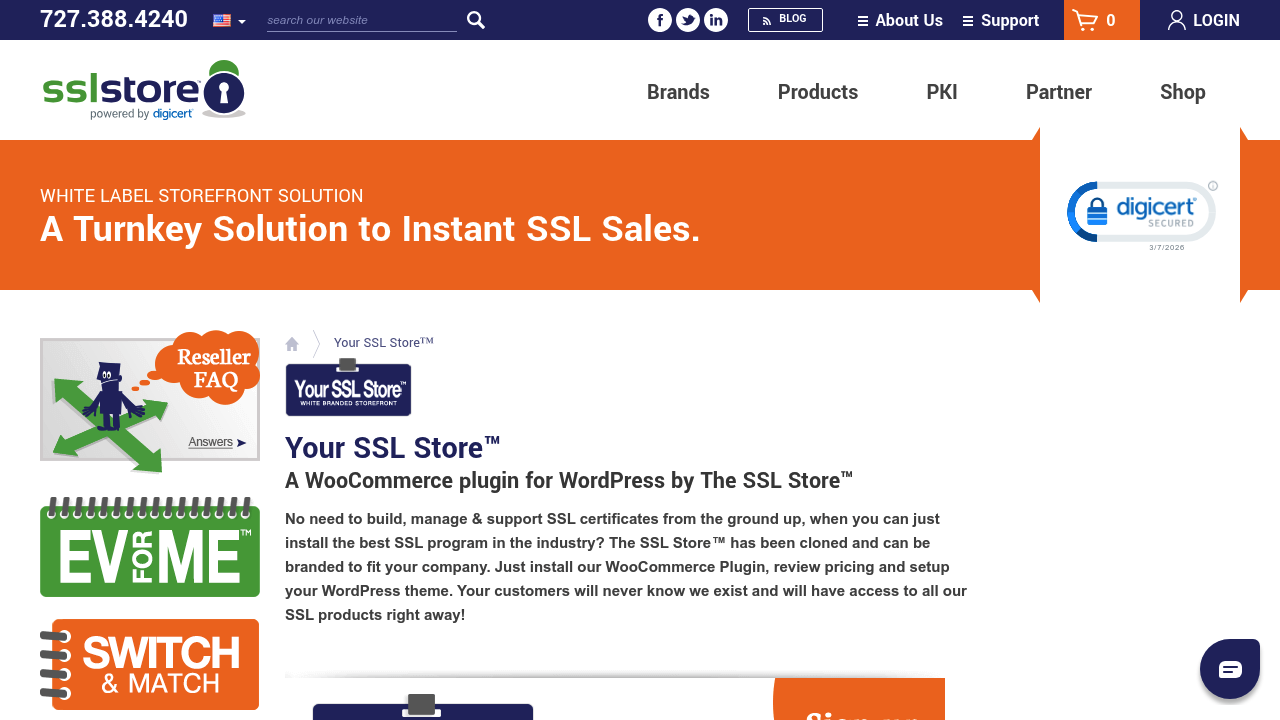
The SSL Store is a certificate retailer owned and operated by Rapid Web Services, LLC, a subsidiary of DigiCert, Inc., according to its privacy notice. The same company runs sister sites such as RapidSSLonline and SectigoStore, which operates under licence from Sectigo. The SSL Store sells DigiCert, Sectigo, GeoTrust, Thawte, RapidSSL and other brands. Its white label route is “Your SSL Store”, a WooCommerce plugin for WordPress that the vendor calls a turnkey storefront solution. A reseller installs the plugin, reviews pricing and applies their own WordPress theme, and gets an ecommerce store with The SSL Store’s catalogue behind it. Customers pay the reseller at the reseller’s own rates, and The SSL Store says they will never know it exists. The vendor lists the storefront at $89.99 and starts partners with a free reseller account, and its reseller programme advertises wholesale discounts of up to 90% off MSRP. Hosts that prefer to sell from billing software can use The SSL Store’s WHMCS module and API instead. Its AutoInstall SSL tools cover Linux and Windows servers as well as web hosts, and an optional installation service is also available.
Best-fit niches: SSL resellers, web hosts, web developers and system integrators, especially agencies already running WordPress and WooCommerce.
White-label capabilities: A store on your own domain with your logo, colours and theme, your own prices and the option to manage your own resellers, though branded login pages and emails are not confirmed.
2. GoGetSSL
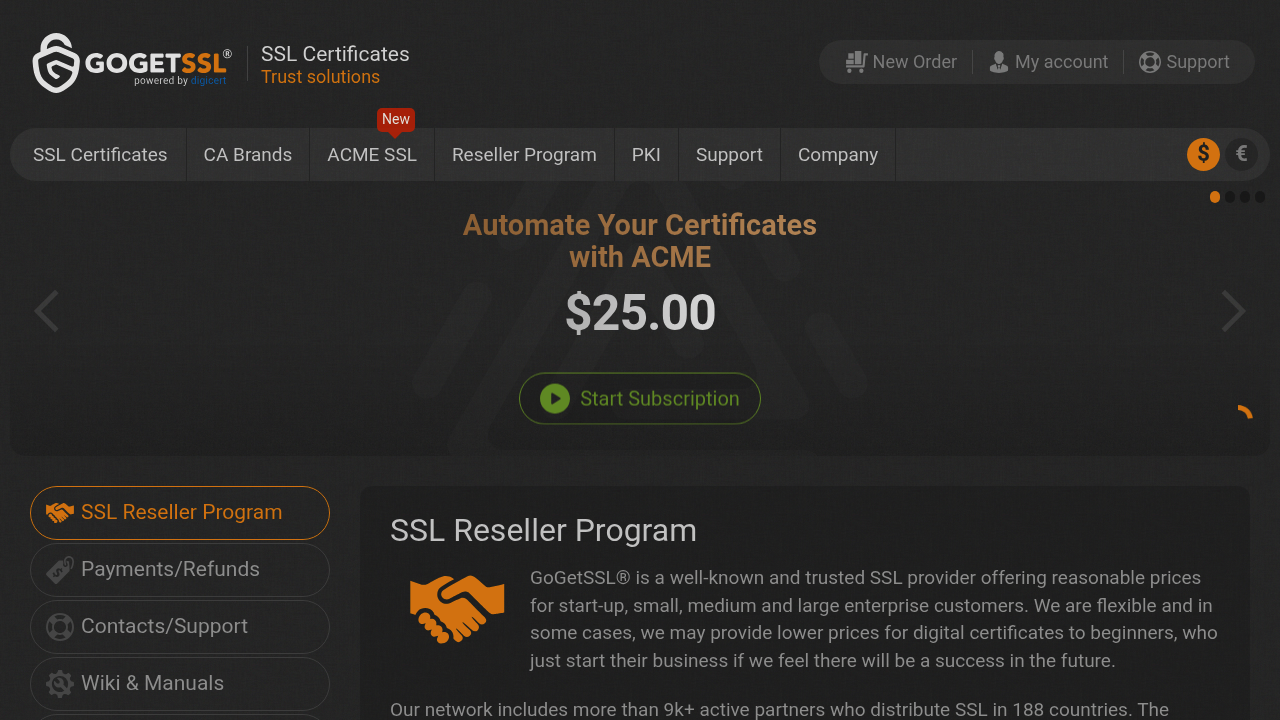
GoGetSSL is built around the billing systems web hosts already use. Its privacy notice states that GoGetSSL is operated by Rapid Web Services, LLC, the company behind The SSL Store, and is affiliated with DigiCert Ireland Limited, both subsidiaries of DigiCert, Inc. Its stated rule is that “the customer of our customer is not our customer”, so end users deal only with the reseller. Partners work through the API or through integrations with WHMCS, HostBill, Blesta, RootPanel and ISP BillManager. GoGetSSL says its WHMCS plugin, developed over more than ten years, handles one-time and recurring billing, subscriptions, cPanel AutoSSL installation, SAN/UCC certificates and multi-year orders, with a sub-reseller plugin and a Lagom order form also available. Sign-up starts on Pay As You Go with no deposit. A deposit is only needed for better pricing tiers, and high-volume partners can move to monthly billing with a credit line. GoGetSSL also advertises competitive pricing, a price-match offer for partners switching providers, marketing development funds of up to $20,000 per campaign, and a 30-day money-back guarantee on certificates. Its catalogue covers DigiCert, Sectigo, GeoTrust, Thawte and RapidSSL plus its own Sub-CA certificates, and it says DV certificates are issued within minutes.
Best-fit niches: Web hosts and domain registrars that bill through WHMCS or similar software, SSL resellers, system integrators.
White-label capabilities: Certificates sold inside your own WHMCS client area at your price, with sub-resellers, local payment methods and a full API, while GoGetSSL stays out of sight.
3. SSL2BUY
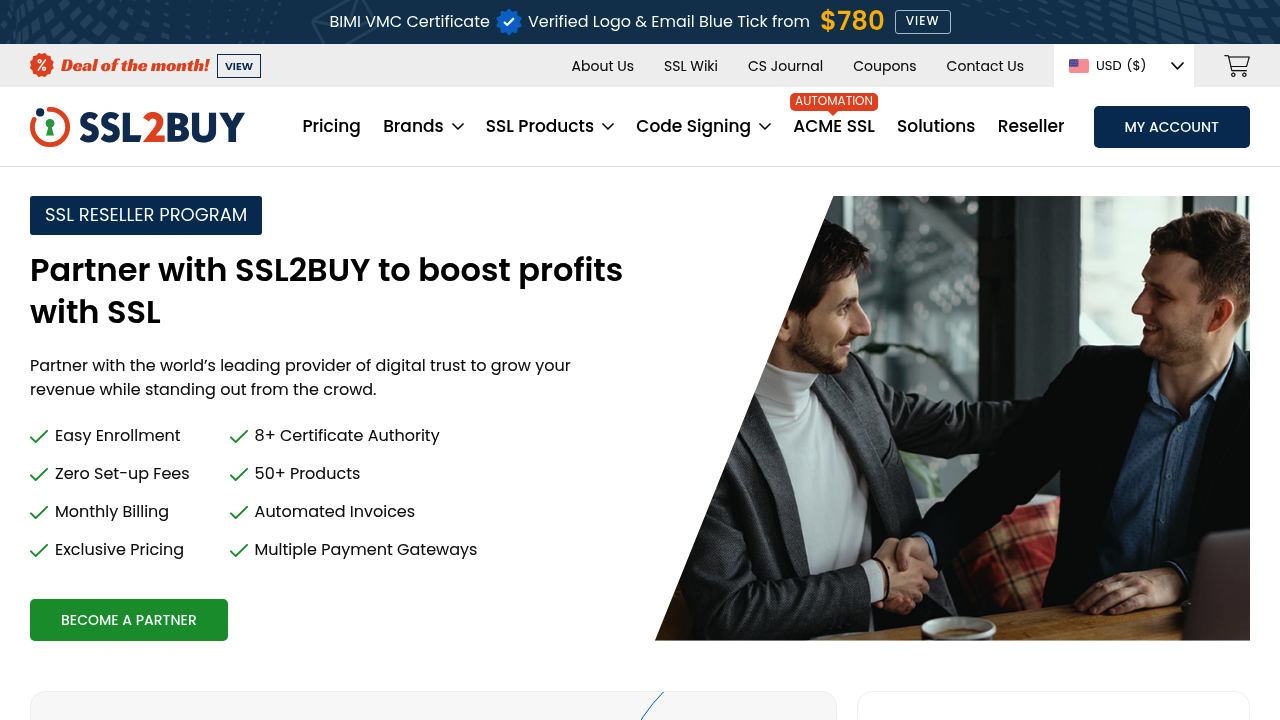
SSL2BUY is aimed at partners who want their own certificate brand without setup costs. It charges no sign-up or setup fees and asks for no contracts. It also says it never contacts the reseller’s customers and does not cap the resale price, so the margin is yours to set. The catalogue spans more than 50 products from over eight certificate authorities, including DigiCert, Sectigo, GeoTrust, GlobalSign, Thawte and RapidSSL, and SSL2BUY advertises exclusive pricing and volume deals for resellers. Day-to-day work runs through an SSL partner portal that handles client orders, enrolment, renewal reminders, reissues and revocations. For automation there is what SSL2BUY calls a robust REST API and a WHMCS module, and a client-facing control panel lets customers manage their own orders. The programme offers monthly billing, multiple currencies, payment by PayPal, card or bank wire, and 24/7 reseller support over live chat. SSL2BUY says accounts are activated within 48 hours.
Best-fit niches: SSL resellers, web hosts, system integrators and domain registrars, particularly those who handle many client orders.
White-label capabilities: Your own brand and domain on the customer side, multi-client accounts with client invoicing, and payments in several currencies through the API or WHMCS.
4. SSLs.com
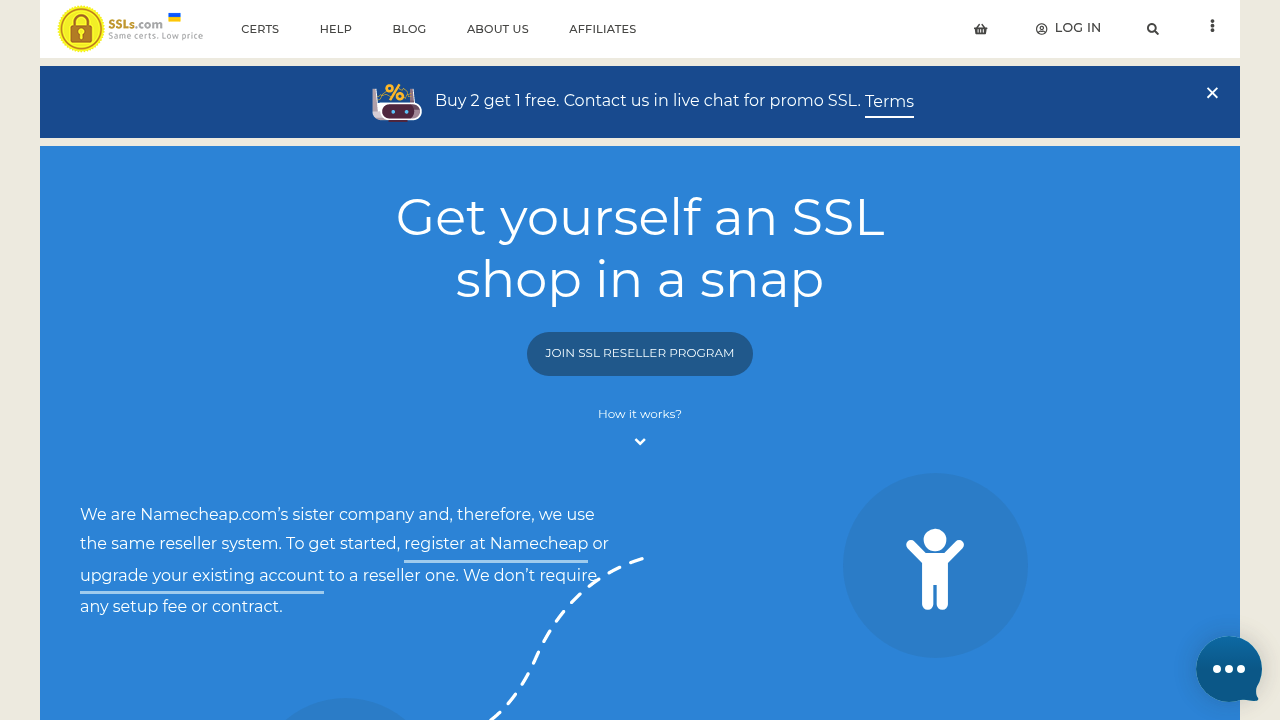
SSLs.com is Namecheap’s sister company, and its reseller programme runs on the Namecheap SSL reseller programme. There are two ways to sell. The first is API access from your own website, covering order creation, activation, validation, delivery, reissues and renewals. Namecheap presents this as the way to “go truly white label”, because the whole buying flow sits on your site. The second is Namecheap’s free, open-source SSL module for WHMCS, for hosts that want certificates next to their hosting plans in an existing client area. Namecheap lists no setup fees, no contracts, instant access and volume-based discounts, and setting your own prices is left entirely to you. Public detail on the branded customer experience is thinner than for most platforms here, so this programme suits developers and hosts who will build that experience themselves.
Best-fit niches: SSL resellers, web hosts, system integrators and domain registrars with a developer on hand.
White-label capabilities: An order flow that runs entirely on your own site through the API, plus a free WHMCS module, with packaging and prices left to you.
5. GoDaddy

GoDaddy takes a different approach. Its reseller programme is a branded storefront for the whole GoDaddy catalogue: domains, web hosting, email, website builder, servers, SSL certificates and Sucuri website security. SSL is one product among many. Storefront branding covers the domain name, logo, colour scheme and page layout, and WordPress users can build their own front end with GoDaddy’s plugin or APIs. Resellers set their own prices, run promotions, and can buy and manage products on customers’ behalf. GoDaddy also offers white-label, English-only 24/7 customer support and a money-back guarantee on the reseller programme. The trade-off is control over checkout. The cart stays white-labelled, but the contract, checkout experience and payment collection are handled by WildWestDomains.com, a GoDaddy entity, and the reseller is paid net commissions. Plans are split into Basic (up to 25 customers) and Pro (unlimited customers), with different buy-rate discounts, so check current pricing on GoDaddy’s site.
Best-fit niches: Hosting and domain resellers, agencies, web professionals and no-code entrepreneurs who want a full catalogue without building a store.
White-label capabilities: A storefront on your domain with your logo and layout, branded emails and support that answers in your name, though GoDaddy still runs checkout.
GoDaddy only just made this list, and it's here because it shows how tricky white label reviews can be. It sits between traditional SSL reselling and white label reselling. Your brand goes on the storefront, the emails and the support, but a GoDaddy entity holds the customer contract, takes payment and pays you net commissions. That still counts as white label, though with limited brand capabilities when measured against the Brand domain of the iwhitelabel White Label Capability Framework. If owning the full customer relationship matters most to you, the other nine programmes give you more of it.
6. ResellerClub
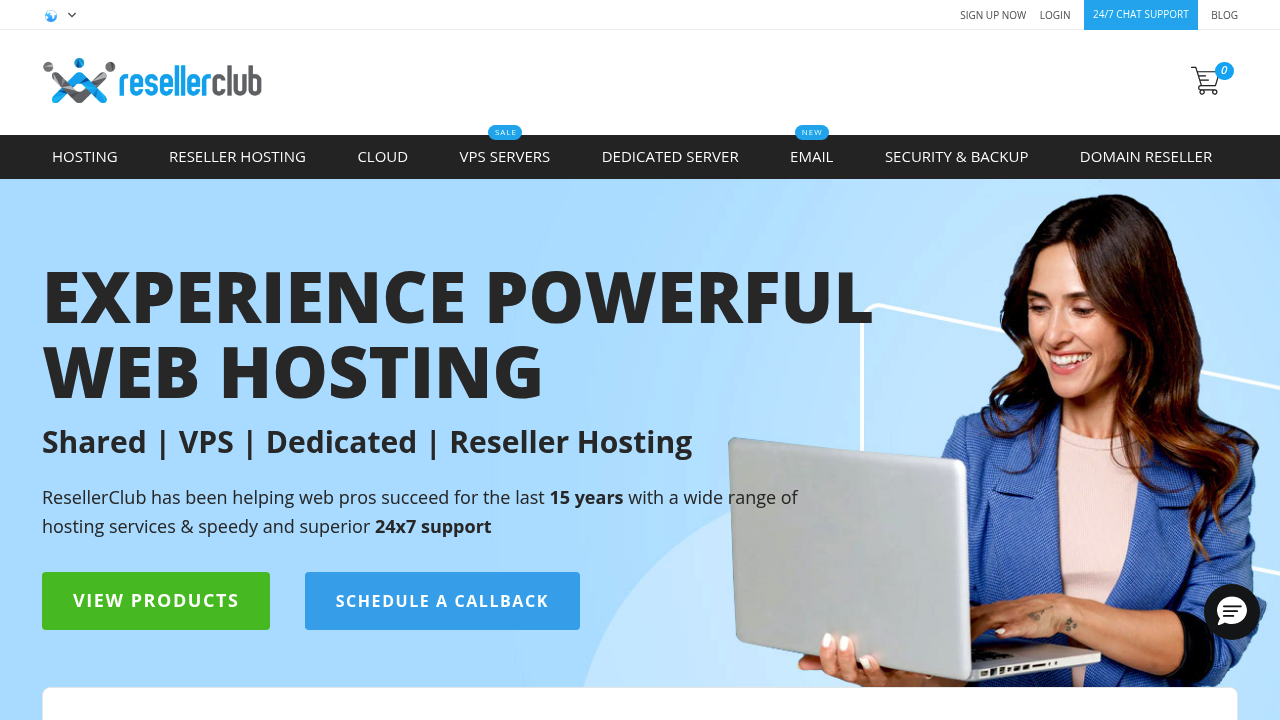
ResellerClub comes at SSL from the domain and hosting side. It is a wholesale platform for domain and hosting resellers, and it presents SSL as the natural add-on to every domain, website and hosting plan a reseller already sells. Its SSL reseller programme offers four certificate types from one wholesale price list: Standard SSL and Premium SSL, both Domain Validation for a single domain, Wildcard SSL for a domain and all its subdomains, and EV SSL. Resellers set their own prices and can provision certificates from the reseller control panel, from their white-label storefront, or through the API. ResellerClub says there are no upfront costs to register: partners add funds to the account and then start buying. Every certificate includes free reissuance, a 30-day money-back guarantee and 24/7 SSL support, and ResellerClub says DV certificates are issued in minutes. The storefront itself is pitched as ready under your brand in hours, with no development work required.
Best-fit niches: Domain and hosting resellers, agencies, web professionals and no-code entrepreneurs who want SSL inside a wider catalogue.
White-label capabilities: A storefront and control panels on your own URLs and nameservers, emails and invoices under your brand, and sub-reseller management.
7. SSL.com
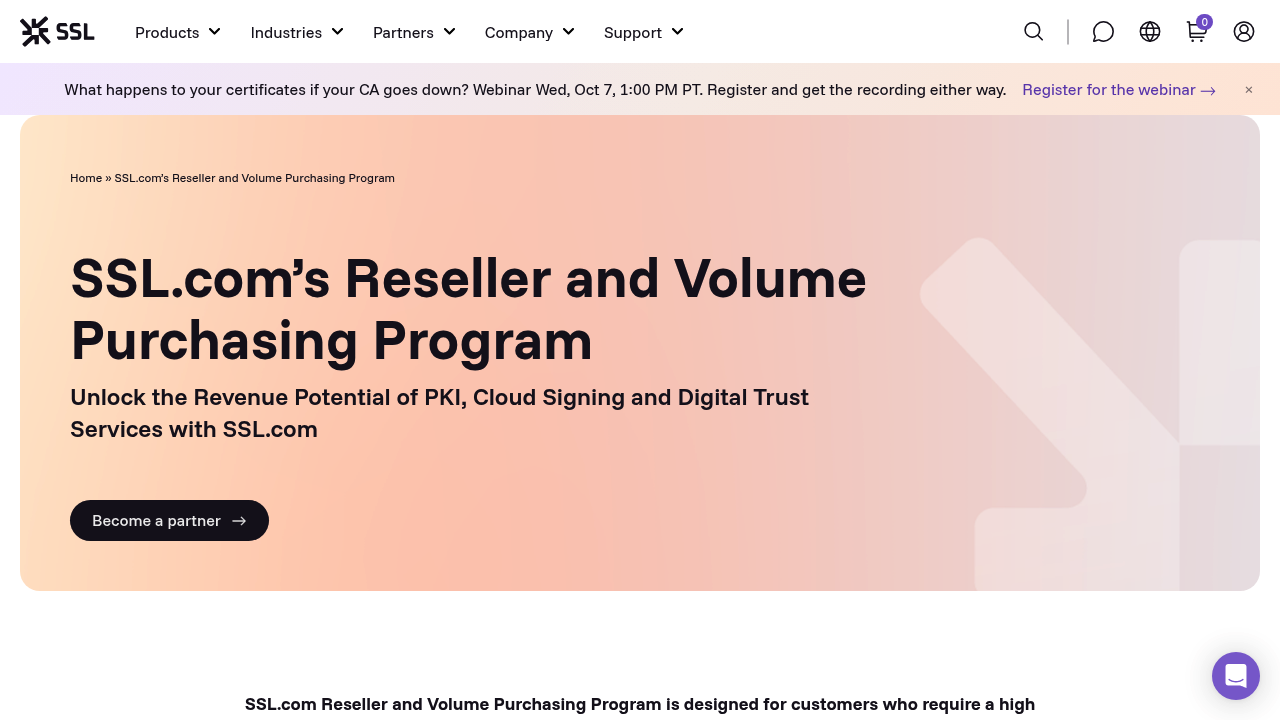
SSL.com is different from most names on this list because it is a publicly trusted certificate authority, so resellers buy straight from the issuer rather than through a middleman. Its Reseller and Volume Purchasing Program offers wholesale discounts of up to 65% across seven pricing tiers, from a pay as you go tier with no deposit up to a $50,000 deposit, and SSL.com says the tier discount stays in place after the deposit is spent. Partners can sell under their own brand through neutral landing pages, or connect SSL.com to their own website with the SWS REST API, which is free for partners and comes with ACME support and a sandbox. Resellers can also hand ACME credentials to their own customers. SSL.com then calls the reseller’s endpoints to approve each order and deliver the issued certificate. Day-to-day work happens in an account portal with teams and roles, where resellers choose when and to whom renewal reminders are sent, and an adaptable driver connects SSL.com to the Venafi platform. For companies that want their own name on the certificate itself, SSL.com offers a custom-branded issuing CA that it hosts.
Best-fit niches: Web hosting providers, domain registrars, software developers, systems integrators and IT contractors, and merchants.
White-label capabilities: Neutral landing pages or your own site over the API, callbacks that send order approvals to your systems, and control over renewal reminders, with no WHMCS module found.
8. InterNetX
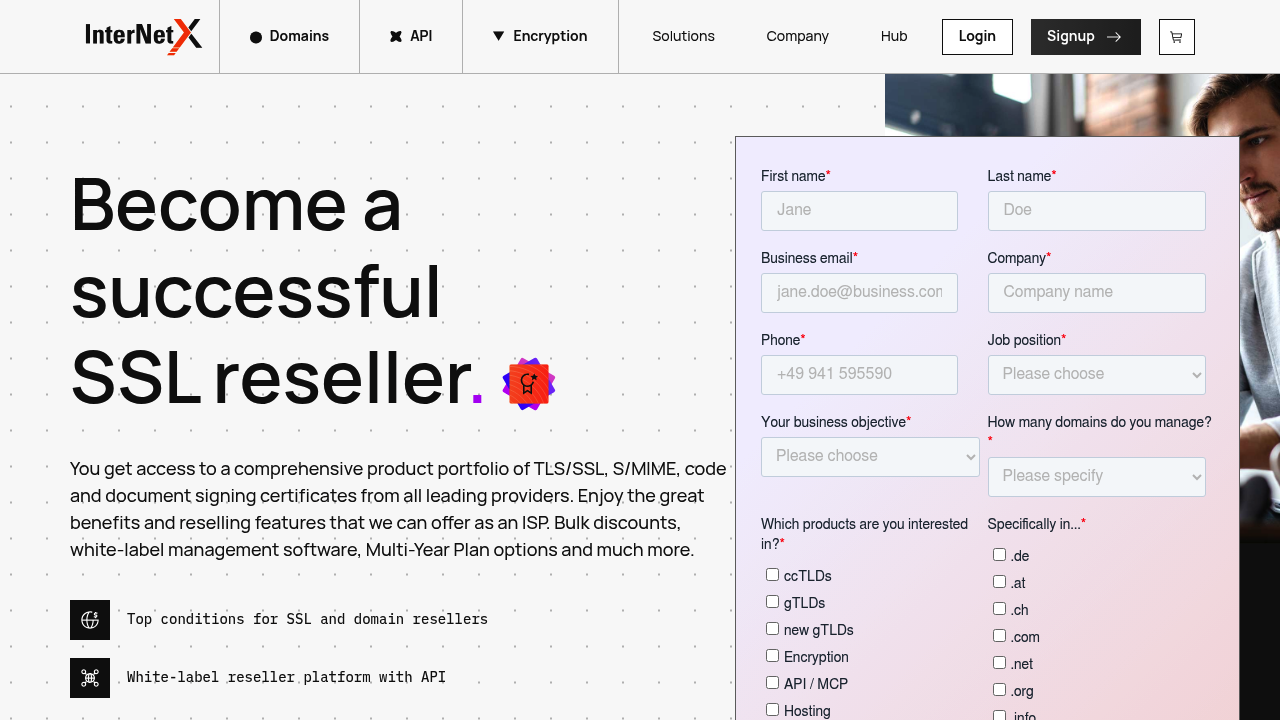
InterNetX is a Regensburg-based ISP that has supported domain and SSL resellers for over 20 years, and its SSL reseller programme runs on AutoDNS, its white label platform. Partners order TLS/SSL, S/MIME, code signing and document signing certificates and VMCs from certificate authorities such as DigiCert, GlobalSign and Sectigo, and manage them for their customers. Joining the programme is free, while the full white label layer comes with AutoDNS Pro at €49.90 a month. Pro moves the platform onto the reseller’s own login URL with an automatically issued TLS certificate, and lets the reseller apply their corporate design, logo and favicon and add their own legal notices and help centre. Customers are set up as subusers with detailed access rights, their own language and time zone, and price lists the reseller builds with markups, promotions, a chosen currency and monthly purchase limits. Billing and automation tools such as WHMCS, ODIN, WeFact and HostBill connect through the API, and system notifications can be pushed to the reseller’s own HTTPS endpoint.
Best-fit niches: Agencies, hosting companies, ISPs, MSPs, IT companies and domain resellers that manage many customer accounts.
White-label capabilities: The whole AutoDNS Pro interface on your own URL with your corporate design and login screen, plus per-customer rights, prices and limits, though branded emails are still listed as coming soon.
9. Synergy Wholesale
Synergy Wholesale is the trading name of Nexigen Digital Pty Ltd, an Australian-owned wholesaler of domains, hosting, email and SSL. Its SSL reseller programme offers Sectigo certificates at wholesale prices, each with a warranty of $50,000 to $1,750,000 depending on the certificate, and Synergy presents it as a completely white label solution. Partners provision and manage certificates through the SSL API, or handle renewals, cancellations, CSRs and billing from WHMCS with Synergy’s open-source module. That module sells certificates as WHMCS products through the partner’s own payment gateways and emails clients a configuration link from the partner’s own WHMCS template. Clients then configure and reissue certificates inside the partner’s own website or customer portal. A few tasks, such as resending validation emails, stay in the Synergy Wholesale management system, where extra staff logins with their own two-factor settings can be added. Support comes from a 24/7 team based in Australia. New partners can start with a 14-day free trial, and the $99 activation cost is rebated once 50 services are activated in the first 30 days.
Best-fit niches: SSL resellers, web hosts, and domain and hosting resellers, particularly those already billing through WHMCS.
White-label capabilities: Certificates sold in your own WHMCS client area through your own payment gateways and email templates, with an API for custom builds.
10. Domain Name API
Domain Name API is the reseller programme of ICANN-accredited registrar Atak Domain, and its SSL offer is aimed at hosting companies, agencies, MSPs and SaaS teams that sell certificates to many customers. Resellers join without a membership fee, buy at wholesale rates from eight brands, including Sectigo, RapidSSL, GeoTrust, Thawte and GlobalSign, then set their own retail prices and sell under their own brand. Published starting prices are $6.99 a year for DV certificates and $56.99 for wildcards. Orders run through a single reseller panel, a REST API, or ready modules for WHMCS, WiseCP, HostBill, Blesta and ClientExec. The API covers the whole lifecycle, from CSR checks and domain validation to status tracking, certificate retrieval and reissues, and a separate OT&E sandbox is available for testing. The panel is offered in more than 20 languages and began moving to a new platform with mandatory two-factor login in June 2026. Two limits are worth knowing: sub-reseller accounts can only sell domain services, not SSL certificates, and the vendor says some details, such as branded system emails and whether it ever contacts end customers, are confirmed per product in the reseller panel.
Best-fit niches: Hosting companies, domain registrars and resellers, web and digital agencies, MSPs and IT providers, and SaaS platforms.
White-label capabilities: Your own storefront and invoicing through a billing module or the API, at your own prices, with a panel in more than 20 languages.
All 10 Programmes at a Glance
The comparison table maps each platform to the buyer it suits and the way resellers actually sell through it.
Platform | Who it suits | How you sell it |
|---|---|---|
WordPress agencies and web hosts wanting a ready-made store | WooCommerce storefront plugin on your domain, plus a WHMCS module and API. | |
Hosts and registrars billing through WHMCS or similar | Detailed WHMCS plugin, sub-resellers and a no-deposit start. | |
Resellers handling many client orders | Partner portal, client control panel, REST API and WHMCS module. | |
Developers building their own order flow | Namecheap reseller API and free WHMCS module. | |
Agencies and no-code resellers selling a full catalogue | Branded storefront and support, with contract, checkout and payment run by GoDaddy and net commissions paid to you. | |
Domain and hosting resellers adding SSL to their catalogue | Reseller control panel, white-label storefront or API, with four certificate types. | |
Developers and platforms buying direct from a CA | SWS REST API with ACME, neutral landing pages and tiered deposits. | |
Agencies, ISPs and MSPs with many customer accounts | Rebranded AutoDNS Pro portal with subusers, plus API links to WHMCS and HostBill. | |
WHMCS hosts selling Sectigo certificates | Open-source WHMCS module or SSL API, with 24/7 Australian support. | |
Hosts on WHMCS, WiseCP, HostBill, Blesta or ClientExec | Reseller panel, REST API with sandbox, and billing modules. |
Which SSL Reseller Platform Fits Your Business?
Web Hosting Providers on WHMCS and cPanel
If you sell reseller hosting or other web hosting services and bill through WHMCS, start with a module so certificates appear next to your hosting plans. GoGetSSL lists one of the most detailed WHMCS feature sets in this group, including cPanel AutoSSL installation and sub-reseller support, and Synergy Wholesale’s open-source module sells certificates through your own payment gateways and email templates. SSL2BUY, SSLs.com, The SSL Store and Domain Name API also offer WHMCS modules, Domain Name API adds WiseCP, HostBill, Blesta and ClientExec, and InterNetX connects WHMCS through its API. If you want two suppliers for redundancy or price leverage, remember that The SSL Store and GoGetSSL are both run by Rapid Web Services under DigiCert, so pair one of them with a provider outside that group, such as SSL.com with its own certificate authority. Whichever you choose, test your theme, order form and every notification email template so customers never see a buy price or a supplier name.
Web Agencies and Designers
Agencies on WordPress can get a branded SSL store running fastest with The SSL Store’s WooCommerce plugin. Agencies that want to sell domains, hosting and email alongside SSL, without building any of it, will find GoDaddy’s storefront the simplest bundle, as long as they accept that a GoDaddy entity holds the customer contract and runs checkout, and that customisation stops at the storefront branding options unless they build their own WordPress front end. ResellerClub suits agencies that already resell domains and hosting and want SSL in the same branded storefront and control panel.
MSPs and System Integrators
MSPs managing certificates across many client domains need renewal tracking more than a storefront. SSL2BUY’s partner portal covers renewal reminders, reissues and revocations in one place. GoGetSSL’s monthly billing and credit line suit higher volumes, where paying for each order separately becomes a chore. InterNetX’s AutoDNS Pro gives each customer a subuser with its own rights, prices and purchase limits, on a portal that carries your corporate design.
Website Builders and Software Platforms
Platforms that want to sell paid certificates inside their own product need an API rather than a hosted store. The Namecheap-backed SSLs.com API, GoGetSSL’s API, SSL2BUY’s REST API and Domain Name API’s REST API, which comes with a test sandbox, let you keep the whole buying flow inside your own application, which is the most complete form of white labelling available in this category. SSL.com goes a step further for platforms: it can issue ACME credentials to your customers and call your endpoints to approve each order.
Key Features to Compare
Custom Branding and Customer Emails
In SSL reselling, branding mostly lives in the surfaces you control: your website, your billing system and your emails. The SSL Store, ResellerClub and GoDaddy give you a storefront to brand, and InterNetX lets you rebrand the whole AutoDNS interface on your own URL. GoGetSSL, SSL2BUY, SSLs.com, SSL.com, Synergy Wholesale and Domain Name API rely on your own site, WHMCS or an API build. Validation and renewal emails are where a supplier name most often slips through, so check them first.
Billing, Setup and Control Panel Integration
WHMCS is the common denominator. The SSL Store, GoGetSSL, SSL2BUY, SSLs.com, Synergy Wholesale and Domain Name API all offer a WHMCS module, and InterNetX connects WHMCS through its API. GoDaddy relies on its hosted storefront and WordPress plugin, ResellerClub on its control panel and storefront, and SSL.com on its API. GoGetSSL also lists HostBill, Blesta, RootPanel and ISP BillManager, and Domain Name API lists WiseCP, HostBill, Blesta and ClientExec. During setup, configure your products, prices and email templates, then run a test order from purchase to installation on a real cPanel account. Automatic installation through cPanel AutoSSL, listed by GoGetSSL, removes the manual step that generates many SSL support tickets.
Automation, Renewals and Domain Validation
With shorter certificate lifetimes, reissues and renewals matter more than the first sale. Look for API coverage of ordering, validation, reissue and renewal, and for ACME-based products: GoGetSSL and SSL2BUY both list ACME certificates in their catalogues, and SSL.com includes ACME support with its API. InterNetX can push system notifications to your own HTTPS endpoint, and Domain Name API offers an OT&E sandbox for testing the full lifecycle before you go live. Plan for server migration too, because moving a site to new infrastructure is a common moment for a certificate to be left behind.
Emerging Trends in SSL Reselling
Shorter Certificate Lifetimes
The SC-081 timeline turns SSL from an annual invoice into an ongoing managed service. Resellers that package certificates as a subscription with automated reissue and installation will find it easier to justify a margin than those selling a bare certificate on price.
Beyond the Basic Certificate
Reseller catalogues now reach past DV, OV and EV certificates. The SSL Store, GoGetSSL and SSL2BUY all list code signing and mark certificates (VMC) for logos in email inboxes, and GoGetSSL sells LEI codes for company validation. InterNetX lists S/MIME, code signing and document signing certificates alongside VMCs, and SSL.com offers a custom-branded issuing CA for companies that want their own name on the certificate. These higher-value products suit agencies and MSPs that already manage a client’s domain and email.
Conclusion: Choosing a White Label SSL Reseller Programme
Assessing How You Sell to Customers
Start with how you sell: from your own billing system, from a store you install, from a hosted storefront, or through an API inside your product. Then match that to what each listing and vendor page actually confirms, not to marketing language alone.
Evaluating Features Before Setup
Confirm the domain, storefront, emails, multi-client accounts, billing terms and API coverage for each platform. Most keep the supplier out of your customers’ view, though Domain Name API confirms some of this per product. They differ in how much of the branded experience they provide and how much you build and control through your own systems.
Final Recommendations
Compare the full SSL Reseller Platforms category before you commit. GoGetSSL, SSL2BUY, Synergy Wholesale and Domain Name API suit hosts and MSPs running certificates through WHMCS and other billing software. The SSL Store is the quickest route to a WordPress storefront. SSLs.com fits teams building on an API, and SSL.com suits those who want to buy direct from a certificate authority. InterNetX is a strong fit if you want a fully rebranded customer portal. ResellerClub bundles SSL into a broader branded storefront. GoDaddy does too and counts as white label, though a GoDaddy entity holds the customer contract and pays you a commission, so you own less of the relationship. If supplier diversity matters, check who owns each provider before you sign, since The SSL Store and GoGetSSL share the same DigiCert-owned operator. Run a test order, and choose the platform whose confirmed features match the brand you want to put in front of clients.
SSL Reseller FAQs
What is the difference between white label and reseller SSL?
A traditional reseller sells another company's certificates, usually under the provider's brand and for a commission, without owning the customer. A white label reseller runs a fully branded SSL business on a provider's platform, owns the customer relationship, sets their own pricing and keeps the margin. One passes on a product; the other builds a business.
Is white label better than reselling SSL?
For building a real, sellable business, yes, because white label gives you your own brand, pricing control and ownership of the customer. Reselling is easier to start and can suit a light side income, but it leaves you selling someone else's product with a capped commission and no asset of your own.
Do I keep more money with white label or reseller SSL?
Usually white label, because you set your own pricing and keep the full gap over what the provider charges you, rather than accepting a commission the provider decides. Reseller margins are capped by the partner's terms, while white label margins are yours to design around your market.
Can I use my own brand as an SSL reseller?
Typically only in a limited way. Traditional reseller programmes usually run under the provider's brand, so your customers can tell whose service they are really using. Full branding, including your own logo, colours, domain and customer emails, is what the white label model is built to give you.
Who owns the customers in a reseller model?
The provider does. You bring the customers, but the relationship, the billing and the platform they use belong to the provider, so if you stop reselling, the customers generally stay with them. With white label SSL, the customer relationship and every renewal are yours.