Building your own software product is one of the slowest and most expensive ways to start a business. Reselling someone else's software under your own brand is a faster route, and it still offers much of what makes software businesses attractive: recurring revenue, margins you control and customers who can stay for years.
Plenty of people are looking for that kind of opportunity. Bankrate's 2025 Side Hustle Survey found that 27% of US adults have a side hustle, down from 36% in 2024. That matters because many side hustles trade hours for money, while a software business can grow its income without the hours rising in step. This guide is for resellers, entrepreneurs and side hustlers who want to use white label software as that path, and it covers how the model works, what resellers need from a platform, how to find customers, how to price, the risks to plan for and what iwhitelabel checks in each listing.
Traditional Reseller or White Label Reseller?
Not every software reseller programme works the same way. A traditional reseller sells another company's product, usually under the provider's brand and for a commission. The provider bills the customer, collects payment and keeps the relationship, so if the reseller stops selling, the customers generally stay with the provider.
A white label reseller runs a branded business on the provider's software. You sell under your own name, set your own prices, bill your own customers and handle their first line of support, while the provider runs the technology in the background. Hostwinds, a hosting provider listed on iwhitelabel, describes this clearly on its white label reseller page: "Clients place their order on your website, and their payments go straight to you."
Some programmes sit between the two, such as GoDaddy's reseller programme, where your brand is on the storefront but GoDaddy is the seller of record and takes payment. iwhitelabel still lists it as white label because it meets the baseline for branding in the Brand domain of the iwhitelabel White Label Capability Framework. Even so, you own less of the customer than with a programme where you bill customers yourself. For anyone building a business they might one day sell, owning the customer is the point, because the customer list and the recurring revenue are what give the business its value.
If the term is new to you, the guide What Is White Labelling? explains how branded software works in more detail.
What White Label Resellers Need
On iwhitelabel, a white label reseller is a business that sells access to another provider's software as its own branded product. To do that well, a reseller needs to package, price and sell the software as its own offering, manage many customers from one place and, where the market calls for it, run a separate environment for each customer.
Every check a reseller makes comes back to one commercial question:
Can I package, price and sell this software as my own branded offering?
In practice, white label resellers tend to look for:
Wholesale or reseller pricing: A buy price that leaves room for a margin.
Control over price and margin: The freedom to decide what customers pay.
Packages and plans: The ability to bundle features into offers of their own.
Feature visibility: A say in which features each customer or plan can see.
Customer set-up and management: Creating and running customer accounts without waiting on the provider.
Separate customer environments: Keeping each customer's data and settings apart.
Branding: Their own brand throughout, with the provider's name removed.
Billing and commercial controls: Deciding how and when customers are charged.
Sales and customer management tools: Features that help them win, track and look after customers.
A reseller may add services such as setup or training, but selling access to the software stays at the heart of the business.
How Resellers Differ From Agencies
Agencies and white label resellers often want the same things from a platform, especially branding, managing many customers, packaging and configuration. The difference is what they sell. An agency sells services that it delivers using the software, while a white label reseller sells access to the software itself as its own branded product.
What iwhitelabel Covers
iwhitelabel focuses on white label resale. Conventional reselling and referral arrangements, where the provider keeps the customer-facing brand and the commercial relationship, sit outside that focus.
Why Resale Can Beat Building
Developing software means paying for design, development, hosting, security and constant maintenance before the first customer pays you anything. Reselling moves that cost and risk to the provider, which leaves you free to focus on the parts of the business that decide whether it succeeds: choosing the market, finding customers and keeping them happy.
Vendors with reseller programmes leave room for different ways of working. SuperSaaS, a booking platform listed on iwhitelabel, tells resellers on its reseller information page: "You are free to choose your own business model, which can range from just helping with the setup to building a fully-fledged site of which our system is a small part." That flexibility matters for a side business, because you can start small with one product and add services as you learn what customers value.
Finding a Niche and a Product
The strongest starting point is a problem you already understand:
Start from a known pain. Your job, trade or hobby gives you insight into problems people pay to solve. Working from a pain you know makes your offer easier to explain and harder for a generalist to copy.
Keep the promise simple. An offer that fits in one short sentence is easier to buy and easier for others to pass on. A narrow focus also keeps the workload manageable while you run the business alongside other commitments.
Then find the software. Once the problem is clear, look for an existing product that solves it and offers a reseller programme. The iwhitelabel categories group white label software by area and industry, and many listings carry a Reseller Fit label to show programmes built for resale.
Package your expertise. Many small business owners lack the time to learn new tools. Setup, training and ongoing help are often what customers are really buying, and they are what separates your offer from buying the software direct.
Examples of Software People Resell
Each example below is white label software: a product built and run by a provider that you rebrand and sell as your own. Most resellers start with software that solves an everyday business problem, and a few examples show the range:
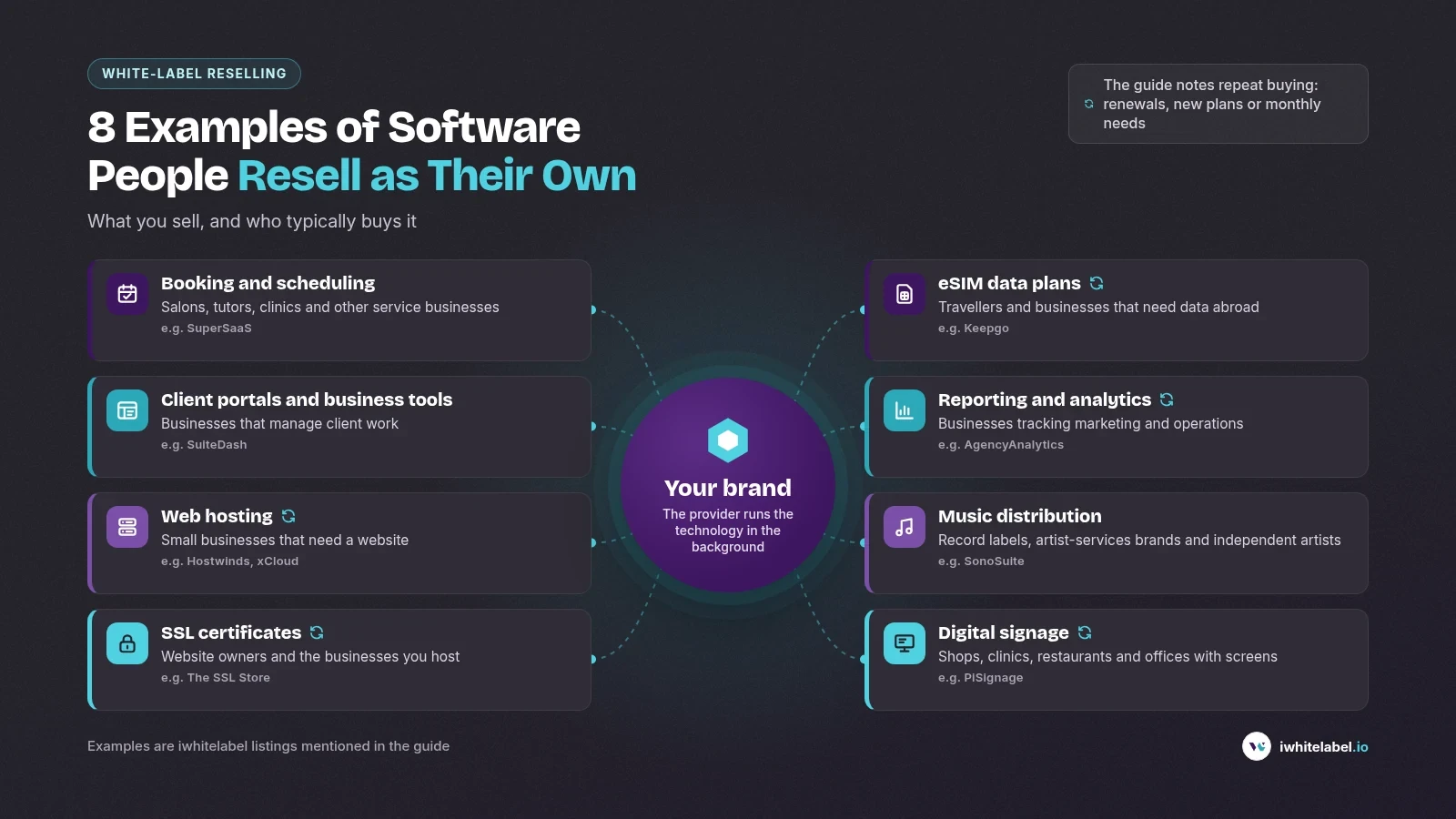
Eight types of white label software people resell, with who typically buys each one and an example listed on iwhitelabel.
Booking and scheduling. Salons, tutors, clinics and other service businesses need online booking, and the appointment scheduling category lists platforms that can be sold under your own brand. SuperSaaS, covered above, is one of them.
Client portals and business tools. SuiteDash combines a client portal, CRM and project management in one platform. Its own guide to reselling sums up the model: "You own the relationship, the brand, and the margin."
Web hosting. Almost every small business needs a website, and hosting renews every month or year. The guide to white label hosting providers compares programmes such as Hostwinds and xCloud.
SSL certificates. Every website needs a security certificate, and certificates have to be renewed regularly, which makes them a natural add-on to hosting. The SSL reseller platforms category lists programmes built for resale. The SSL Store is one example tagged as a Reseller Fit.
eSIM data plans. Travellers and businesses buy mobile data for trips abroad, and each trip can mean a new plan. The eSIM solutions category lists providers that let you sell data plans under your own brand. Keepgo is one example tagged as a Reseller Fit.
Reporting and analytics. Businesses want clear dashboards that show how their marketing and operations are performing, and they keep paying for them month after month. The reporting and analytics category is one of the largest on iwhitelabel. AgencyAnalytics is one example tagged as a Reseller Fit.
Music distribution. Record labels and artist-services brands can offer distribution to music stores and streaming services under their own name. The music distribution platforms category lists platforms built to be rebranded this way. SonoSuite is one example tagged as a Reseller Fit.
Digital signage. Shops, clinics, restaurants and offices use screens to show menus, offers and notices, and that content needs managing every month. An AV or IT company can sell branded screen-management software to these venues alongside the screens it installs. The digital signage category lists platforms that can be sold under your own brand. PiSignage is one example tagged as a Reseller Fit.
Table 1 brings the same examples together in summary form.
Table 1: Examples of white label software people resell
| Software type | What you sell | Who typically buys | Example in this guide |
|---|---|---|---|
| Booking and scheduling | Online booking under your brand | Salons, tutors, clinics and other service businesses | SuperSaaS |
| Client portals and business tools | Client portal, CRM and project management in one platform | Businesses that manage client work | SuiteDash |
| Web hosting | Hosting that renews every month or year | Small businesses that need a website | Hostwinds and xCloud |
| SSL certificates | Security certificates for websites, renewed regularly | Website owners and the businesses you host | The SSL Store |
| eSIM data plans | Mobile data plans under your brand | Travellers and businesses that need data abroad | Keepgo |
| Reporting and analytics | Branded dashboards and reports | Businesses that want to track marketing and operations | AgencyAnalytics |
| Music distribution | Distribution to music stores and streaming services under your own name | Record labels, artist-services brands and independent artists | SonoSuite |
| Digital signage | Branded software for managing screen content | Shops, clinics, restaurants and offices with screens | PiSignage |
Tactics for Winning Customers
Recommendations carry unusual weight in this kind of business. Nielsen's 2021 Trust in Advertising study found that 88% of respondents trust recommendations from people they know more than any other channel. That is why several of these tactics focus on relationships rather than advertising:
Sell through networks, not just to them. Local business groups and industry communities are useful less for the members who buy than for the people they can introduce you to. A clear, simple offer makes it easy for them to explain what you do.
Ask for introductions. A request for a specific introduction is smaller and easier to agree to than a general request for referrals, because the other person does not have to judge the fit before connecting you.
Lead with value. Opening with something useful, such as a short guide, an audit or a chance to share their expertise, starts a conversation more easily than pointing out a prospect's problems.
Look beyond your local area. Software is delivered online, so once referrals start, your customers can be anywhere your offer makes sense.
Pricing and Billing
In a white label model, the margin is yours to design:
Buy at a discount and set your own price. SuperSaaS gives resellers a 20% discount and states on its partner page that what you charge your customers for your services is up to you. Its reseller page adds that resellers can set their own price, whether fixed or monthly recurring.
Price on value, not on cost. Customers pay for the result and the service around the software. Basing your price on what the outcome is worth to them, rather than on your buy rate, leaves room for a healthy margin.
Offer tiers. A simple entry plan makes the first decision easy, while higher plans can include extra features, integrations or more of your time.
Answer the obvious question. Customers may ask why they should not buy the software direct. Your answer is the service around it: setup, advice, support and terms that suit them.
Consider flexible terms. Monthly plans without long minimum terms make it easier for customers to sign up and keep you focused on delivering value every month.
Make sure you control billing. Programmes that let you take payment directly keep the customer relationship with you. xCloud, for example, says its reseller hosting programme "gives you full branding control with built-in client and billing management".
Risks to Plan For
Reselling software has real trade-offs:
The provider can change. Software companies are bought, merged and repriced. A switch to new pricing can squeeze your margin overnight, so check how a provider has treated resellers before and keep your customer relationships strong enough to survive a move.
You give up some control of the product. Features and fixes follow the provider's roadmap. Larger resellers may gain influence over time, but a new reseller with a few accounts should not expect it.
Customers see you as the product. When something fails, the customer contacts you. Honest, prompt updates keep trust even when the fix is in someone else's hands.
Branding can fall short. If the vendor's name appears in emails, logins or invoices, customers can find the source and buy direct.
For a closer look at these issues, see the drawbacks buyers should weigh up before committing to a provider.
What iwhitelabel Looks For in Each Listing
To help resellers answer their core question, iwhitelabel checks each listing for the capabilities that matter most for resale, drawn from the iwhitelabel White Label Capability Framework. Branding for each customer comes first, followed by the account management checks in Table 2 and the packaging and monetisation checks in Table 3.
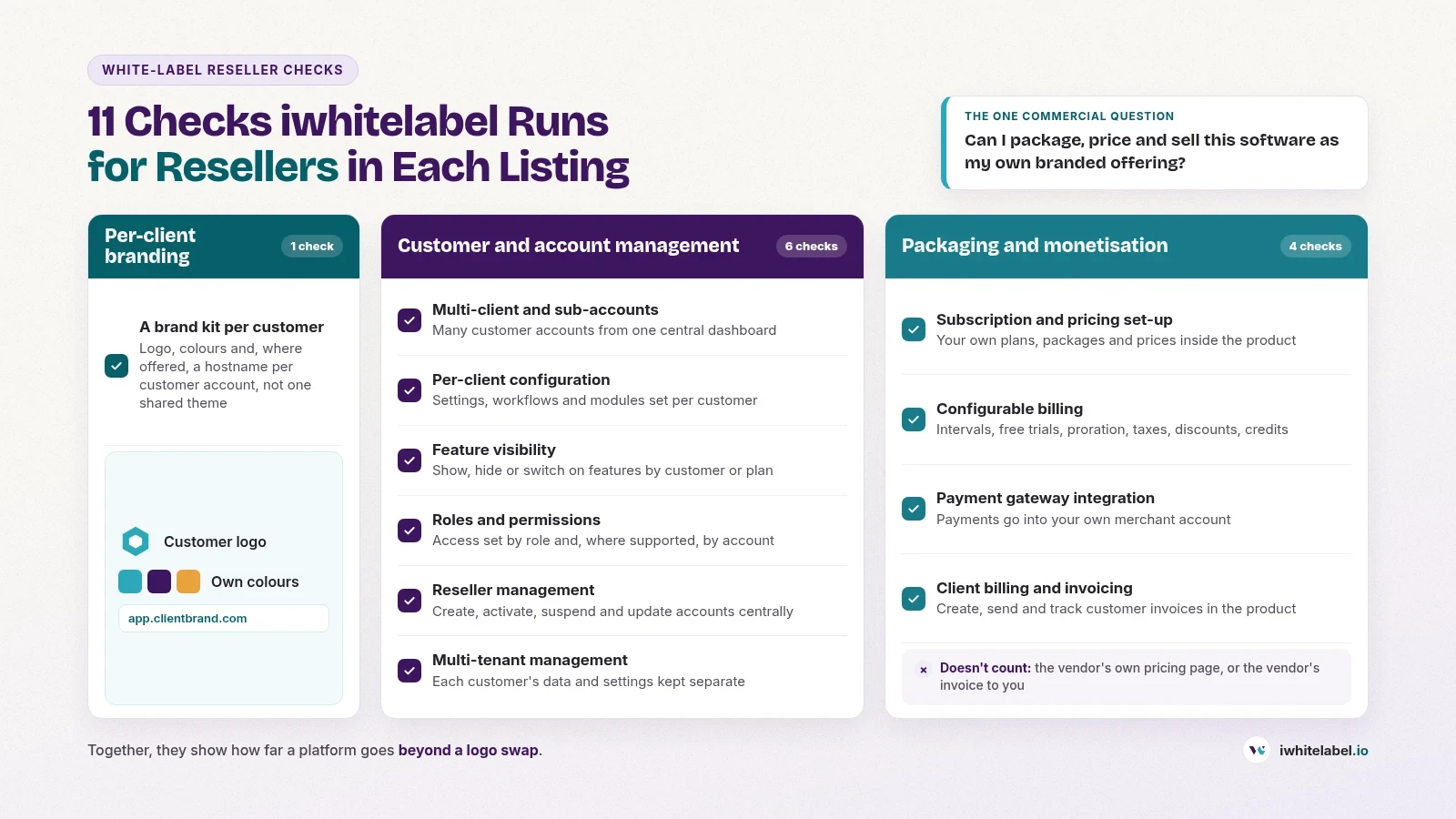
The 11 reseller checks behind each listing: per-client branding, customer and account management, and packaging and monetisation.
Per-Client Branding
Resellers often serve customers who want to see their own brand. iwhitelabel checks whether each customer or tenant account can use its own brand kit, such as a logo, colours and, where offered, its own hostname, rather than sharing one theme across the whole reseller account.
Customer and Account Management
These checks show how well a platform can be organised around many customers, which matters most when you need to run a separate environment for each customer from a single platform. Table 2 lists what iwhitelabel looks for.
Table 2: Customer and account management checks
| Capability | What we look for |
|---|---|
| Multi-client and sub-accounts | You can create and manage many customer accounts from one central dashboard, with a clear structure of clients and sub-accounts. |
| Per-client configuration | Settings, workflows, fields, modules, branding or other features can be set differently for each customer account, not only for the main account. |
| Feature visibility | You can show, hide or switch on features by customer, account, package or plan in the admin screens, so you control what each customer can use. |
| Roles and permissions | Access can be set by role and, where supported, by customer account, covering what your staff, customer administrators and end users can see or change. |
| Reseller management | You can set up and run customer accounts as part of your own resale business, including creating, activating, suspending and updating them from a central reseller or admin area. |
| Multi-tenant management | Each customer's environment and data are kept logically separate, so one customer cannot see or accidentally change another customer's data or settings. |
Packaging and Monetisation
These checks show whether you can turn the software into your own customer offers and decide how each one is priced, billed and paid for. Table 3 sets them out.
Table 3: Packaging and monetisation checks
| Capability | What we look for |
|---|---|
| Subscription and pricing set-up | You can create and manage your own customer plans, packages and prices inside the product, such as monthly or annual subscriptions, usage-based or per-seat pricing and one-off fees. The vendor's own pricing page does not count. |
| Configurable billing | You can decide how customers are billed, including billing intervals, free trials, proration, taxes, discounts and credits. |
| Payment gateway integration | Customer payments go through a payment gateway you connect, such as Stripe, and the money is paid into your own merchant account rather than the vendor's. |
| Client billing and invoicing | You can create, send and track customer invoices or billing records inside the product. The vendor's invoice to you does not count. |
Together, Tables 2 and 3 show how far a platform goes beyond a logo swap towards a product you can run and sell as your own.
The Reseller Fit Tag
Listings that show strong support for resale, such as a reseller programme, wholesale pricing, customer billing and full branding, carry a Reseller Fit tag. It is one of several buyer-fit labels iwhitelabel uses to show who a platform suits best, and our guide to the best white label software by buyer fit explains how they work.
To build a shortlist, start with the Reseller Fit filter, which shows only tagged listings, and narrow it to a category you already have in mind. Then check each listing against Tables 2 and 3 before you sign up. SonoSuite and PiSignage, both mentioned above, are examples of listings with the tag.
Checks Before You Commit
Researching white label software is often harder than it should be, so a few checks help:
Read the programme terms. Confirm who bills the customer, who they contact for support and whether your pricing is free to set.
Test the branding. Custom domains, your own logo and emails sent in your name decide whether customers see your business or the vendor's. The Framework sets out what to look for across brand, flexibility, control, trust, and commercial and operations.
Watch a walkthrough. iwhitelabel is slowly adding video walkthroughs to its listings, so you can see how a platform looks and works before you sign up. The Partnero listing is one example, with its walkthrough embedded just below the summary at the top of the page.
Keep a second option in mind. Knowing at least one alternative platform reduces the damage if a provider changes its terms.
Learn the language. Programme pages use terms such as wholesale pricing, sub-accounts and custom domains, all explained in the white label glossary.
Conclusion
You do not need to build software to run a software business. Choosing one problem you understand, finding an existing product that solves it and wrapping it in your own brand, pricing and service can turn a side project into a business with recurring revenue. The value you add is the relationship: you find the customers, explain the result, support them and keep them on terms they are happy to renew. Pair that with a programme where you own the customer, and the income becomes an asset rather than a second job.
FAQs
Here are short answers to common questions about reselling white label software.
A white label reseller is a business that sells access to another provider's software as its own branded product. It packages, prices and sells the software under its own name, and usually manages many customers from one place.
Both often need branding, multi-customer management and packaging. An agency sells services it delivers using the software, while a white label reseller sells access to the software itself as its own product.
A traditional reseller sells under the provider's brand for a commission, and the provider keeps the customer. With a white label programme, the brand, the pricing, the billing and the customer relationship are yours, which is what turns the income into a business you own and is why iwhitelabel focuses on white label resale.
Yes. The provider builds and runs the software, so you can start alongside a job and grow at your own pace. Starting with one niche and one product keeps the workload manageable.
Not usually. The provider builds and maintains the software, while you handle sales, onboarding and first-line support. Knowing your customers' problems matters more than knowing how to code.
You buy access at a wholesale or discounted rate and set your own retail price. Many resellers price on the value of the result and the service they add, rather than on their buy rate.
iwhitelabel checks whether each customer account can carry its own branding, how well the platform handles many customer accounts and separate customer environments, and whether you can create your own plans, set billing rules, take payments through your own gateway and invoice customers yourself. Tables 2 and 3 in this guide list the checks in full.
It marks listings with strong support for resale, such as a reseller programme, wholesale pricing, customer billing and full branding. Filtering by Reseller Fit is a quick way to start a shortlist before you check each listing against Tables 2 and 3.
Increasingly, yes. iwhitelabel is slowly adding video walkthroughs to its listings, such as the Partnero listing, so you can see the software before you choose a provider.
Your costs or the product can change. Strong customer relationships, honest communication and knowing at least one alternative platform make it easier to negotiate or switch.