
Nativeblocks is a white-label server-driven UI (SDUI) SDK for Android and iOS that renders dynamic screens and forms natively using your app's own components.
White Label Form Builders
White-label form builder software for agencies and resellers. Rebrand custom form creation, data capture, and workflow automation under your own brand.
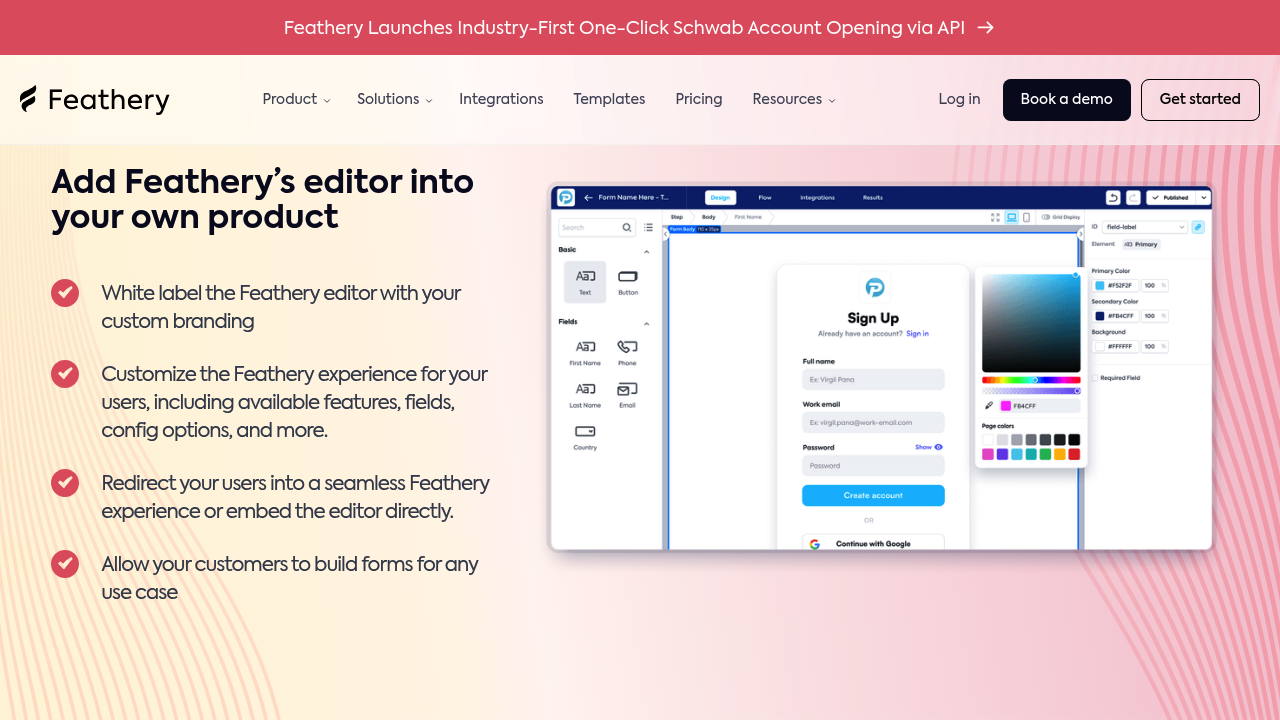
Embed Feathery's white-label form editor into your product via iframe or custom domain, with per-workspace branding, feature controls, JWT auth and Workspace API.
Click here for Form Builders FAQs
White Label Form Builder FAQs
Welcome to our comprehensive guide on White Label Form Builders. In this article, we address the most frequently asked questions about white-label form builder platforms, helping you understand, evaluate, and leverage these tools effectively. Whether you are a digital agency, SaaS reseller, healthcare provider, or entrepreneur, this FAQ resource will clarify how white-label form builders can strengthen your data collection workflows and elevate your brand.
Yes. True white-label form builders let you map a custom domain (e.g., forms.youragency.com), replace all vendor logos, apply your own color palette and typography, and send submission notification emails from your own branded SMTP address. The depth of branding control varies significantly by platform. Jotform Enterprise includes an AI Brand Kit that auto-generates a brand theme from your uploaded logo and assets, while platforms like GlobalPatron and 123FormBuilder support full domain mapping and client-facing login pages branded to your organization. Shallow implementations often still expose the vendor's subdomain or footer link, so always verify the full removal of vendor identity before committing to a plan.
123FormBuilder Enterprise starts at $225/month (billed annually) and its HIPAA-compliant Compliance tier starts at $255/month. Jotform Enterprise and Formaloo use custom, quote-based pricing. White-label functionality including custom domain, branded email delivery, and sub-account management is not available on self-serve or SMB plans. The cost also depends on the number of users, submissions volume, and compliance certifications required. Compared to building a custom form solution from scratch, which can cost $50,000 to $120,000, white-label SaaS subscriptions represent a fraction of that investment.
The core distinction is purpose and data depth. Form builders are optimized for data collection and process automation, covering contact forms, registrations, payments, file uploads, e-signatures, and workflow triggers. Survey tools are designed for research and feedback, featuring rating scales, Likert scales, matrix questions, randomization, sentiment analysis, and statistical reporting. In practice, the lines are blurring. Platforms like Jotform Enterprise, Formaloo, and 123FormBuilder effectively do both, supporting multi-page branching logic, rating scales, and analytics alongside payment processing, document generation, and workflow automation. If you need both in a white-labeled package, prioritize platforms that include native analytics dashboards alongside form-building, rather than buying a separate survey tool.
Yes. This is one of the defining capabilities of enterprise-grade white-label form platforms. Sub-account management lets you provision separate branded environments for each client, each with isolated data, branding, permissions, and users, all managed from a single admin panel. Formaloo supports role-based access control within these sub-accounts, so you can define exactly what each team member or client user can view, edit, or export. 123FormBuilder Enterprise allows custom user roles and permissions with no minimum user requirement, meaning you can start with one user and scale. This architecture is especially important for agencies managing 10 or more client accounts simultaneously.
The feature set across leading platforms covers a broad range of use cases. Standard inputs include text fields, dropdowns, checkboxes, date pickers, and file uploads. Conditional logic enables show/hide fields based on prior answers and adaptive question paths. Payment processing supports native Stripe, PayPal, Square, and Authorize.net integrations with branded checkout. Additional capabilities include e-signatures and digital signing for legal and HR workflows, calculated fields for dynamic pricing and scoring, document generation to auto-produce PDFs and reports from submissions, and multi-page forms with save-and-resume for long workflows. FormWise lets you convert GPT prompts into deployable branded AI tools, and Jotform Enterprise's white-labeled mobile app supports offline field data entry without an internet connection.
Yes. Integration depth is a major differentiator across platforms. 123FormBuilder Enterprise offers 45+ native integrations and access to 4,000+ more via Zapier, including Salesforce, HubSpot, Monday.com, and Google Sheets. Formaloo connects with 5,000+ tools via webhooks and API. FormWise is specifically built around GoHighLevel (GHL) CRM integration, making it a strong choice for agencies running GHL-based client stacks. Standard workflow automations include submission notifications, approval chains, data pushes to CRMs, calendar invites, and Slack alerts. For regulated industries, look for platforms that include audit trail logging as part of their workflow. 123FormBuilder Enterprise includes this at both standard and compliance tiers.
Compliance coverage is a critical buying criterion for healthcare, legal, and EU-based buyers. 123FormBuilder's Compliance tier adds individual AWS encryption keys, custom data retention policies, and HIPAA security protocols on top of the standard enterprise plan. Jotform Enterprise supports local data residency, allowing healthcare and EU organizations to ensure data never leaves a specific geographic region. Formaloo uses AES-256 encryption and complies with POPIA in addition to GDPR. Paperform meets GDPR requirements but does not currently offer HIPAA compliance. Always request a Business Associate Agreement (BAA) from any platform you plan to use for protected health information, as this is a legal requirement under HIPAA.
Yes, and this is one of the fastest-growing use cases in this category. FormWise is purpose-built for this model: agencies create branded AI-powered form tools, set subscription prices, and collect payments via Stripe without any FormWise branding visible to end users. 123FormBuilder has a formal reseller and agency partner program with volume pricing that improves margins as your client base grows. The economics are compelling since Jotform Enterprise's white-label setup means clients interact exclusively with your brand, never seeing the underlying platform, which supports a premium positioning and pricing strategy.
Based on current platform positioning and market demand, the highest-value niches include:
- Healthcare - HIPAA-compliant patient intake, consent forms, and telehealth assessments (Jotform Enterprise, 123FormBuilder Compliance)
- Legal - multi-signature case intake, contract collection, and document generation (Formaloo, 123FormBuilder)
- Real estate - lead qualification tools, property interest assessments, and CRM-connected pipelines (FormWise with GoHighLevel)
- HR and operations - employee onboarding workflows, approval chains, and performance reviews (Formaloo)
- Digital agencies - managing branded forms across 10 to 100+ client accounts with sub-account isolation
- EdTech and training - assessments, quizzes, and enrollment forms with conditional branching
- Events - multi-page registrations with payment processing and capacity management
- SaaS builders - embedding form functionality into an existing product via white-label API
Full white-labeling requires verifying several layers of brand removal: custom domain (no jotform.com or paperform.co in URLs), removal of vendor logos on all form pages and confirmation screens, branded email delivery using your own SMTP so notification emails come from @yourdomain.com, and white-labeled login pages for admin access. Some platforms still expose the vendor name in email headers, browser tab titles, or redirect URLs after submission. Test each of these touchpoints before deploying to clients. Jotform Enterprise specifically supports OAuth 2.0 SMTP so all outbound emails carry your domain identity, which is one of the most commonly overlooked white-label verification steps.
Yes. AI integration is now a core feature on leading platforms. Jotform's AI Brand Kit auto-generates form themes from your brand assets and applies them instantly across all forms. FormWise goes further, letting you build GPT-powered interactive tools such as a branded Business Valuation Calculator or Insurance Needs Assessment that are fully white-labeled and monetizable via subscription. Formaloo includes AI-powered data analysis tools that let end users query submission data in natural language. This category is evolving rapidly, with AI-native form builders shifting the category from passive data collection to active, branded engagement tools that can be packaged as standalone SaaS products.
Several recurring mistakes affect buyer satisfaction in this category:
- Underestimating compliance needs - discovering a HIPAA requirement after purchase forces a costly mid-contract upgrade
- Ignoring sub-account architecture - platforms without proper client isolation can expose one client's data to another, creating serious liability for agencies
- Overlooking email branding - forms sent from @jotform.com or @paperform.co break the white-label experience for recipients regardless of how polished the form itself looks
- Not testing offline and mobile needs - only a few platforms such as Jotform Enterprise mobile support offline data collection for field teams
- Assuming all integrations are native - over-reliance on Zapier adds latency, cost, and potential data mapping errors that native integrations avoid
Data ownership is a core benefit of enterprise white-label platforms. Unlike free or SMB form tools where vendor terms may allow data use for model training or analytics, enterprise plans typically include contractual data ownership clauses and custom data retention policies. 123FormBuilder Enterprise offers data residency in both the US and EU, ensuring submission data is never processed outside your chosen jurisdiction. Formaloo uses AES-256 encryption and is compliant with POPIA in addition to GDPR. For high-sensitivity deployments, prioritize platforms that offer individual encryption keys rather than shared infrastructure, and a Business Associate Agreement for HIPAA compliance.
Agencies should evaluate platforms across five dimensions. First, branding depth covers full removal of vendor identity including domain, emails, login pages, and mobile app. Second, sub-account scalability covers the ability to spin up isolated client environments quickly with templated branding setups to reduce onboarding time. Third, integration stack compatibility covers native connections to the CRMs and tools your clients already use such as Salesforce, HubSpot, Monday.com, and GoHighLevel. Fourth, compliance coverage determines whether the platform can serve regulated verticals like healthcare, legal, and finance without requiring a separate tool. Fifth, reseller economics cover whether the platform offers volume pricing, a partner program, or the ability to resell or monetize branded form tools as independent subscription products.
Yes. For teams with engineering resources, developer-first platforms offer deeper customization than SaaS form builders. SurveyJS is a fully open-source, self-hosted form and survey library that gives developers complete CSS-level white-label control with no vendor branding, no submission limits, and no data leaving your own infrastructure. It supports complex conditional logic, multi-page forms, and JSON-based schema definitions, making it ideal for teams embedding forms into existing products. NativeBlocks offers a white-label Form SDK specifically designed for mobile-first deployments, allowing developers to build, render, and update branded forms natively inside iOS and Android apps without redeploying the app itself. These developer SDKs are a better fit than SaaS platforms when customization requirements exceed what drag-and-drop builders support, licensing costs need to be minimized at scale, or the form experience must be deeply embedded within a proprietary product.