Most businesses offer free guest Wi-Fi, giving visitors wireless internet access on a network separate from their internal staff connection. While the business pays for the internet service and the access points broadcasting the signal, it gets nothing back from the guest unless it asks for something at login.
For resellers and agencies, that login step is a valuable service you can sell.
What Is Guest Wi-Fi Marketing
Instead of letting visitors connect automatically, guest Wi-Fi marketing puts a branded welcome screen, known as a captive portal or splash page—between the guest and the internet. Before getting online, the page can:
Capture an email address (with the guest's consent)
Display a special promotion or welcome offer
Ask the visitor to leave a review
Behind the scenes, the software tracks visitor analytics and triggers automated follow-up campaigns.
Guest Wi-Fi marketing means the marketing runs on the network visitors use, not on staff or internal networks. Some platforms, such as Purple, also manage staff Wi-Fi from the same account, but this guide looks at their guest side. You will also see the same type of product called social Wi-Fi when the login uses a social media account such as Facebook or Google, or captures an email address. Social WiFi, written that way, is also the name of one platform reviewed below.
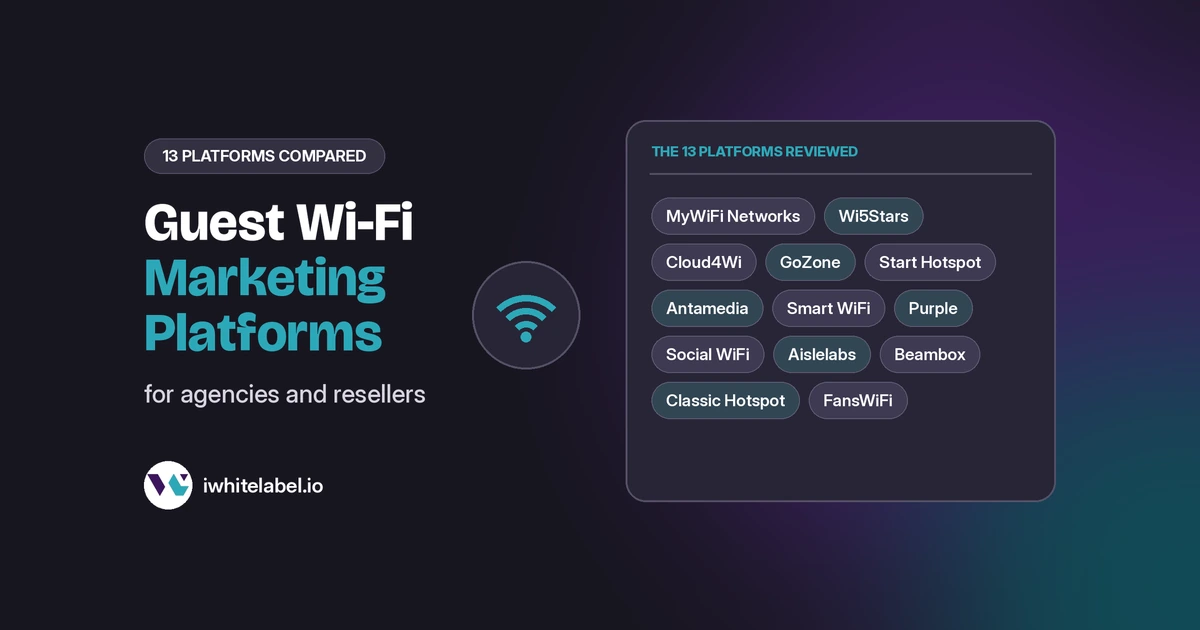
This guide covers the 13 platforms in the iwhitelabel directory's Wi-Fi Marketing Tools category, each checked against what the vendor publishes, and shows which ones you can sell under your own brand.
Why Guest Wi-Fi Matters to Resellers and Agencies
The opportunity starts with how many venues already offer guest Wi-Fi. Cisco's Annual Internet Report forecast nearly 628 million public Wi-Fi hotspots by 2023, up from 169 million in 2018. Directories show the local picture. WiFi Map's country table lists 1,021,033 free Wi-Fi spots in the United States. WiFi SPC states that it holds over 300,000 hotspots in 200+ countries and territories. These are the sites' own figures and each counts differently, so read them as a sign of scale, not as the size of your market.
(Note: Because these platforms count hotspots differently, treat these numbers as a sign of massive global scale rather than an exact count of your addressable market.)
Every single one of these venues is already paying for internet service and hardware. Yet, most of them simply give the connection away without getting anything in return. Without a branded login step (like a captive portal), a venue collects zero guest contact details and misses out on valuable marketing data.
This is where resellers and agencies can step in to add immediate value and create a new recurring revenue stream:
Resellers can white-label a guest Wi-Fi platform, selling proven software under their own brand name.
Agencies can bundle Wi-Fi marketing into their existing client services, turning a basic utility into a powerful lead-generation and customer-retention tool.
The platforms in this guide describe three uses:
Data capture: Aislelabs lets you choose captive portal form fields such as name, date of birth, mobile, email and postcode.
Reviews: Beambox includes review automation.
Repeat visits: Smart WiFi has pre-built welcome, win-back, birthday and post-visit campaigns.
Several vendors also describe the commercial terms. Smart WiFi lets you set client prices and keep the profits, with a monthly fee that includes one location plus a small fee per client. MyWiFi Networks takes client payments through Stripe Connect. GoZone lists partnerships from $1000 a year and lets you create and sell your own plans.
The next point is reasoning, not a sourced figure: if you charge a venue more each month than the platform costs you for it, the difference repeats for every month the venue stays, and each extra venue adds another.
How to Find and Qualify Venues That Offer Guest Wi-Fi
Start your outreach with businesses that already offer free internet. Because they already pay for the connection and hardware, you do not have to sell them on the value of Wi-Fi. Instead, your pitch focuses entirely on turning their existing login screen into a marketing tool.
Build a List
Directories show that a venue offers Wi-Fi. The Wi-Fi-FreeSpot directory lists venues state by state in the USA, followed by Europe and other regions. WiFi SPC describes its data as collected from user contributions and partner networks, so confirm each entry before you contact the venue.
Map and review sites add detail. Yelp lists whether a business offers Wi-Fi among its business details. Google Maps can list Wi-Fi as an amenity, but a thread on the Google Maps Community forum shows a visitor finding a cafe that listed Wi-Fi it did not have, so treat the label as a lead, not proof.
Official registers can add venues the maps miss. In the UK, the Food Standards Agency publishes food hygiene rating data for restaurants, pubs, cafes, takeaways and hotels, free through an API and updated daily. In New York City, the Issued Licenses dataset lists licences by business category with the initial issuance date, which helps you find recently licensed businesses. Cross-check every name on a map before you add it to your list.
For a larger list, extraction tools can export Google Maps results. Outscraper's Google Maps scraper exports business names, addresses, phone numbers, websites and ratings, and its email add-on crawls business websites for publicly listed emails. PhantomBuster's Google Maps Search Export includes opening hours and a current status, and returns about 120 to 200 results per search, so split a town into smaller areas.
Check the terms of any platform you extract data from, and follow privacy law for the contacts you collect. The ICO says unsolicited marketing emails to sole traders and some partnerships need consent or a soft opt-in, and that you need a lawful basis to use people's information for direct marketing.
Check Each Venue Before You Call
A few checks stop you contacting venues that have closed or no longer offer Wi-Fi.
Read recent Google and Yelp reviews that mention Wi-Fi to see whether customers are still using it.
Check the venue's social media accounts for posts from the last 30 days, and remove venues that look closed.
In a dense area, scan for nearby network names (SSIDs) on site. A Wi-Fi analyser app such as NetSpot lists nearby networks by name and marks password-protected ones with a padlock. A network name is a conversation starter, not proof of what the venue runs.
What you see on site gives you a specific opening line. An open network with no branded login page is a missed chance to capture emails with consent. A password written on a chalkboard is a reason to pitch a login page that removes the password question for staff and builds a marketing list.
Match the Pitch to the Venue Type
Lead with a problem the venue is likely to recognise. Table 1 gives a starting point for three venue types, and the problems are questions to ask in conversation, not findings.
Table 1: Three venue types, a problem to test and the pitch to match
| Venue type | Problem to test | Pitch | Platform to check first |
|---|---|---|---|
| Cafes and coworking spaces | Guests stay for hours and use bandwidth | Time or bandwidth limits on the free network, and a branded login page | Start Hotspot |
| Hotels | Staying in touch with guests and collecting reviews | Review requests and follow-up campaigns after a stay | Beambox |
| Salons and gyms | Getting customers to come back | Welcome, win-back and birthday campaigns using email or phone details captured at login | Smart WiFi |
How White Label Guest Wi-Fi Marketing Works
The internet standard RFC 8952 defines a captive portal as a network where access is limited until requirements are fulfilled, such as reading advertisements, accepting an acceptable-use policy or providing credentials. Guest Wi-Fi marketing platforms build on this.
Figure 1 shows the five steps from the venue's Wi-Fi to reports.
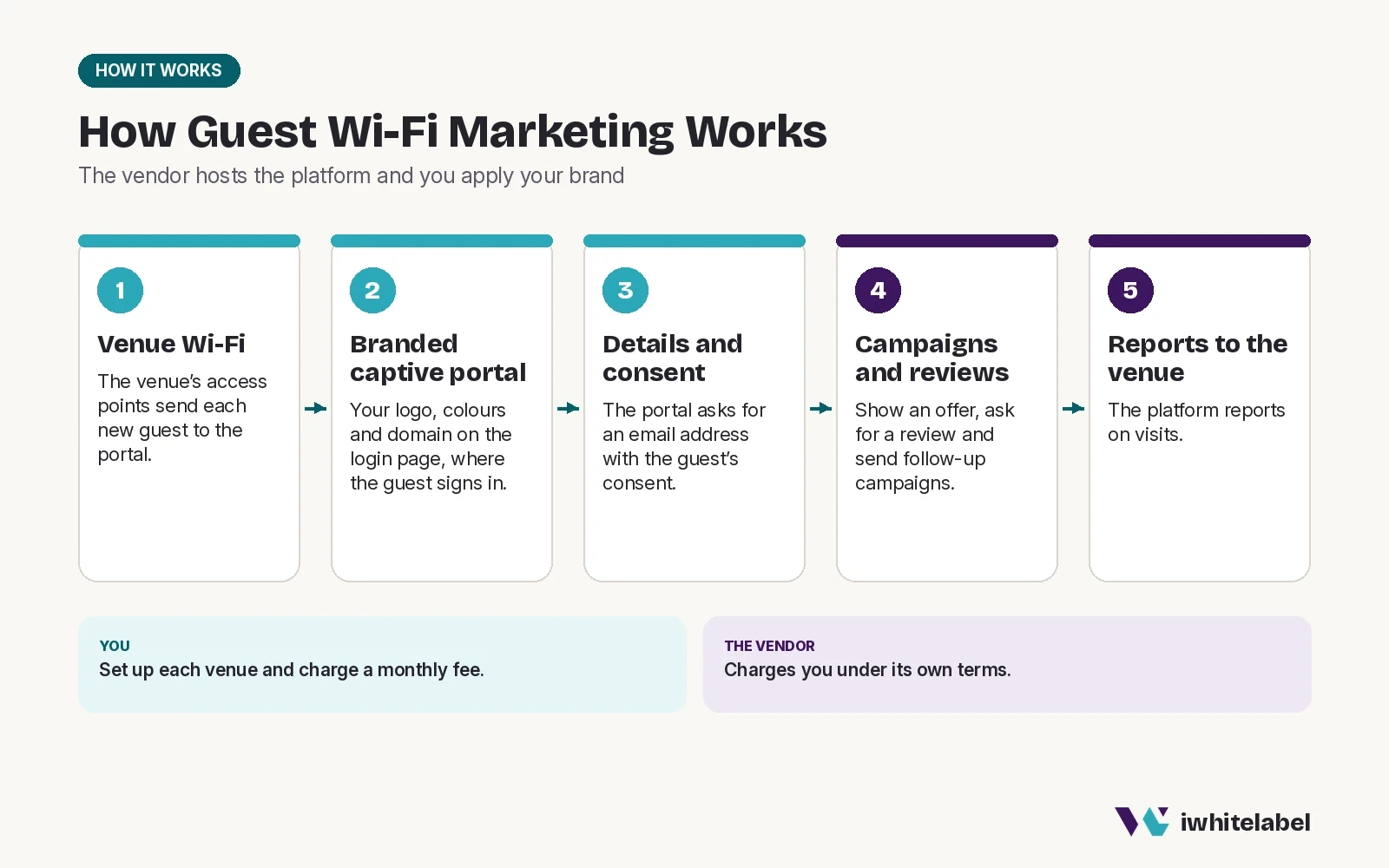
Figure 1: How guest Wi-Fi marketing works, from the venue's Wi-Fi to reports to the venue
The vendor hosts the platform and you apply your brand. You set up each venue, design its portal and campaigns, and charge the venue a monthly fee, while the vendor charges you under its own terms. Platforms differ on who invoices the venue, which is covered in the checks below.
The platform also has to work with the hardware the venue already owns. MyWiFi Networks lists support for Meraki, UniFi, Aruba, MikroTik and Ruckus access points.
Collecting contact details brings legal duties. In the UK, the Information Commissioner's Office (ICO) says that unsolicited marketing emails to individuals normally need consent, and that people must take a positive action to give it, so pre-ticked boxes do not count.
Rules differ in other countries, so check the local law before you promise a venue a mailing list.
What to Look For Before You Choose a Guest Wi-Fi Marketing Platform
Five checks separate the platforms below: how much of the service carries your brand, who bills the venue, how many clients you can manage, which hardware and systems it connects to, and how it handles consent.
Your Brand on Every Surface
Check the dashboard, login page, captive portals, emails, reports and any mobile app. Social WiFi puts your logo and domain on the dashboard and portals, but its dashboard registration and login page cannot show your logo yet.
Who Bills the Venue
If you want to own the customer, you need to send the invoice. MyWiFi Networks connects Stripe so you can take card payments from your own clients. Beambox has partners bill clients themselves outside the platform.
Managing Many Clients
Look for multi-tenant management, meaning each client's data and settings are kept separate, plus sub-accounts, per-client branding and roles. Classic Hotspot lets partners create sub-accounts, but they are 15 day trials without white label branding.
Hardware and Integrations
An API (application programming interface) lets your own software create and manage accounts, and a webhook sends an alert to another system when something happens, such as a new subscriber, so you can pass details to a customer relationship management (CRM) system. Cloud4Wi offers webhooks and a software development kit (SDK) for building Wi-Fi sign-in into your own app, and hotels often need a link to their property management system (PMS), the software that holds bookings and guest records.
Consent and Data Handling
Look for consent tick boxes and forms you can edit. Social WiFi offers custom consent forms. Cloud4Wi has a Data Processor mode that protects each managed customer's data.
The 13 Platforms Reviewed
White labelling means the vendor runs the software and you present it as your own, with your brand, domain and prices on the portal and dashboard. It suits Wi-Fi marketing because each venue needs its own setup and campaigns, which is service work you can bill for, while the vendor keeps the software running.
Each profile below comes from the iwhitelabel directory listing for the platform. The order runs from the platforms with the most documented controls for running a multi-client reselling business, such as billing, pricing and client management, to those where the brand stays with the venue.
1. MyWiFi Networks
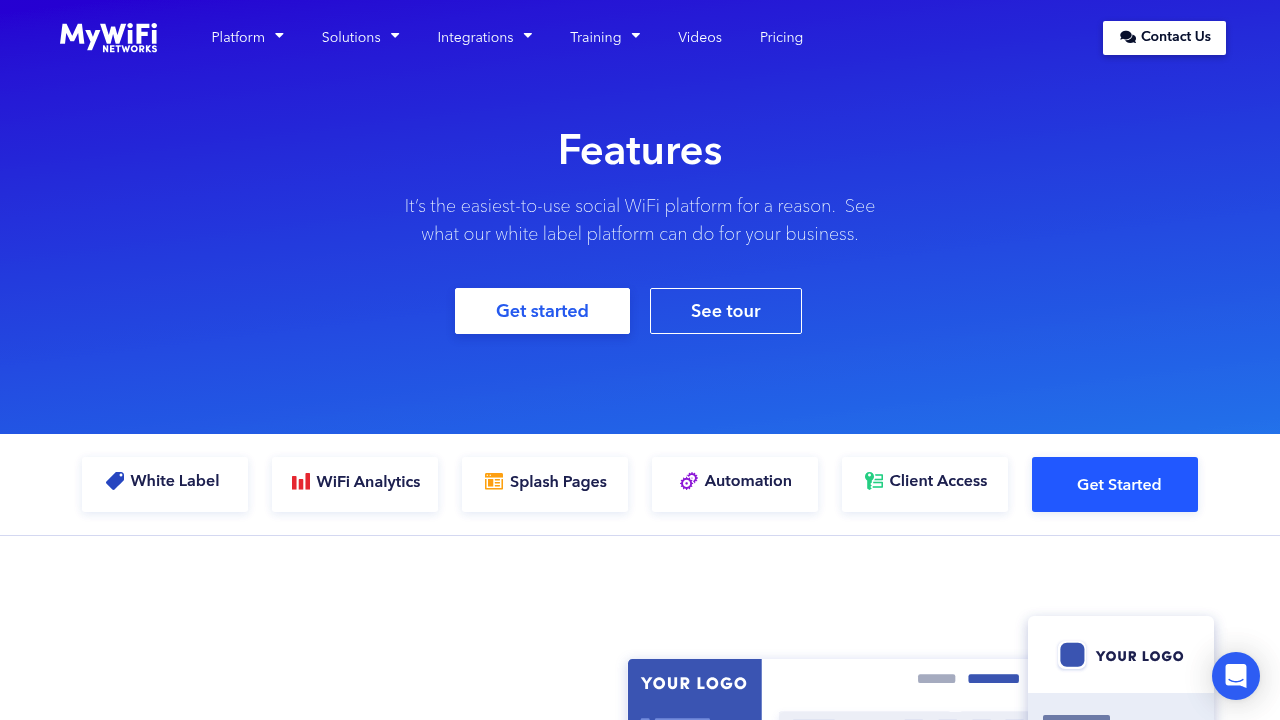
MyWiFi Networks is a guest Wi-Fi marketing platform for managed service providers (MSPs), digital agencies and value-added resellers (VARs). You run branded captive portals, marketing automation and analytics for many clients from one multi-tenant console on your own domain.
Client billing is built in, because Stripe Connect lets you take card payments from your own clients, with invoicing and a revenue dashboard. Every plan includes white label dashboard branding, client sub-accounts start on the Growth plan, and the Enterprise plan adds a branded mobile app.
Best-fit niches: MSPs, digital agencies, VARs, internet service providers (ISPs), wireless ISPs and telecom providers reselling guest Wi-Fi marketing to venues.
White-label capabilities: Your logo, colours, domain and login screen across the dashboard, portals, reports and emails, with no "Powered by" footer. Each client can have its own custom domain. A drag-and-drop builder covers portals and email campaigns, and automations can trigger email, SMS, WhatsApp or webhook actions. A REST API can create sub-users, webhooks stream events, and more than 200 native integrations plus Zapier, a tool that links apps, connect other tools.
2. Wi5Stars
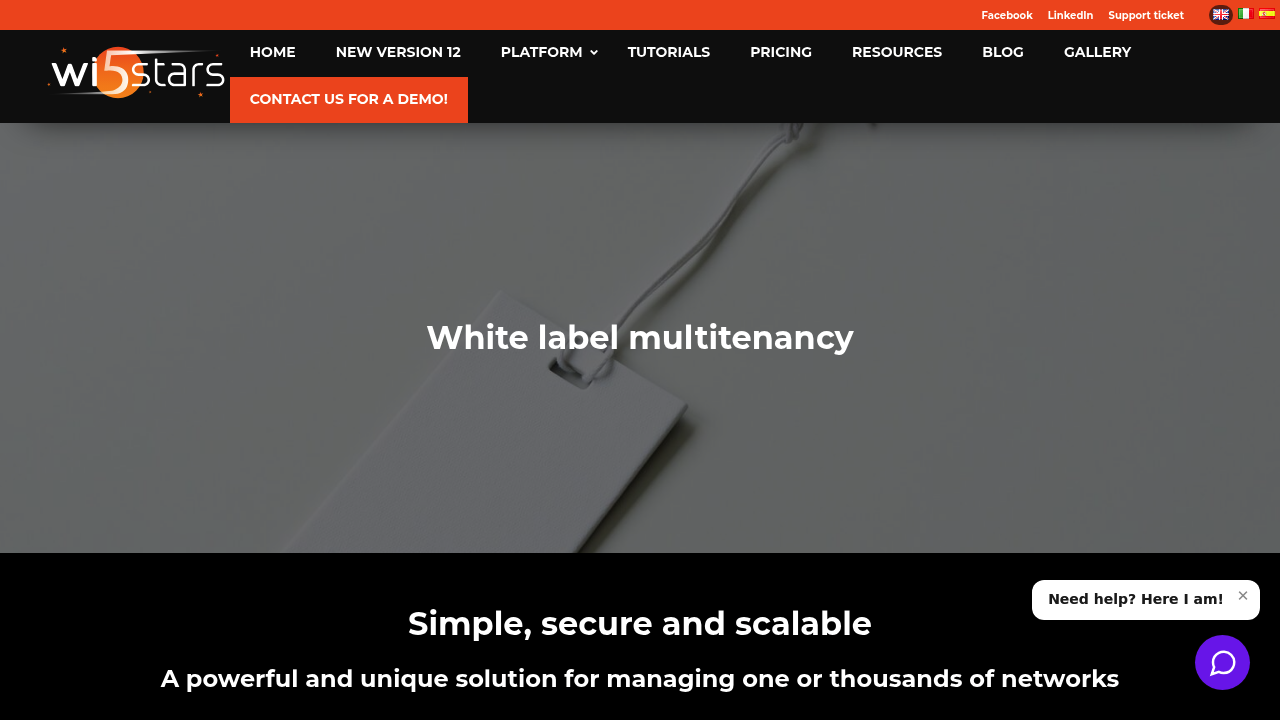
Wi5Stars is a hotspot and guest Wi-Fi billing platform, so it suits resellers who sell paid or voucher-based Wi-Fi as well as marketing.
On the Enterprise edition you run it on your own domain with your own SSL certificate (the security certificate that gives your domain a secure connection), replace the Wi5Stars logo on login pages and dashboards, and style dashboards with custom CSS styling. The structure runs from reseller to manager to advertiser, and each level can have its own products, tax rates and payment gateways. Sales tables show the amounts to invoice to managers and advertisers.
Best-fit niches: ISPs, system integrators, resellers and multi-venue operators selling branded hotspot and guest Wi-Fi access.
White-label capabilities: Your own domain and SSL, separate logos for managers and advertisers, and a help desk section in the welcome portal showing your phone, WhatsApp and email. Resellers get products with a discount on the price list, tax rate lists and pre-integrated gateways including PayPal, Stripe, Mollie and Authorize.Net, plus regional ones such as M-Pesa and PayFast. An add-on connects to hotel property management systems including Opera, Fidelio Suite8 and Protel.
3. Cloud4Wi
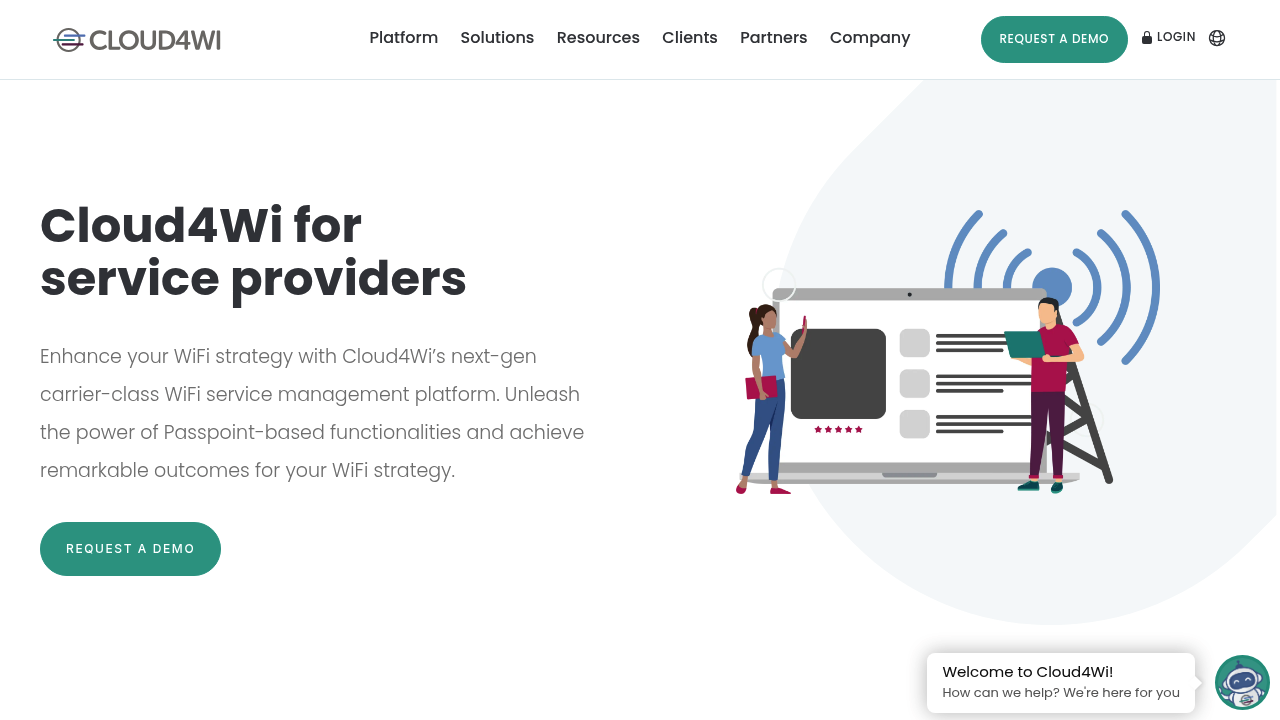
Cloud4Wi is a Wi-Fi service management platform with branded captive portals, a partner dashboard for many client accounts, and developer tools.
The white label option puts your logo, login page and domains on the dashboards. The Dashboard For Partners manages many client accounts with role-based access, and an SDK lets you build Wi-Fi sign-in into your own app. White labelling and partner pricing are arranged with its sales team, so confirm the commercial terms before you plan an offer.
Best-fit niches: Mobile carriers, ISPs, MSPs and system integrators delivering branded managed Wi-Fi to venues, enterprises and subscribers.
White-label capabilities: Fully customisable captive portals with an editor or custom CSS, a custom sender identity for email, and per-client branding settings. Onboarding journeys can include forms, opt-ins, consents, surveys and custom pages. An Events Classifier turns arrivals, dwell time and departures into triggers. Webhooks cover network, onboarding and classified events, but they do not retry if the destination is busy, and connectors reach CRM, customer data platforms, marketing automation, PMS, visitor management and data warehouses.
4. GoZone
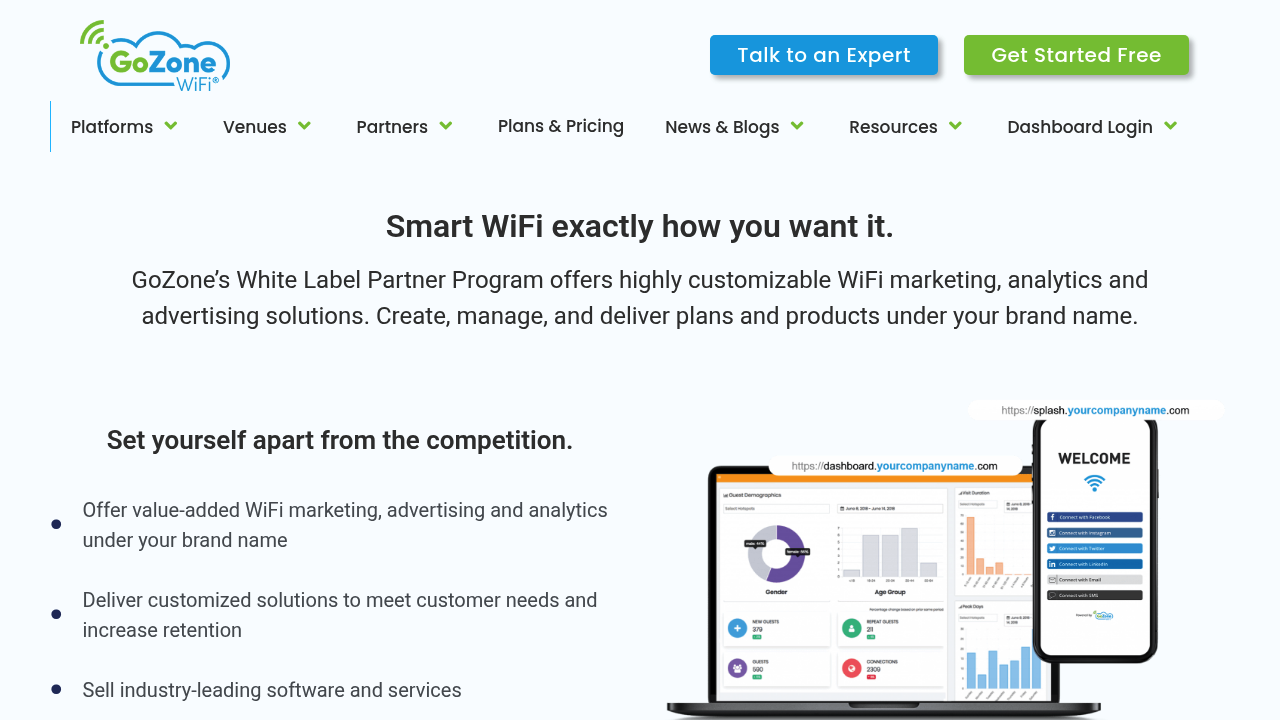
GoZone is a Wi-Fi marketing, analytics and advertising platform that service providers sell under their own brand. Partnerships start at $1000 a year.
Partners put their logo on the dashboard and splash pages, run both on their own domain URLs, and send reports and Smart emails from a branded address. A multi-tenant operator dashboard holds clients, users, plans, billing and invoicing.
Best-fit niches: Marketing agencies, MSPs, ISPs and cable or telecom providers offering branded guest Wi-Fi marketing to venues.
White-label capabilities: A Client Management System for unlimited clients and users, with permissions and settings per client, venue and user. You create and sell your own plans and pricing, choose which products and plans each client sees, and use the billing system with a client overage report. Partners also get onboarding and training, and splash pages can offer social login with your own apps.
5. Start Hotspot
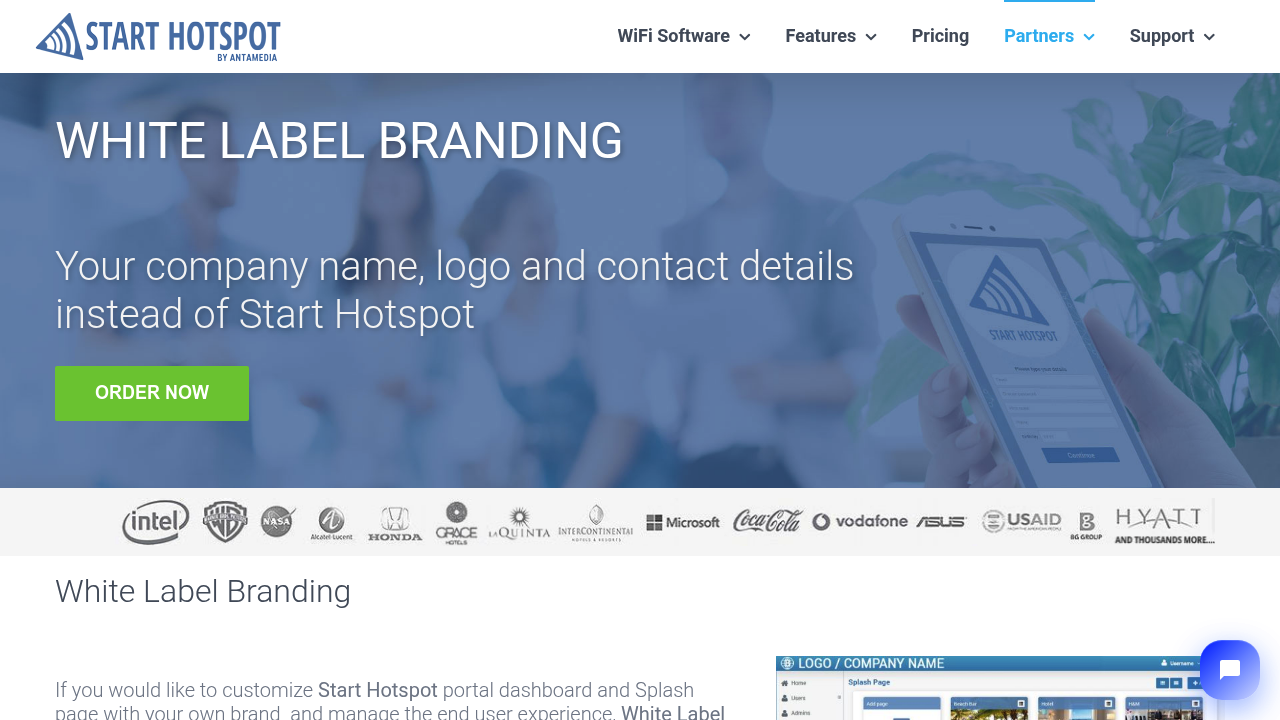
Start Hotspot, now marketed as Antamedia WiFi Hotspot, is a cloud captive portal and guest Wi-Fi platform with a White Label add-on.
The add-on replaces the vendor's branding with your logo, colours and contact details, serves splash pages and the customer portal from your own domains with SSL, and sends campaigns through your own email server. Client admins log in to your branded portal to manage their own Wi-Fi.
Best-fit niches: Wi-Fi resellers, MSPs, system integrators and small ISPs selling guest Wi-Fi, hotspot billing and Wi-Fi marketing to venues.
White-label capabilities: You can set any price for your customers and sell internet plans limited by time, bandwidth or data. A Resellers section manages reseller accounts, allocated credit and a configurable commission percentage. Payment gateways include PayPal, Stripe, Authorize.NET and regional options, and a visual editor builds splash pages with smart forms and surveys. Automation and birthday emails start on the Premium plans, and API and webhook integration on Cloud Premium and above.
6. Antamedia
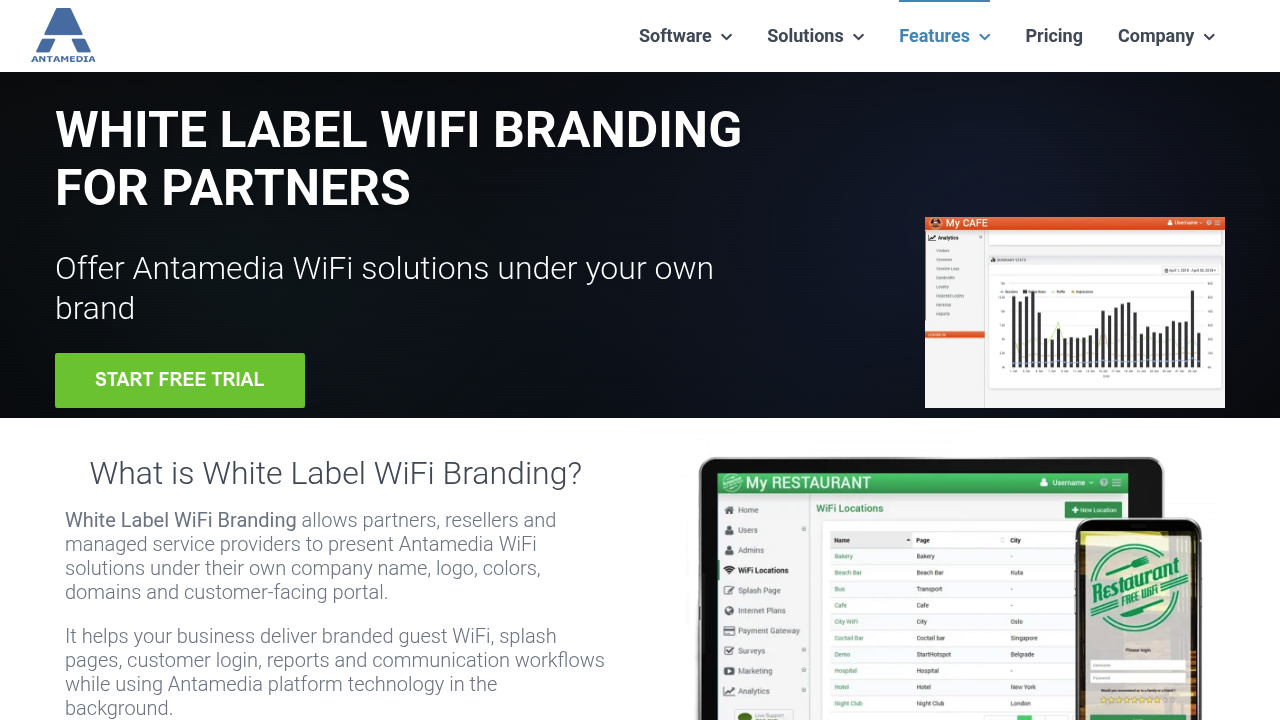
Antamedia is captive portal and hotspot billing software that you can present as your own, and its Enterprise Wi-Fi option covers private-cloud or on-premise deployments. Start Hotspot above is now marketed under the Antamedia name, so the two come from the same vendor, and this profile covers the partner dashboard.
Splash pages and the customer portal can carry your business name, logo, colours and domains, and emails can be sent from your own domain or server. White label branding lets you set your own customer pricing, including internet plan prices and billing rules.
Best-fit niches: ISPs, MSPs, resellers, marketing agencies, hospitality technology providers and managed Wi-Fi operators offering guest Wi-Fi, splash pages, hotspot billing and customer portals under their own brand.
White-label capabilities: A partner dashboard manages customer accounts, credit, locations and internet plans, and each customer account can have its own branding, splash methods and access settings. Account roles include system admins, billing, front desk and location admins. Automation covers welcome, thank-you and post-visit survey messages, and integrations include hotel PMS, Stripe, PayPal, MikroTik, SMS gateways and WhatsApp.
7. Smart WiFi
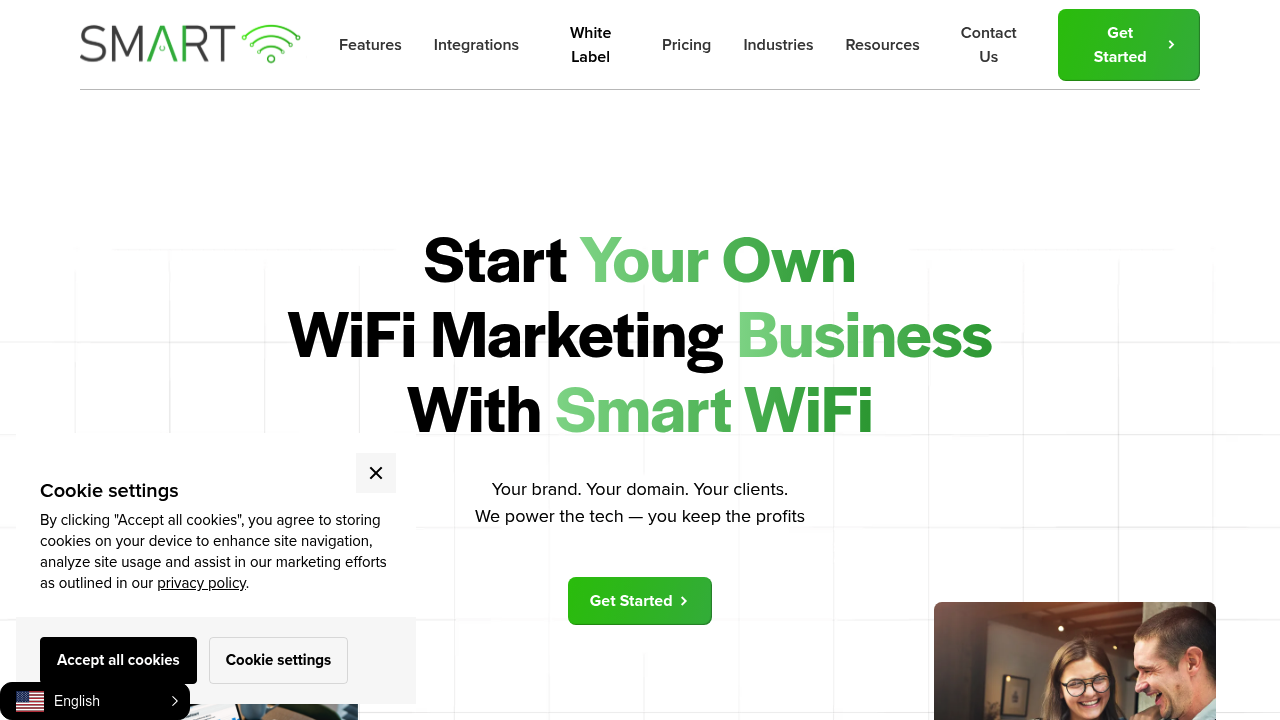
Smart WiFi lets agencies sell guest Wi-Fi marketing under their own brand and domain through its White Label portal.
Each client gets login pages in its own branding from a drag-and-drop editor, either per location or synced across locations, and Smart WiFi stays invisible to the client. You decide the pricing for your clients and keep the profits, and the portal has a monthly fee that includes one location plus a small fee per client.
Best-fit niches: Digital agencies and new ventures reselling guest Wi-Fi marketing to restaurants, cafes, hotels, salons and other local businesses.
White-label capabilities: Your logo, colours and fonts on every login page, branded QR codes and a custom network name. Pre-built workflows cover welcome, win-back, birthday and post-visit campaigns, with segments by visit frequency, location and demographics. Mailchimp, Constant Contact, Google Tag and Facebook Pixel integrations are included, and login pages translate into more than 30 languages. Staff and managers see their own location while admins see everything.
8. Purple
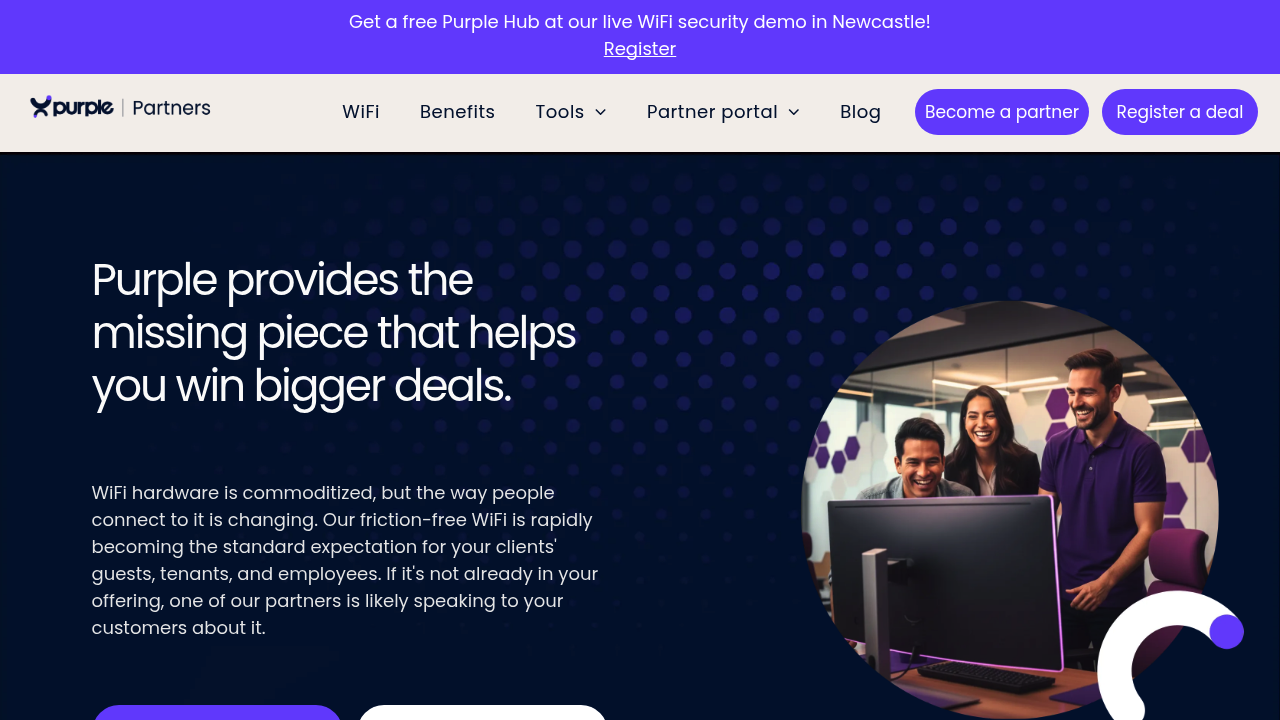
Purple is a guest Wi-Fi and identity-based access platform that partners can sell under their own branding.
A partner portal lets you create and manage customers, each with its own logo, splash pages, access journeys (the steps a guest follows to get online) and permissions. Resellers buy licences at Purple's list price and bill their customers themselves.
Best-fit niches: Resellers, MSPs, ISPs and systems integrators delivering guest Wi-Fi, staff Wi-Fi and multi-tenant Wi-Fi to hospitality, retail, healthcare and venues.
White-label capabilities: The partner, customer and venue levels let you set up a customer by impersonating its account. Splash pages can use templates or your own designs, custom fields and surveys collect information guests volunteer, and Paid Wi-Fi works with PayPal, Windcave, Worldpay or Stripe. Webhooks push visitor data to your CRM on the Engage licence, and the partner dashboard includes deal registration.
9. Social WiFi
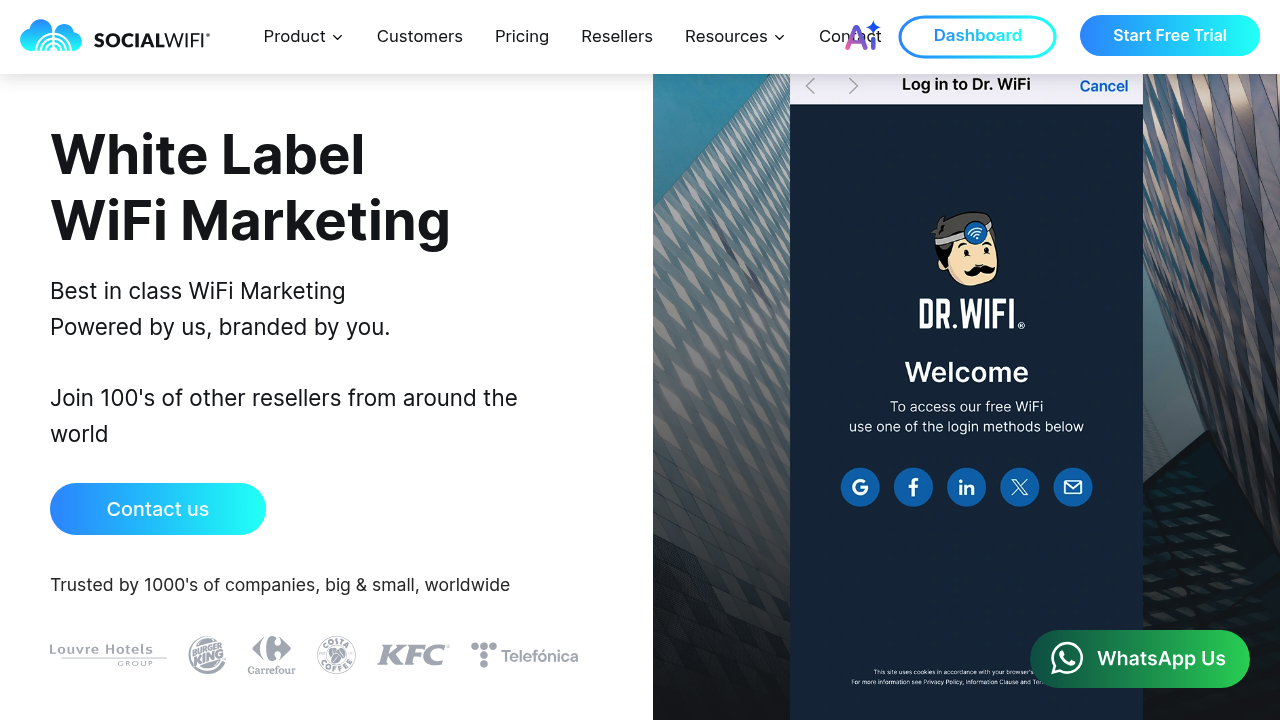
Social WiFi is a guest Wi-Fi marketing platform whose white label option puts your logo and custom domain on the dashboard and the guest captive portals.
Unlimited clients sit under one white label login for a fixed monthly fee, and clients log in on your domain. Marketing emails can be sent from your own domain after you update your domain's DNS settings. Two limits are documented: the dashboard registration and login page cannot show your logo yet, and the Social WiFi Academy is not white labelled.
Best-fit niches: MSPs, ISPs, telecom providers and marketing agencies reselling guest Wi-Fi marketing to hospitality, retail and venue clients.
White-label capabilities: Login page designs per venue, a drag-and-drop email editor, custom consent forms, surveys and automated email and SMS journeys. Settings, portals and automations are set per project and per venue, with roles and permissions across both. Integrations cover HubSpot, Klaviyo, Mailchimp, Brevo, GoHighLevel and Zapier, and webhooks push new subscribers and unsubscribes to your CRM.
10. Aislelabs
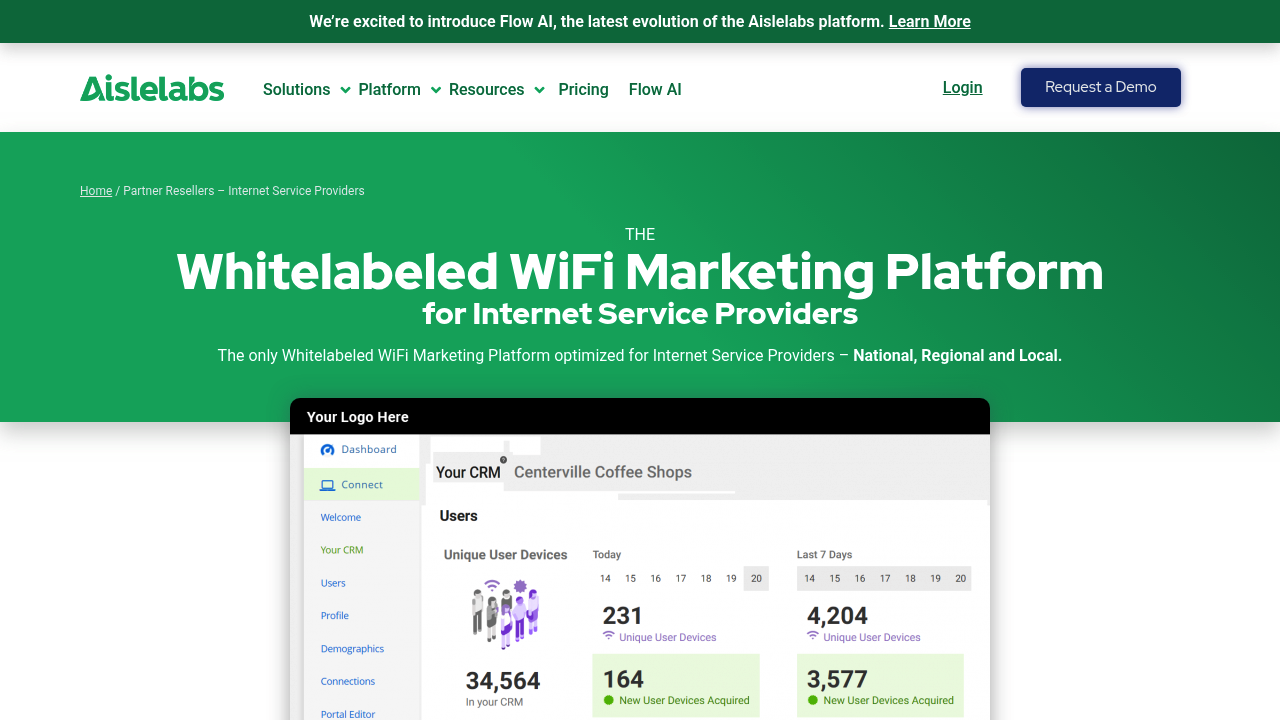
Aislelabs is a Wi-Fi marketing and analytics platform with a reseller programme for ISPs, telecom providers, MSPs and VARs.
Partners put their logo on customer logins, the captive portal and the dashboard, and give each venue a fully branded captive portal. Customer accounts are ordered from Aislelabs, which activates each one and shares credentials for you to hand over, and reseller pricing is agreed with its sales team.
Best-fit niches: Internet service providers, telecom providers, MSPs and VARs reselling guest Wi-Fi, footfall analytics and Wi-Fi marketing to business customers.
White-label capabilities: Visit-triggered email and SMS campaigns from your own sender domain, welcome and loyalty sequences, and win-back messages for lapsed guests. Captive portal forms let you choose fields such as name, date of birth, mobile, email and postcode. Integrations sync lists with CRMs, ERPs, loyalty platforms and email service providers, and the console manages many customer accounts.
11. Beambox
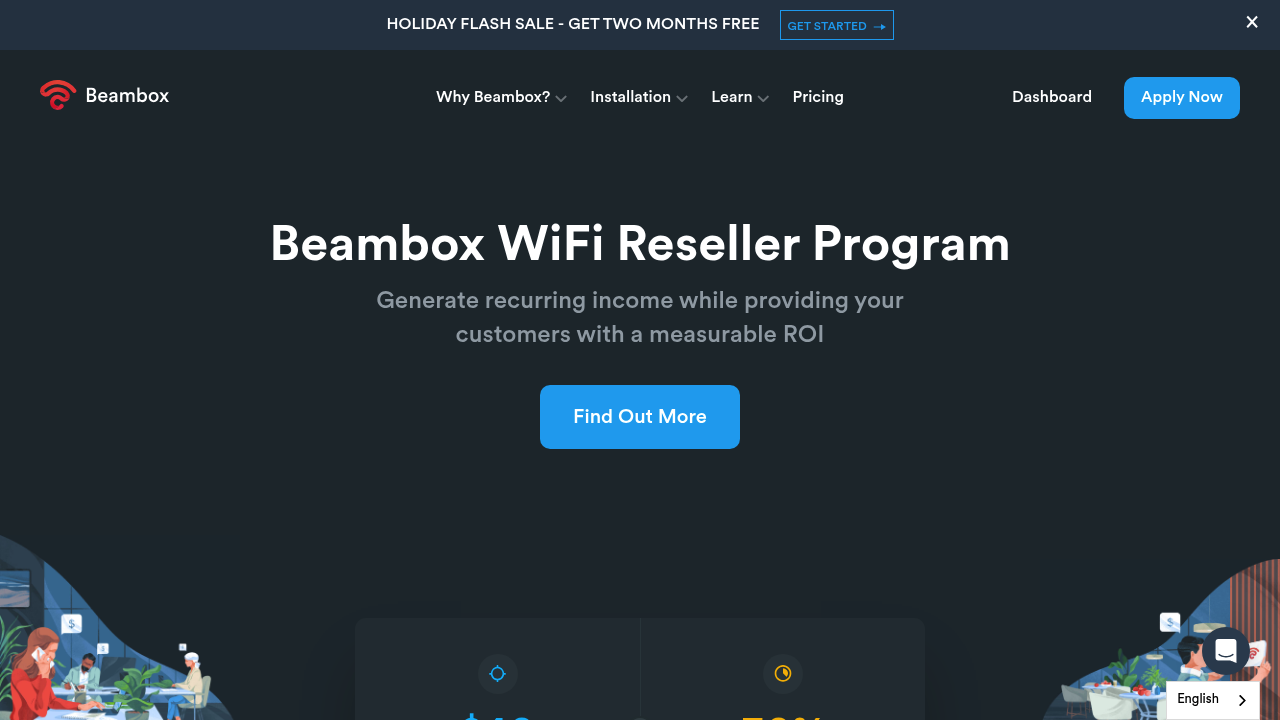
Beambox is a guest Wi-Fi marketing platform that lets agencies and managed service providers (MSPs) run guest Wi-Fi marketing for many venues, with captive portals, guest profiles, email and SMS campaigns, review automation and support for major Wi-Fi hardware brands.
Partners create client venue accounts from a Partner Dashboard, and each venue brands its own Wi-Fi login with its logo, colours and sender email domain. Partners choose which areas clients can see, such as hiding billing, by granting Administration, Finance or Marketing access, and they bill clients themselves outside Beambox. The partner portal also tracks commissions and weekly PayPal payouts, with a branded partner sign-up landing page. Two limits are documented: partners and clients sign in to the Beambox dashboard, which has no rebranding option, and Wi-Fi logins hosted by Beambox show a Beambox Terms of Wi-Fi and Privacy Policy notice.
Best-fit niches: Hospitality and retail venues branding their own guest Wi-Fi, and MSPs and marketing agencies managing venue accounts.
White-label capabilities: Each client runs in its own account with a five-step setup covering Wi-Fi login, branding, locations and notifications. Login pages carry the venue logo, colours, font and background, with three login methods, custom form fields and translations chosen by the guest's browser language. Custom sender addresses on the venue domain are authenticated with DKIM, a check that shows emails really come from that domain. Campaigns use a drag-and-drop canvas with a YES or NO condition card, and built-in connections cover Mailchimp, Zapier, Twilio SMS and Square POS, plus cloud Wi-Fi controllers such as UniFi, Meraki and Omada.
12. Classic Hotspot
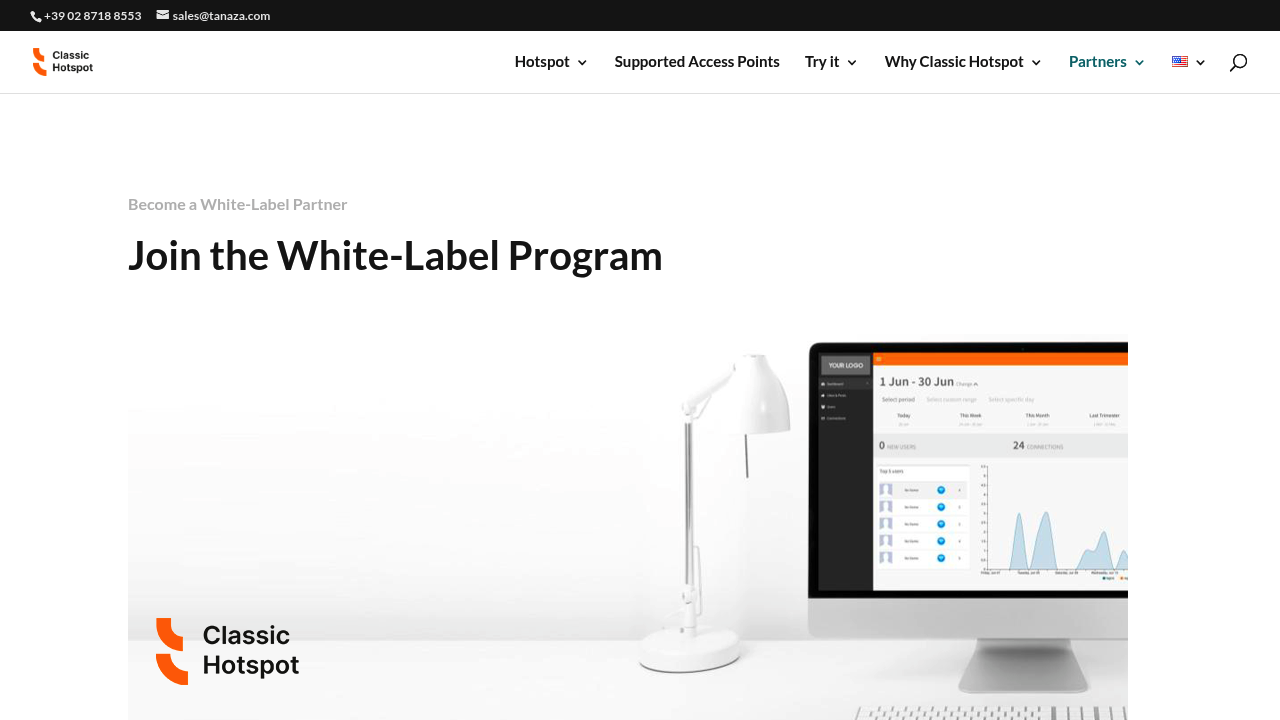
Classic Hotspot is a cloud hotspot application from Tanaza for guest Wi-Fi, social login, paid Wi-Fi vouchers and analytics on Tanaza-managed access points.
Its white label partner programme lets Wi-Fi professionals rebrand the splash pages and analytics dashboard with their own name, logo and URLs, and hide the Classic Hotspot name from customers. Partners can create any number of sub-accounts to manage customer networks, but these are 15 day trials without white label branding.
Best-fit niches: Wi-Fi solution providers, VARs, ISPs, wireless ISPs and system integrators deploying guest Wi-Fi for hospitality, retail, education and public venues.
White-label capabilities: A drag-and-drop splash page editor with your colours, logo and font, sign-in by email, phone or form, and splash pages in more than 60 languages. Multi-level roles cover vouchers, monitoring and statistics.
13. FansWiFi
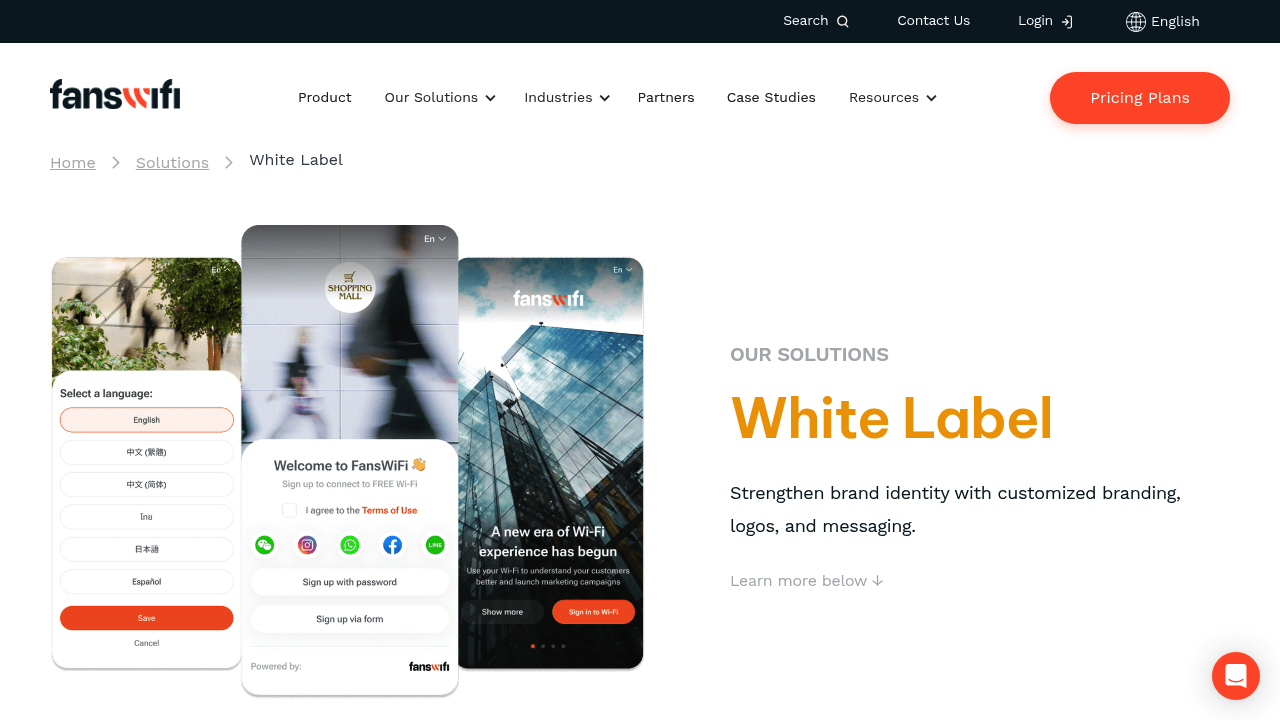
FansWiFi is a social Wi-Fi marketing platform where a venue brands its own guest captive portal.
The venue sets its business name, logo, colours, cover image, business information and terms, then runs social login, surveys, campaigns and loyalty offers from the portal. A partner programme lets telecom providers and hardware resellers resell it, but how a partner would rebrand it is not documented.
Best-fit niches: Venues, retailers, malls, hotels and sports or event operators branding their own guest Wi-Fi, plus telecom providers and Wi-Fi hardware resellers bundling it.
White-label capabilities: Templates you can edit, sign-up by social login, video, password, one-click or a registration form, and campaigns in multiple languages with automatic translation. It integrates with CRM and email marketing tools, works with various hardware brands, and lets you set user accounts and permissions to match your organisation.
Comparison at a Glance
Table 2 shows who bills the venue and the capability that sets each platform apart.
Table 2: Who bills the venue and the standout capability of each of the 13 platforms
| Platform | Who bills the venue | Standout capability |
|---|---|---|
| MyWiFi Networks | You, through Stripe Connect | Branded mobile app on Enterprise and a REST API |
| Wi5Stars | You, using sales tables for invoicing | Reseller, manager and advertiser hierarchy with local payment gateways |
| Cloud4Wi | Arranged with its sales team | SDK, webhooks and connectors for developers |
| GoZone | You, through its operator billing system | Plans and pricing you create and sell; partnerships from $1000 a year |
| Start Hotspot | You set your own prices | Reseller accounts with a configurable commission |
| Antamedia | You set your own customer pricing | Enterprise Wi-Fi for private cloud or on premise |
| Smart WiFi | You set client prices; a monthly fee plus a fee per client | Branded login pages per client and per location |
| Purple | You, after buying licences at list price | Partner portal with deal registration |
| Social WiFi | Fixed monthly fee for unlimited clients | Unlimited clients from one white label login |
| Aislelabs | Reseller pricing agreed with its sales team | Order-and-activate multi-tenant console |
| Beambox | You, outside Beambox | Partner Dashboard with commission tracking |
| Classic Hotspot | Not published | Rebranded splash pages on Tanaza access points |
| FansWiFi | Not published | Venue-branded portal with social login and surveys |
Conclusion
The right platform depends on whether you want to resell, manage clients for an agency or run guest Wi-Fi marketing for your own venues. To send the invoice and set your own prices, start with MyWiFi Networks, which takes client payments through Stripe Connect. GoZone adds plans, billing and invoicing in an operator dashboard. Smart WiFi suits agencies that want branded login pages for each client and prices they set themselves.
For paid and voucher-based Wi-Fi with local payment gateways, look at Wi5Stars. Start Hotspot adds reseller accounts with a configurable commission. Antamedia covers private-cloud and on-premise deployments. Developers building Wi-Fi sign-in into their own product should look at Cloud4Wi, which offers an SDK and webhooks.
Purple gives providers a partner portal with per-customer logos and splash pages. Social WiFi keeps unlimited clients under one branded login. Aislelabs gives each venue its own branded portal through an order-and-activate console. Beambox adds a Partner Dashboard for client venue accounts, though its dashboard cannot be rebranded.
A business that wants to brand its own venues can look at FansWiFi for social login and surveys. Classic Hotspot offers rebranded splash pages on Tanaza access points.
Whichever you choose, confirm the billing model and how the platform records consent before you sign up a venue. You can browse more platforms in the Wi-Fi marketing tools category. If you are new to reselling branded software, read how white labelling works.
FAQs
These answers draw on the platform reviews above.
It is marketing software that runs on a venue's guest Wi-Fi network and that you sell under your own brand. The vendor runs the platform, you apply your logo and domain, set up each venue's captive portal and campaigns, and charge the venue for the service.
Search your town in a directory such as WiFi Map, WiFi SPC or Wi-Fi-FreeSpot, check Yelp and Google Maps for a Wi-Fi label, and cross-check official registers such as the UK food hygiene ratings data. Confirm with each venue that the Wi-Fi is still offered, because entries can be out of date.
In the UK, the ICO says unsolicited marketing emails to individuals normally need consent, given by a positive action such as ticking an unticked box. Rules differ elsewhere, so check local law and choose a platform with editable consent forms, such as Social WiFi or Cloud4Wi.
MyWiFi Networks takes client payments through Stripe Connect, GoZone includes a billing and invoicing system, and Wi5Stars provides sales tables for invoicing. Start Hotspot, Antamedia and Smart WiFi let you set your own client prices, and Beambox partners bill clients outside the platform.
Often, yes. MyWiFi Networks lists Meraki, UniFi, Aruba, MikroTik and Ruckus, Beambox connects to cloud controllers such as UniFi, Meraki and Omada, and Classic Hotspot runs on Tanaza-managed access points. Check the vendor's hardware list for each venue.
For the venue-facing parts, often. MyWiFi Networks has no co-branding or "Powered by" footer, Smart WiFi stays invisible to clients and GoZone puts your logo on the dashboard and splash pages. Check each one, because the Beambox dashboard has no rebranding option and the Social WiFi dashboard login page cannot show your logo yet.
GoZone partnerships start at $1000 a year. Smart WiFi charges a monthly fee that includes one location plus a small fee per client, and Social WiFi charges a fixed monthly fee for unlimited clients. Cloud4Wi and Aislelabs agree pricing with their sales teams.