
Cloud-based video surveillance has become one of the easiest recurring services for a security installer, integrator, ISP or managed service provider to add. Rather than selling a recorder once and walking away, you can connect a customer's security cameras to a hosted platform, charge a monthly fee per camera and keep earning while the cameras stay online.
The catch is that most video surveillance as a service (VSaaS) products are sold under the vendor's own name, which leaves the vendor holding the customer relationship. A white label platform reverses that. Your brand sits on the apps, the web portal and the alert emails, you set the price, and the customer signs up with you.
The market behind this is growing quickly. MarketsandMarkets projects the video surveillance as a service market will grow from USD 5.88 billion in 2026 to USD 12.01 billion by 2032. This guide looks at 12 platforms that let resellers sell cloud video under their own brand, with each programme checked against the vendor's own website.
Why Resellers Add Cloud Video Surveillance
For a business that already installs cameras or supplies connectivity, cloud recording turns a one-off project into a monthly subscription. A traditional video surveillance system records to a box on site, while a cloud service stores video footage off the premises, and customers can watch live video and recorded clips from a phone or browser. That suits commercial surveillance customers with cameras across multiple locations, who want one view of all their sites.
It also opens the door to higher-value add-ons. Many of the platforms below bundle AI-powered analytics such as people counting, licence plate recognition and intrusion detection, which detect events and send an alert, and which can be priced as extra tiers on top of basic recording. For installers, this turns a camera job into a wider set of security solutions sold on subscription.
How a White Label VSaaS Programme Works
The vendor runs the video management software (VMS), either in its own cloud or as software you deploy in yours. You apply your brand to the apps and portal, connect your customers' cameras, and bill those customers at a price you choose. The vendor then charges you, usually per camera, per channel or through a licence fee.
This is different from a traditional reseller arrangement, where you pass the customer to the vendor and collect a commission while the vendor bills them under its own name. Some programmes offer both, letting you either bill customers yourself or have the vendor bill them and pay you a share. Where a platform lets you choose your own billing and branding, it still meets the lowest level of brandability in the Brand domain of the White Label Capability Framework, so it is included here with a note on which option to pick.
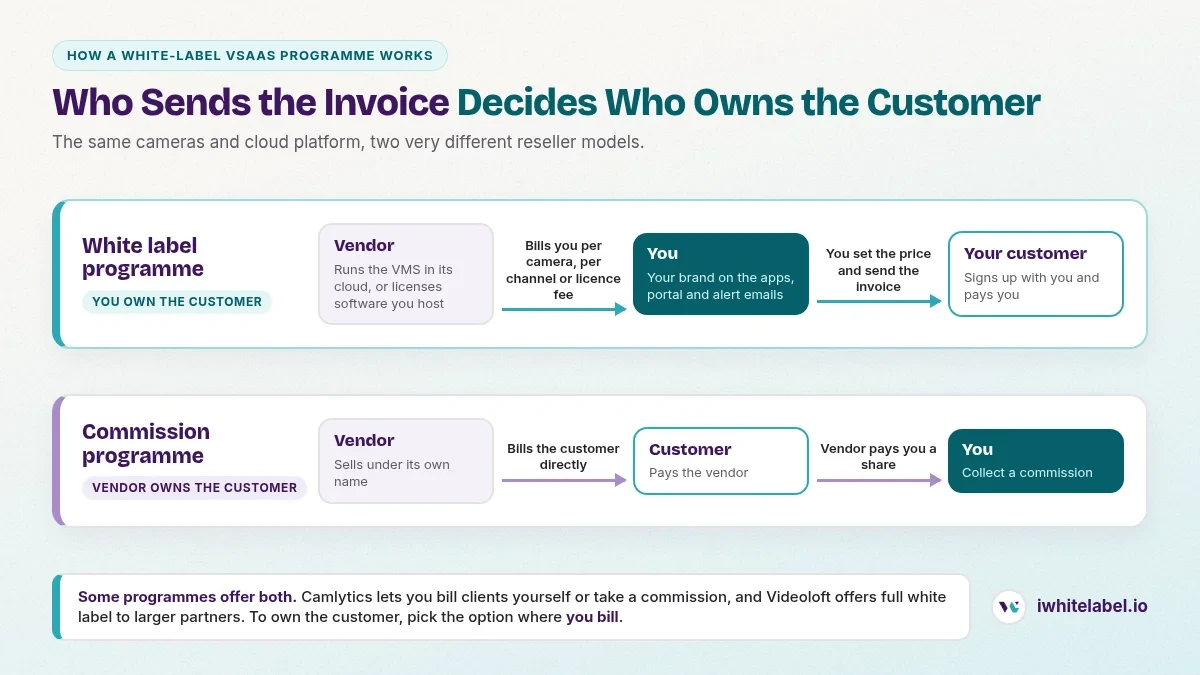
Whoever sends the invoice owns the customer, so where a programme offers both models, pick the one where you bill.
What to Look For Before You Choose a Platform
Before comparing names, decide what matters most for your customers. The four checks below cover how fully the service carries your brand, who invoices the end customer, where the system is hosted and which cameras it supports, because these decide whether you truly own the customer and whether the service fits the surveillance systems you already install.

Four checks that show whether you truly own the customer and whether a platform fits the cameras you already install.
Your Brand on Every Screen
Check whether branding covers the mobile apps, the web portal, the login page, notification emails and the domain. Some vendors brand the web portal only and supply a generic app, while others publish fully branded apps to your own app store accounts.
Who Bills the End Customer
If you want to own the customer, you need to invoice them yourself. Confirm that the customer subscribes with you and that the vendor bills you rather than them.
Hosting and Deployment
Hosted platforms get you selling quickly. Self-hosted licences suit ISPs and telecom operators that want footage to stay in their own data centre and integrate with existing billing systems.
Minimums and Support for Existing Cameras
Look at minimum licence or camera commitments before branding is unlocked, and check that the platform works with the IP cameras and existing cameras your customers already use, so you can sell video monitoring without replacing hardware.
The 12 Platforms Reviewed
The platforms below are the video surveillance listings in the iwhitelabel directory. Each one was checked against the vendor's own website for its white label scope, who bills the end customer, how it is deployed and any published pricing, and the order runs roughly from the deepest branding to the lightest.
1. 3dEYE
3dEYE is a cloud video surveillance platform with AI analytics that connects existing IP cameras without on-site recorders. Its published plans start from $200 a month.
The Complete White Label option is paid for as a one-time setup fee and removes the 3dEYE name from the customer experience. 3dEYE states that the service agreement is between you and your customer, and you set your own markup and invoice each account yourself.
Best-fit niches: security integrators, managed service providers, alarm monitoring companies and telecom operators.
White-label capabilities: You can run the service on your own domain with SSL and a custom login page, publish branded iOS and Android apps through your own app store accounts, and send alert emails under your brand.
2. VXG Cloud VMS
VXG Cloud VMS is a cloud video management system that you deploy in your own cloud or data centre. VXG lists a licence price of $80 per camera, with its managed deployment service offered free of charge.
The platform is built for service providers that want a fully branded product. VXG supplies the web and mobile apps with source code, so you can rebrand and extend them as your own.
Best-fit niches: telecom operators, ISPs, cloud providers and camera manufacturers.
White-label capabilities: It offers white label web and mobile apps, full source code and SDKs for customisation, and deployment inside your own infrastructure.
3. Aipix
Aipix is a video surveillance and analytics platform aimed at telecom operators and ISPs that want to launch cloud video as a value-added service.
Its white label option lets operators deliver their own mobile app, web portal and desktop solution under their brand, with integration into existing BSS and OSS billing systems so subscribers are billed on the operator's own account.
Best-fit niches: telecom operators, ISPs, smart city projects and large integrators.
White-label capabilities: Operators get branded mobile, web and desktop apps, integration with their own billing and OSS systems, and multi-tenant management for large subscriber bases.
4. Camcloud
Camcloud is a hardware-free cloud video surveillance service that connects existing IP cameras to cloud recording and AI detection.
Its partner programme includes a full white label option covering the website, camera integration, the billing interface and your own mobile apps, built on Camcloud's recurring billing platform. Confirm the billing set-up with Camcloud to make sure invoices go out under your name.
Best-fit niches: security installers, ISPs, camera manufacturers and managed service providers.
White-label capabilities: You can brand the customer website and billing interface, release your own mobile apps, and connect through APIs for single sign-on and account provisioning.
5. Acoba
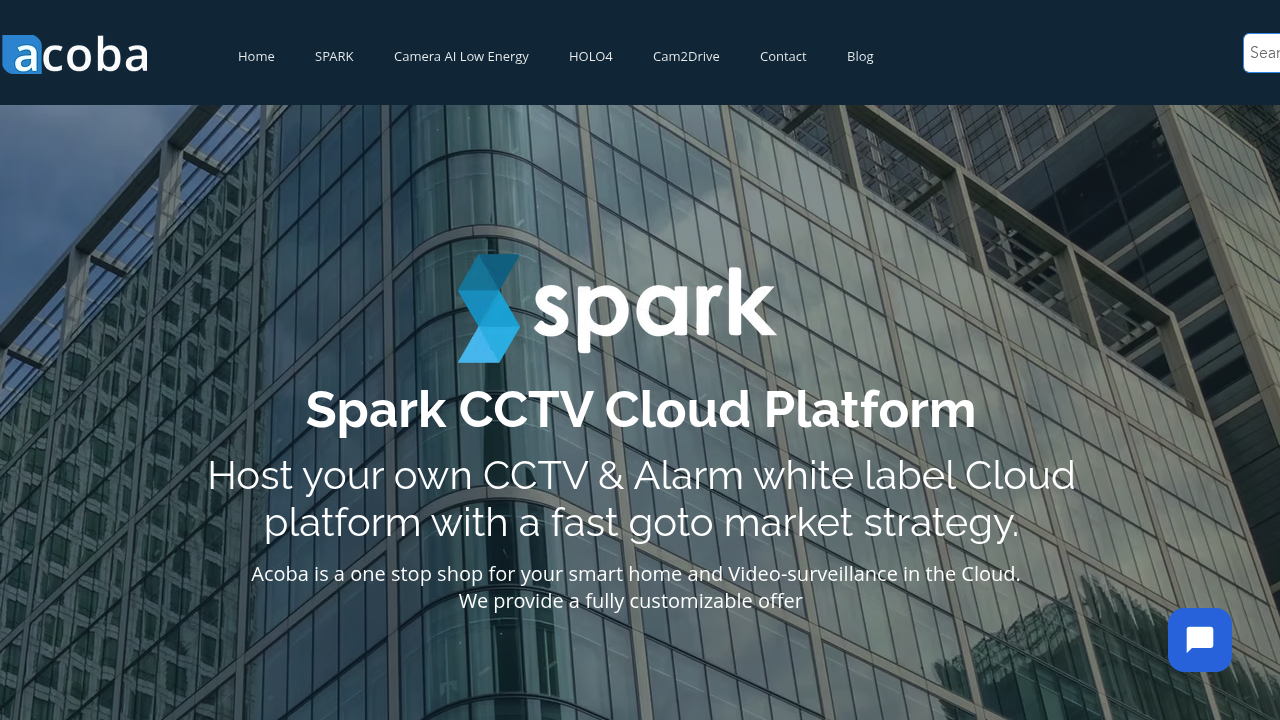
Acoba offers SPARK, a CCTV and smart home cloud platform that it can host for you or that you can host in your own data centre on AWS, VMware or OpenStack.
The SPARK-PRO Master License is designed for monitoring stations, ISPs, telecom companies and manufacturers that want to sell a complete cloud CCTV service. It includes a back office, a billing platform and mobile and web apps, and the PRO tier adds customisation of the app and portal to fit your brand.
Best-fit niches: alarm monitoring stations, ISPs, telecom operators and CCTV manufacturers.
White-label capabilities: The PRO tier gives you a branded mobile app and web portal, a built-in billing platform and back office, and the choice of hosting the whole service yourself.
6. Focoten

Focoten provides an end-to-end AI video surveillance as a service programme that it says can be launched under your brand within three months.
Unusually, the package goes beyond software to include white label cameras alongside the cloud platform, apps and AI models, together with operations and billing integration with your ERP.
Best-fit niches: telecom operators, ISPs and large security providers wanting a complete branded service.
White-label capabilities: It supplies white label camera hardware, branded web and mobile apps, and an operations platform with billing and ERP integration.
7. Camlytics

Camlytics is video analytics software for people counting, occupancy, heatmaps and retail insights, available as desktop software and as a cloud service.
White label is free once you commit to a minimum of seven licences or seven channels on an annual plan. Camlytics offers two billing models: you can collect payments from your clients and be billed the total, or let Camlytics bill your clients and pay you a commission. To own the customer, choose the first.
Best-fit niches: retail analytics consultants, security integrators and IT resellers serving shops and venues.
White-label capabilities: You get a branded installer and web portal, a custom subdomain at no extra cost, and full control over the prices you charge.
8. IPCamLive
IPCamLive streams IP camera footage to websites, which suits webcams for tourism, construction sites and live venue feeds as well as basic cloud recording.
It runs separate affiliate and white label programmes, so pick the white label one. That programme presents the platform as fully white label, with IPCamLive staying invisible to your clients, who remain your customers.
Best-fit niches: web agencies, webcam installers, tourism and construction site monitoring.
White-label capabilities: It offers a fully unbranded streaming platform, discounted reseller pricing, and embeddable players for your customers' websites.
9. Otter Video
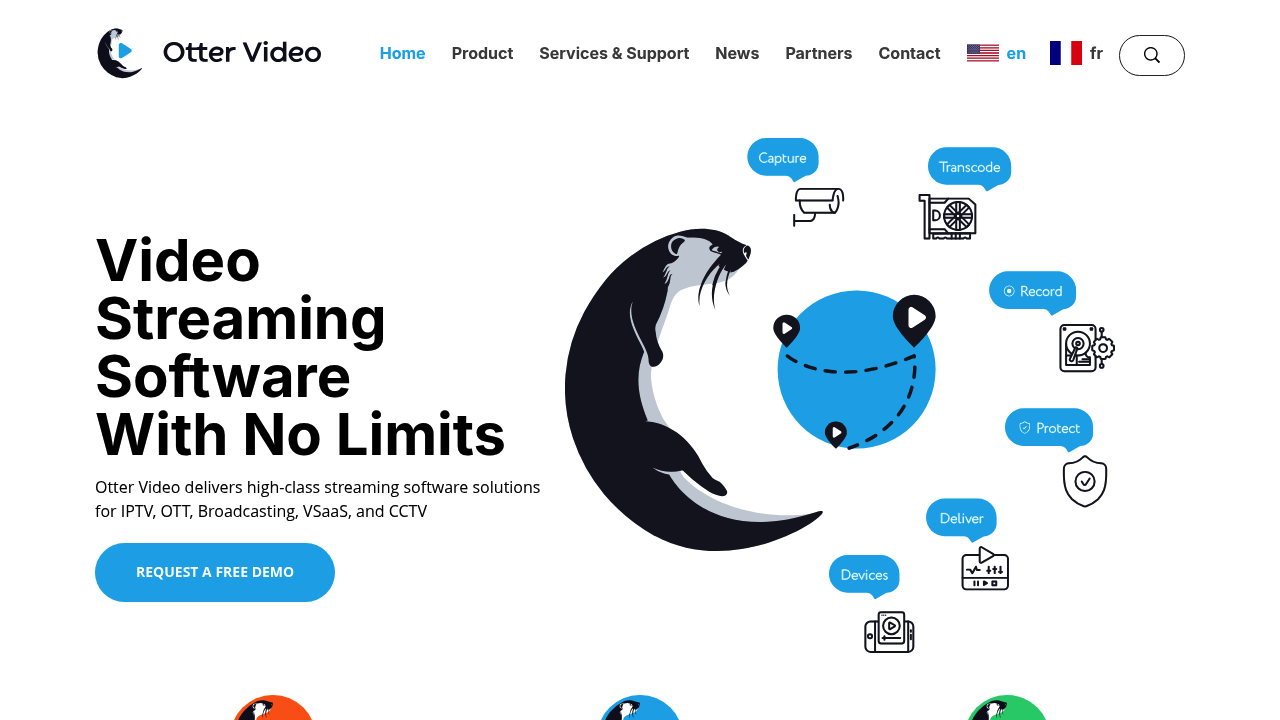
Otter Video provides Otter Watcher, software for running your own cloud video service either on your own servers or in the cloud, with up to 800 cameras per server.
Branding is included in the Cluster plans, which start from 100 cameras. Billing integration lets you charge subscribers through your own systems.
Best-fit niches: ISPs, hosting companies and security providers running their own infrastructure.
White-label capabilities: Cluster plans give you your own branded service, on-premise or cloud deployment, and integration with your billing system.
10. VSaaS
VSaaS is an AI video analytics platform with offices in Chile and Mexico, used for smart city, retail and security projects and deployable at the edge, on premise or in the cloud.
The company runs a partner programme and a dedicated programme for ISPs and telecom operators. Ask the partner team which elements you can brand, such as the apps, domain and billing.
Best-fit niches: ISPs, telecom operators and smart city integrators in Latin America.
White-label capabilities: Partners can deploy the platform in their own data centre, offer a broad library of AI analytics, and sell through the ISP programme.
11. Compelling Software
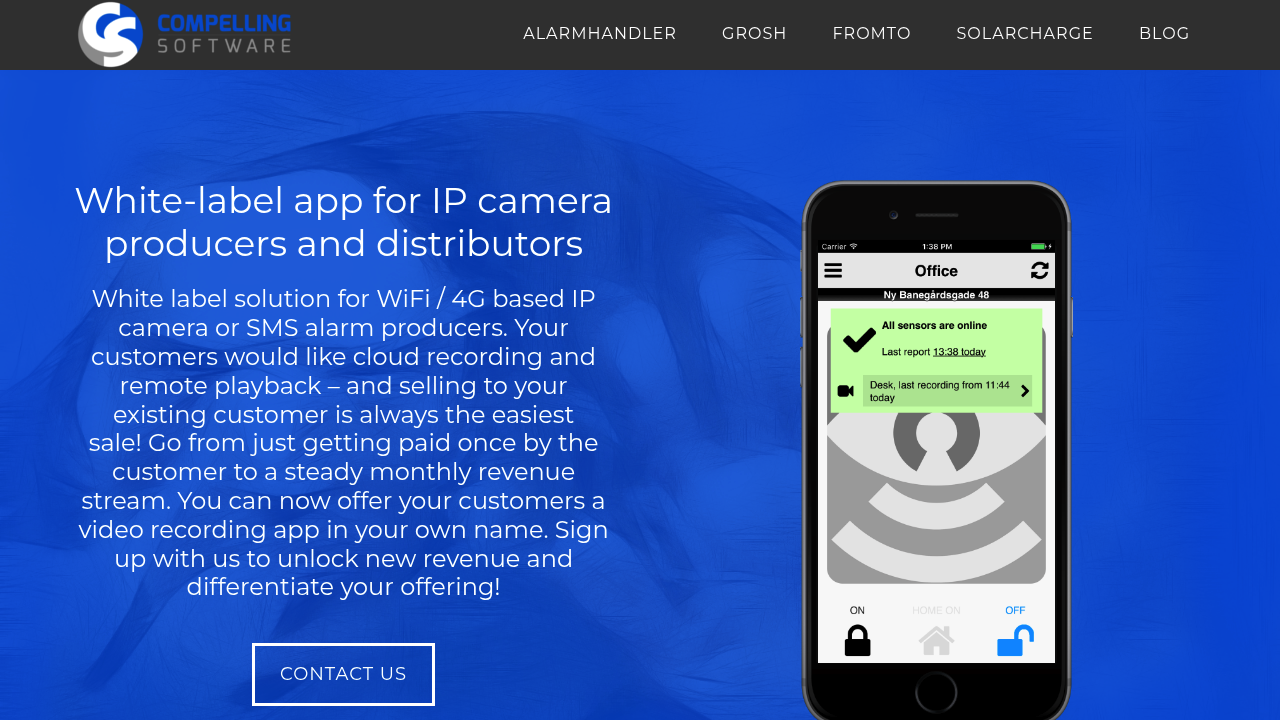
Compelling Software, based in Denmark, builds a white label app for producers of IP cameras and SMS alarm systems, based on its own AlarmHandler technology.
The app runs on iOS and Android with cloud recording and remote playback, and it is released under the producer's brand, making it a good fit for hardware brands rather than service resellers.
Best-fit niches: IP camera manufacturers, alarm system producers and hardware distributors.
White-label capabilities: It provides branded iOS and Android apps, cloud recording with remote playback, and alarm notifications for your own devices.
12. Videoloft
Videoloft connects existing CCTV cameras and recorders to the cloud through its Cloud Adapter, with cloud plans starting from $4.99 a month.
Its standard partner programme offers trade pricing, and Videoloft can handle recurring payments and pay you a commission at each renewal, which is closer to a traditional reseller model. A full white label solution is available subject to volume and business requirements, so ask for that option if you want to bill customers yourself.
Best-fit niches: CCTV installers and security companies with an existing camera base.
White-label capabilities: It offers your logo in the partner app, trade pricing for installers, and a full white label service for larger partners.
Side-by-Side Comparison
The table brings the reviews together so you can see at a glance where each platform runs, who sends the invoice and the one capability that sets it apart. The billing column matters most if you want to own the customer.
| Platform | Deployment | Who bills the end customer | Standout capability |
|---|---|---|---|
| 3dEYE | Hosted cloud | You | Branded apps in your own app stores |
| VXG Cloud VMS | Your cloud or data centre | You | App source code included |
| Aipix | On premise or hybrid | You, through your BSS | Telecom billing integration |
| Camcloud | Hosted cloud | Confirm with vendor | Branded billing interface |
| Acoba | Vendor or self hosted | You | Built-in billing platform |
| Focoten | Hosted or operator cloud | You | White label cameras |
| Camlytics | Desktop and cloud | You or vendor (your choice) | Retail analytics |
| IPCamLive | Hosted cloud | You | Website live streaming |
| Otter Video | On premise or cloud | You | 800 cameras per server |
| VSaaS | Edge, on premise or cloud | Confirm with vendor | AI analytics library |
| Compelling Software | Hosted cloud | You | Apps for hardware brands |
| Videoloft | Hosted cloud | Vendor, or you on full white label | Cloud Adapter for existing cameras |
Conclusion
The right platform depends on how much of the service you want to run yourself. For a hosted service with your brand on every screen and your name on the invoice, 3dEYE covers the widest set of branding options among the hosted platforms here. ISPs and telecom operators wanting full control in their own infrastructure should look at VXG Cloud VMS, which ships app source code. Aipix is the alternative for operators that need BSS and OSS billing integration. Monitoring stations can look at Acoba. Installers adding cloud recording to existing cameras may prefer Camcloud. For analytics and live streaming, Camlytics covers retail insight. IPCamLive handles website camera feeds. Self-hosting operators with large camera counts can consider Otter Video. AI analytics projects in Latin America may suit VSaaS. Camera and alarm manufacturers should also consider Compelling Software. Operators wanting a complete branded service including cameras can look at Focoten. CCTV installers with a large camera base can ask Videoloft about its full white label service.
Whichever you choose, confirm the billing model before you sign up, because owning the invoice is what makes the customer yours. You can browse more platforms in the video surveillance solutions category. If you are new to reselling branded software, read how white labelling works.
FAQs
These answers draw on the platform reviews above.
It is video surveillance as a service (VSaaS) that you sell under your own brand. The vendor runs the cloud-based platform or licenses software you host, you put your brand on the apps and portal, connect your customers' cameras and bill them at a price you choose.
It turns one-off camera installs into a monthly fee per camera, keeps the customer relationship with you rather than the vendor, and lets you add AI analytics as higher-priced tiers.
Check how fully the apps, portal, domain and emails carry your brand, confirm that you rather than the vendor bill the end customer, decide between hosted and self-hosted deployment, and look at minimum camera or licence commitments.
Often, yes. Camcloud and 3dEYE connect existing IP cameras without on-site recorders, and Videoloft's Cloud Adapter links existing CCTV cameras and recorders to the cloud.
Self-hosted options are built for scale: Otter Video supports up to 800 cameras per server, and Aipix offers multi-tenant management for large subscriber bases. Hosted platforms such as 3dEYE let you add sites without running your own servers.
AI-powered analytics detect events such as intrusions, count people or read licence plates, and send alerts automatically. Camlytics focuses on retail analytics such as counting, occupancy and heatmaps, while VSaaS offers a broad library of AI analytics.
Published starting points vary widely. 3dEYE plans start from $200 a month with a one-time setup fee for complete white label, VXG lists a licence of $80 per camera, and Camlytics and Otter Video set minimums before branding is included, so ask each vendor for a quote.
Not always. Hosted platforms such as 3dEYE and Camcloud run the infrastructure for you, while licences from VXG, Otter Video and Acoba suit providers that want to host the service themselves.
In a white label programme you own the customer and send the invoice. In a commission programme the vendor bills the customer under its own name and pays you a share of the revenue.