Key takeaways
Businesses can sell mobile data under their own brand without owning a network. The 25 white label eSIM providers below serve phone retailers, banking and travel apps, tour operators, creators, loyalty programmes, connectivity sellers and IoT businesses. Some supply a finished shop; others supply app features or an API for software the buyer builds.
Travel is one example of the opportunity: PW Consulting forecasts travel eSIM revenue of about US$1.9 billion in 2026, rising to US$6 billion by 2032. Profit per sale is small at the supplier’s catalogue price; as Table 3 shows, it comes from charging more than that price and from selling larger plans.
Selling where customers already know the business or are planning a trip helps. Tour operators, travel agents, hotels, airport shops and employers with travelling staff already sell this way.
Many buyers need help with the basics. In a 2025 YouGov survey for BICS of 6,625 adults in the US, UK and China, 33% knew what an eSIM was and 42% were unsure whether their phone had one. A device check before payment and help with installation are part of the reseller’s job.
Resellers supplying IoT devices such as trackers and sensors also need written confirmation of which eSIM standard each device supports and which network certifications it holds.
How a White Label eSIM Business Works
An eSIM is a built-in alternative to a removable SIM card. On a compatible device, customers can download a mobile plan instead of inserting a new card.
A white label eSIM platform supplies mobile plans and software for selling them under your business name. That software may be a ready-made shop, features added to an existing app or an API connecting your software to the provider.
For a phone shop selling through MegaEsim, the customer pays the shop through its own payment processor, and the shop buys the plan from a prepaid supplier wallet. Its reseller page says the shop pays for each eSIM ordered, rather than being charged separately for every megabyte the customer later uses. The supplier earns money within its selling price; the shop earns the difference between that price and the amount it charges the customer. That difference is not take-home profit: payment fees, customer support, marketing and any shop subscription still have to be paid. Its reseller terms also say that customer chargebacks do not reverse wholesale purchases, and upstream penalties or repricing caused by customer traffic can be passed on to the shop.
With eSIM Access, a fixed-data bundle gives the customer one allowance to use during the plan’s stated period. Its plan guide says data stops when that allowance runs out, whereas its unlimited-daily plans continue at reduced speed after the day’s high-speed allowance is used. The plan can also end when its time runs out, even if data remains. A paid top-up on an eligible fixed plan adds data and days; on an unlimited-daily plan it adds days, not a larger daily high-speed allowance. The top-up instructions explain that buying the top-up deducts its price from the reseller’s balance. Automatically adding money to the supplier wallet is a separate action from buying more data for a customer.
Usage-based services work differently. DROAM supports PAYGO, where data use is charged per megabyte against a company wallet, as well as monthly bundles that can carry overage charges. Its billing documentation describes these as different products, with different refill and recurring-charge settings. A monthly bundle with an overage rate can therefore keep adding charges after its included data runs out.
Businesses Served by White Label eSIM Providers
The business using the platform and the person buying mobile data have different roles. A phone retailer uses a branded shop to sell plans to phone users. A banking app can include a shop for buying mobile data plans within the app its customers already use.
Table 1 shows the businesses supported by the white label eSIM providers below, the customers those businesses serve and the products available to them.
Table 1: Supported businesses, their customers and the available offering
| Business using the platform → customers served | What the provider offers |
|---|---|
| Phone retailers → individual phone users | eSIMfly supplies a branded shop, tools for managing customers and orders and control over retail prices for phone retailers and telecom resellers. |
| Banks and finance apps → app users | Zendit supplies an embedded storefront for banks and wallets, while the business keeps its own payment account. Boxo supplies finance apps with an eSIM miniapp using the host app’s login and payments. Firsty supplies an API and an embeddable web app that banks and crypto wallets use to offer data under their own brand. |
| Airlines and booking platforms → passengers and travellers | Hubby eSIM lets travel businesses give customers mobile data or sell it as an extra, with booking-system integration and branded customer emails. |
| Tour operators and travel agencies → holiday customers | Hubby eSIM supplies a branded traveller app or pages displayed inside the partner’s app, with per-booking package settings and separate branding for sub-brands. |
| Creators → followers and readers | SimBlox supplies branded storefronts and embedded store/widget options, with branded delivery emails and the partner’s own Stripe connection. |
| Loyalty programmes → members | Zendit supplies an embedded data-plan storefront with the programme’s branding, catalogue and retail prices. |
| Connectivity providers → business customers | Telna supplies branded management tools, company/sub-company accounts and tools for reselling mobile data services. |
Travel is where many people use the technology. GSMA Intelligence’s 2025 consumer research found that 50% of consumers were aware of eSIM and that 51% of eSIM users had used an eSIM service while travelling abroad for leisure or personal reasons in the previous 12 months. Price is part of the appeal: Juniper Research estimated that in 2024 mobile subscribers would pay an average of $8.57 per GB when roaming, compared with $5.50 per GB for travel eSIM users, a saving of about 35%.
Familiar brands also start with an advantage. In Kaleido Intelligence research published in 2026, 89% of travellers said they would choose their mobile operator for a travel eSIM, compared with 60% for standalone eSIM providers. The finding concerns mobile operators rather than every brand, but it shows that buyers weigh an existing relationship when deciding where to buy.
White label eSIM resellers can use the same advantage by selling where customers already know the business or are already preparing to travel:
Tour operators, travel agents and loyalty programmes can add data to a booking. Hubby eSIM supplies all three. Its tour-operator customer Sunweb includes 1GB of free mobile data with selected holiday packages, delivered through an app carrying Sunweb’s brand. Its partnership with Paxconnect lets more than 6,200 travel agencies in Germany, Austria and Switzerland offer the service under their own brand. Flight Centre Travel Group gives members of the paid Member Plus tier of its World360 Rewards programme a complimentary eSIM from the same supplier.
Package holidays can include a set amount of data. ConnectedYou supplies Jet Tours, whose customers each receive an eSIM with 2GB of data that activates on arrival. The partnership was formalised in March 2026.
Hotels can sell at the property. At Corendon Hotels & Resorts in Amsterdam and Curaçao, guests buy data packages through QR codes in the lobby, lifts and reception.
Shops serve travellers in person. Roam Communication runs a partner programme for airport telecom shops, mobile shops and travel agents. Its partner page describes airport shops supplying eSIMs to passengers as they land.
Companies with travelling staff are a business-to-business market. The same partner programme covers corporate travel managers and shipping companies equipping seafaring crews. NTT Limited Japan reported savings of 66% by 2024 after replacing rented Wi-Fi routers with business eSIMs for employees travelling abroad.
Creators and affiliates can refer buyers without running a shop. eSIMfly pays affiliates 10% to 20%, rising as their sales grow. Tourist eSIM pays up to 20%. BNESIM pays from 10% to 30% depending on monthly order volume. MegaEsim pays a flat 10%. A reseller paying commission from its own margin needs to price above the supplier’s catalogue: at the 15% discount in Table 3 below, a 10% commission on a $10 plan is $1.00, more than the $0.91 profit per sale on a $10 plan sold at catalogue price.
Show compatibility guidance before checkout. In the BICS survey above, 42% of people were unsure whether their phone had an eSIM.
25 White Label eSIM Providers and Their Supported Buyers
These providers supply different products. A ready-made shop includes customer-facing pages. An API connects software built by the buyer to the supplier’s systems. A software development kit, or SDK, supplies code or components for adding functions such as an eSIM store to an existing app.
The Internet of Things, or IoT, includes devices such as trackers and sensors that send information over mobile networks. Telna supplies mobile data services for travel businesses and IoT providers, with tools for managing company and sub-company accounts. XIPO Connect provides a branded portal for SIM management and top-ups to connectivity sellers, including IoT and machine-to-machine providers.
Table 2 shows the businesses each provider serves, the software it supplies and the branding, account and payment controls included in its offering. The numbered profiles below describe each product separately.
Table 2: Providers, businesses served, supplied software and controls
| Provider | Businesses served | Software supplied | Branding and operating controls |
|---|---|---|---|
| Mobilise | Brands and agencies launching a consumer eSIM app. | Branded iOS and Android app with customer account management. | App fonts, colours and copy; in-app payments, client billing and multiple client accounts. |
| DROAM | Resellers and agencies operating an eSIM shop under their business name. | Branded shop and reseller-management platform. | Own domain and login, pricing and payment integration; separate client accounts. |
| eSIM Access | Travel brands and resellers serving customers through a shop or app. | Shopify or Stripe shop options, API integration and optional commissioned apps. | Branded shop and delivery emails; pricing controls and payment integration; optional apps under partner store accounts. |
| 1GLOBAL | Brands and agencies adding eSIM plans to an app. | Telecom API for an existing app or a Zappter-built app. | Configurable plans and prices; branded app experience and network name on the device. |
| Keepgo | Travel brands and agencies operating an own-domain store. | The esimba.ai webstore with plan catalogue and customer accounts. | Own logo, colours, domain and login; pricing controls and payment integration. |
| Ye-Sim | Brands and resellers selling plans through their own site or app. | Partner API for website, app and WordPress integration. | Partner-branded offer and partner-set retail prices. |
| Monty eSIM | Travel brands and resellers also working with sub-partners. | Branded web/mobile store, API and reseller portal. | Package pricing and billing configuration; onboarding of sub-partners. |
| Roambit | Travel agencies, online shops and software platforms. | Branded storefront, API and shop product feeds. | Partner-set retail prices; Gold/Platinum branding, own domain and branded emails. |
| Bitcall | IT providers, agencies, telecom consultants and travel companies. | Hosted client portal for voice and travel eSIM services; Elite API. | Own domain and payment accounts; unlimited client sub-accounts; branded invoices/reports on Professional and Elite. |
| MegaEsim | Travel agencies, tour operators and telecom shops. | Hosted store, optional native apps and Partner API. | Own retail prices and card processor; apps under partner developer accounts; QR delivery into custom checkout. |
| Limitflex | Travel businesses, telecom resellers, retailers and creators. | Managed branded store, reseller portal and API/SDK tools. | Wholesale-to-retail pricing and commission controls; multi-layer reseller/affiliate management. |
| eSIMfly | Travel and booking businesses, phone retailers and telecom resellers. | Branded shop, native apps, owner dashboard and Business API. | Retail pricing and team roles; own Stripe/local gateway; apps under partner developer accounts. |
| Hubby eSIM | Tour operators, agencies, airlines, booking businesses and hotels. | Branded traveller app or embedded app screens, plus a booking-system API. | Branded emails and separate sub-brand settings; gifting or upselling; per-booking package configuration. |
| BNESIM | Telecom resellers, travel agencies, retailers and digital-service providers. | Branded connectivity service, distributor dashboard and API Partner model. | Custom design and resale pricing; branded mobile experience; API integration. |
| Roam Communication | Travel agents, airport/mobile shops and corporate travel managers. | Branded store, partner portal and API access after onboarding. | Own domain, visual branding, end-user prices and promotion/customer management. |
| Boxo | Travel, finance, lifestyle and residential app operators. | eSIM miniapp inside an existing app, integrated through its SDK and APIs. | Host-app branding, login and payments; package/order management and usage events. |
| XIPO Connect | Connectivity resellers and travel or IoT and machine-to-machine providers in Europe. | Branded portal for physical SIM and eSIM management and top-ups. | Own logo, house style, URL and retail prices; partner runs customer service. |
| Telna | Connectivity providers, mobile operators, travel brands and IoT integrators. | Branded apps/webstores, connectivity API and management tools. | Company/sub-company accounts, pricing controls and billing tools. |
| SimBlox | Travel brands, telecom resellers, creators, fintechs and software platforms. | Branded store and mobile apps, with app build/submission handled by the provider; SDK/API integration and a reseller/agent portal. | Own domain, branded emails and Stripe account; partner-owned app accounts; separate reseller/agent access. |
| Tourist eSIM | Travel agencies, online travel platforms, airlines and travel creators. | Hosted store and Partner API with PHP, Node.js and Python SDKs. | Own domain, emails, Stripe/PayPal and retail prices; customer-facing delivery under the partner brand. |
| Zendit | Banks, wallets, booking platforms, marketplaces and loyalty programmes. | Configurable storefront embedded in a website or app. | Logo, colours, fonts, catalogue and retail prices; partner retains merchant account. |
| ZIM Connections | Travel brands, banks/fintechs, transport businesses and loyalty programmes. | Hosted store, native apps and API; native SDKs on request. | Retail prices and promotions; subscriptions/top-ups through API; order, usage and margin dashboard. |
| ConnectedYou | Large travel businesses and airlines with potential for at least 10,000 monthly orders. | Managed branded store with top-ups and sales analytics. | Own domain, logo and colours; retail-price controls and language/currency options. |
| eSIM.tech | Travel/telecom businesses and technical teams building their own service. | API supplying installation details and activation/usage notifications, not a finished shop. | Buyer-built interface and checkout; retail packages/prices; notifications for activation, usage thresholds and low balances. |
| Firsty | Travel apps, banks and crypto wallets adding branded data to their own product. | eSIM API with a test environment, or an embeddable hosted web app. | Own brand and pricing; support answered in the partner’s brand; eSIM and usage webhooks. |
1. Mobilise
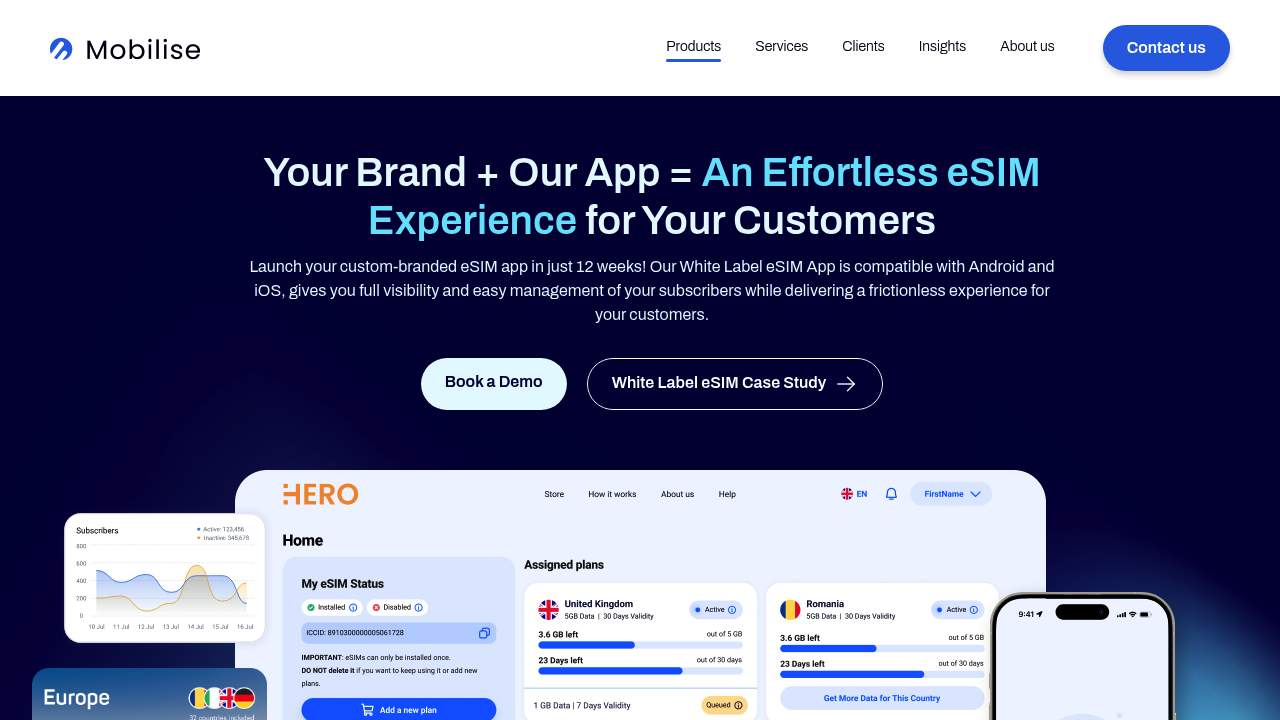
Mobilise is an eSIM app platform for launching a branded iOS and Android service. Customers can manage their account and pay inside the app, while the platform supports multiple client accounts.
Best-fit niches: Brands and agencies launching a consumer eSIM app.
White label capabilities: App fonts, colours and copy; provider branding removal; payment integration and client billing.
2. DROAM
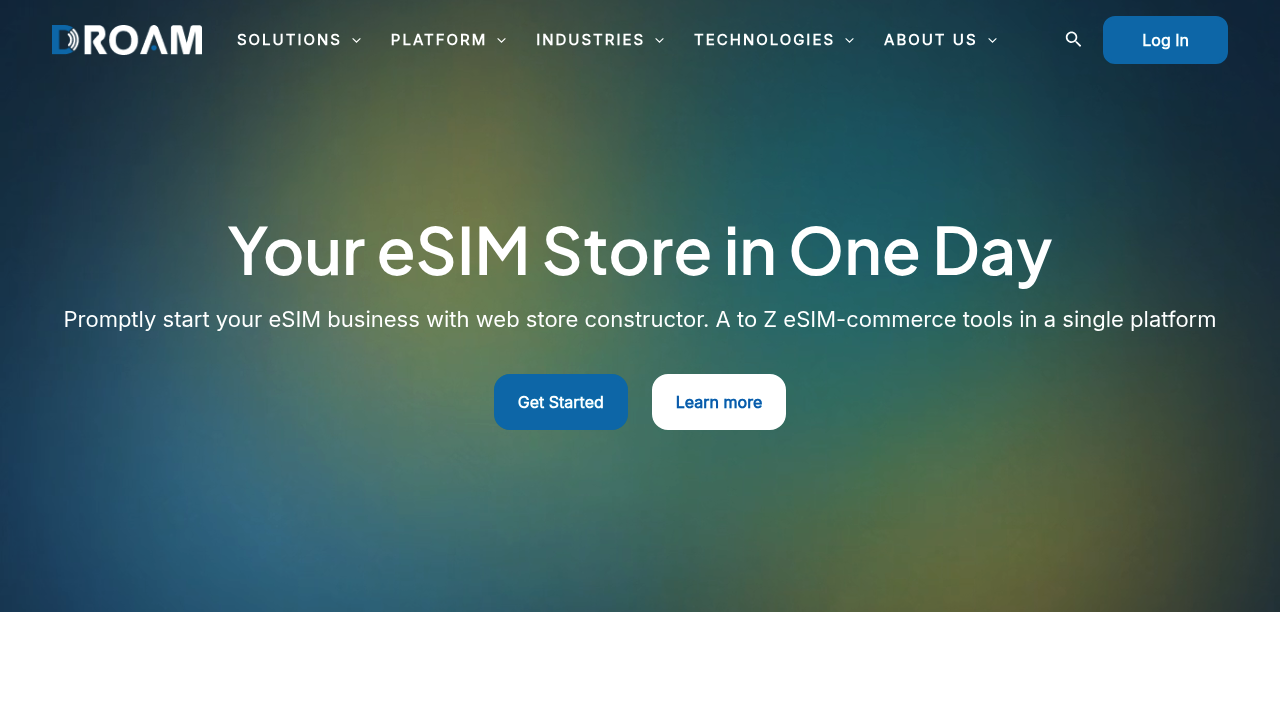
DROAM is an eSIM store and reseller platform. Partners sell plans from their own catalogue through a branded shop, with separate customer accounts and tools for managing other resellers.
Best-fit niches: Resellers and agencies running an eSIM store.
White label capabilities: Your domain, logo, colours and login; payment integration, webhooks and multi-tenant reseller management.
3. eSIM Access
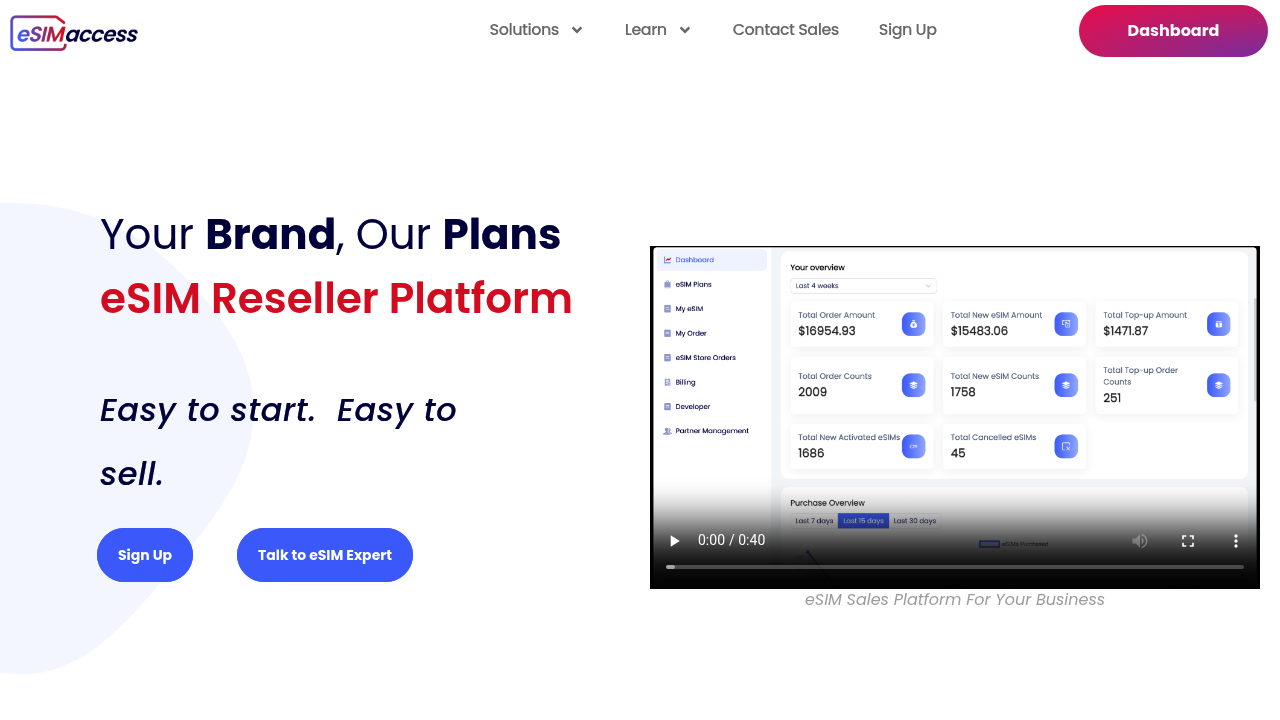
eSIM Access is a platform for reselling travel data plans through an API or shops using Shopify or Stripe. It supports a branded shop and delivery emails, and partners can commission an iOS and Android app published under their own store account.
Best-fit niches: Travel brands and resellers selling data through a shop or app.
White label capabilities: Shop branding, delivery emails and optional branded mobile apps; pricing controls and payment integration.
4. 1GLOBAL
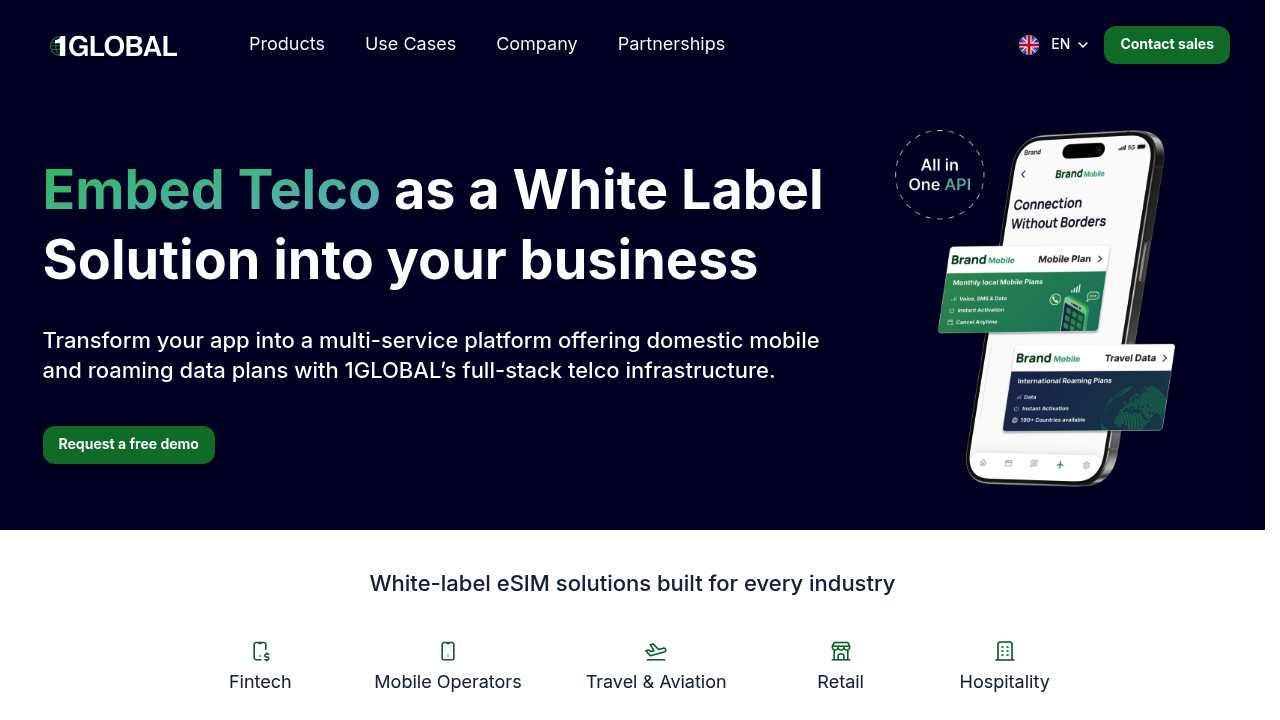
1GLOBAL provides embedded telecom services for brands adding eSIM plans to an app. Partners can use their own app or a Zappter-built app, with 1GLOBAL supplying the underlying telecom service.
Best-fit niches: Brands and agencies embedding connectivity in an app.
White label capabilities: A branded app experience and network name on the device, with configurable plans and prices.
5. Keepgo
Keepgo offers the esimba.ai eSIM webstore. Partners sell a catalogue of plans from a shop on their own domain, with customer login accounts and payment integration.
Best-fit niches: Travel brands and agencies running an own-domain store.
White label capabilities: Your logo, colours, domain and login; provider branding removal, pricing controls and client accounts.
6. Ye-Sim
Ye-Sim supplies a wholesale Partner API for selling plans through websites, apps and WordPress stores. Partners control retail prices and present the offer under their own brand.
Best-fit niches: Brands and resellers selling through their own site or app.
White label capabilities: Partner-branded selling through the API, with control over retail prices.
7. Monty eSIM
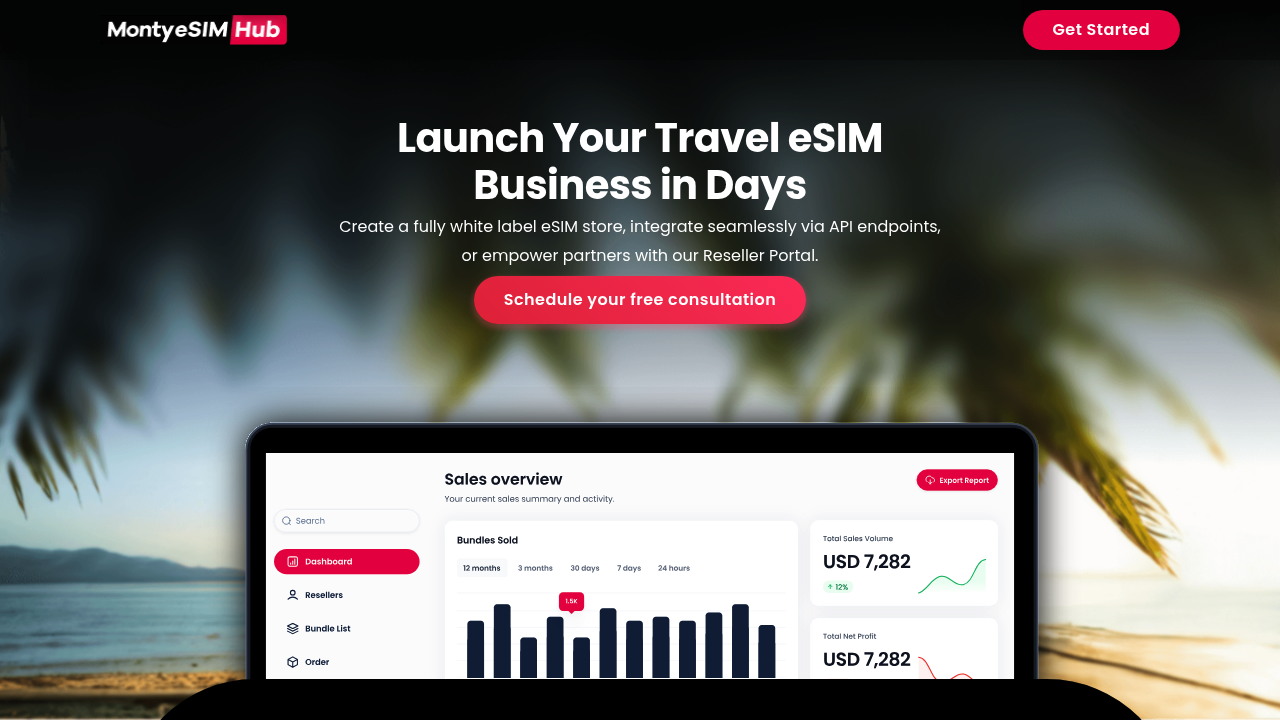
Monty eSIM is a travel eSIM platform with a branded web and mobile store, API connectivity and a reseller portal. Partners can sell directly or add sub-partners through the reseller portal.
Best-fit niches: Travel brands and resellers operating a store and partner channel.
White label capabilities: Branded web and mobile shops, configurable packages and prices, client accounts and reseller management.
8. Roambit
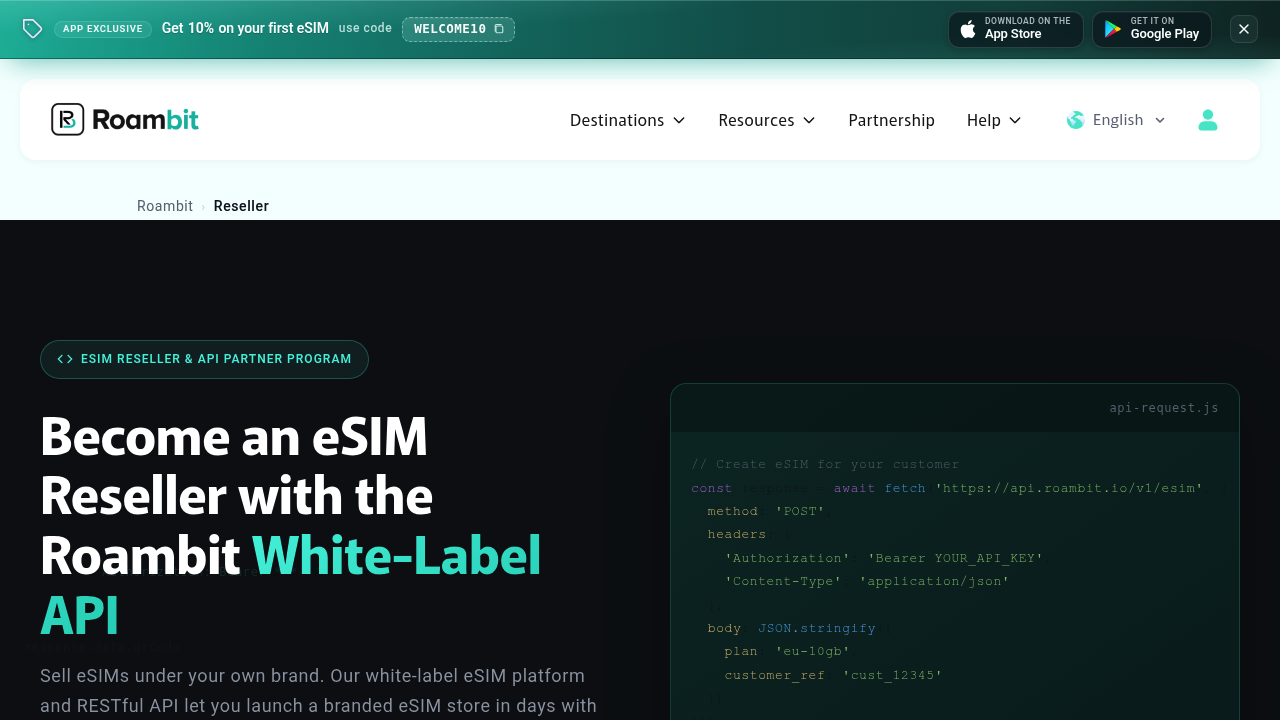
Roambit is a wholesale travel eSIM platform and API for shops and software products. Its REST API creates eSIMs and reports usage, while webhooks cover order, usage and expiry events.
Best-fit niches: Travel agencies, tech platforms, online shops and eSIM resellers.
White label capabilities: Gold and Platinum branding options include your logo, colours, domain and branded emails; partners control retail prices.
9. Bitcall
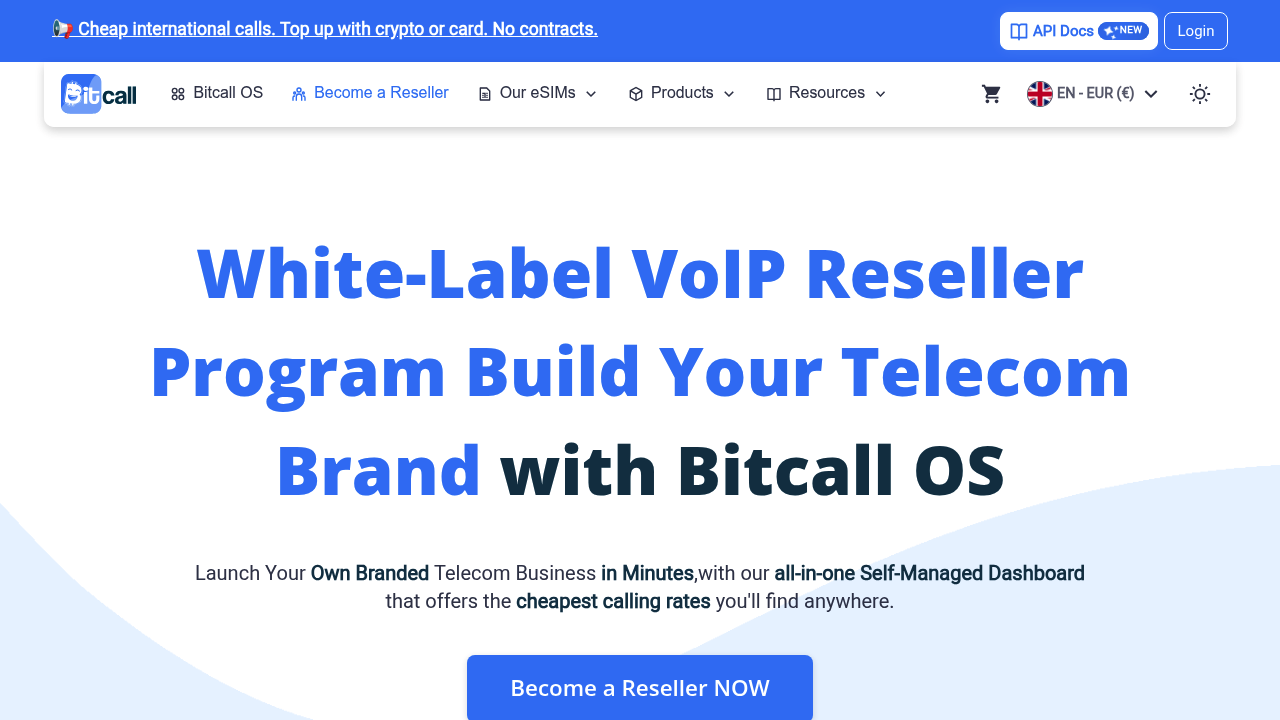
Bitcall combines VoIP and travel eSIM resale in a hosted client portal. Partners can manage unlimited client sub-accounts, collect payments through their own Stripe, PayPal or crypto accounts, and use the Elite API for accounts, billing and services.
Best-fit niches: IT providers, agencies, telecom consultants and travel companies.
White label capabilities: Your logo, colours and domain; branded emails and, on Professional and Elite, branded invoices, reports and custom client screens.
10. MegaEsim
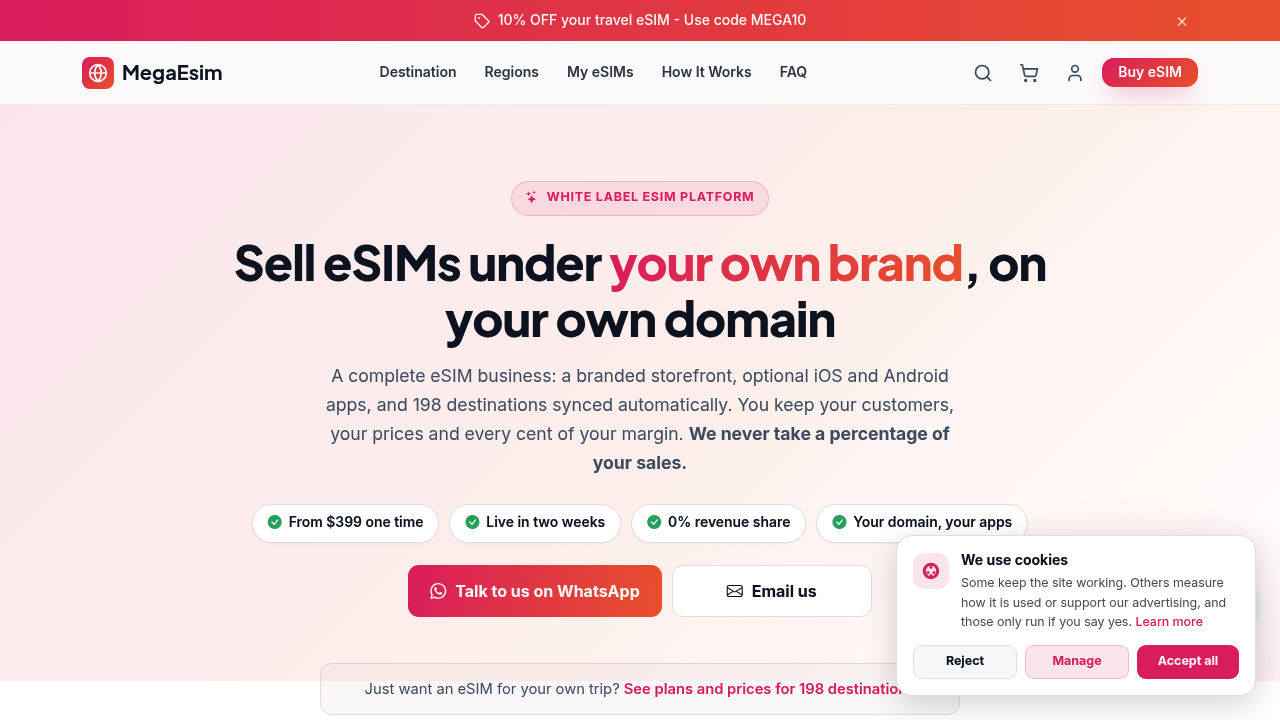
MegaEsim provides a hosted eSIM store with optional native iOS and Android apps. Card checkout runs in the partner’s processor account, and a Partner API can return QR codes into a custom checkout.
Best-fit niches: Travel agencies, tour operators, telecom shops and travel-facing apps.
White label capabilities: Your domain, logo, colours and typography; optional apps published from your developer accounts; API and delivery webhooks.
11. Limitflex
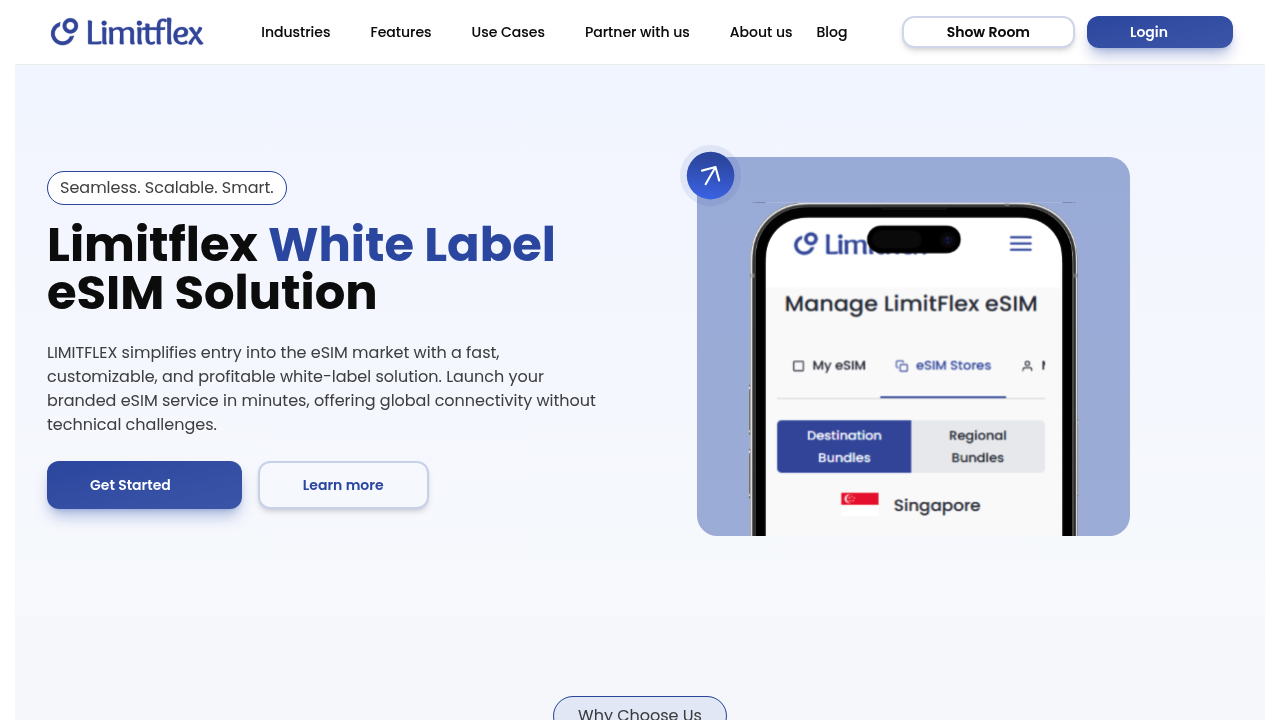
Limitflex is a managed eSIM store and reseller platform. Its partner portal supports multiple layers of resellers and affiliates, with wholesale-to-retail pricing and commission controls.
Best-fit niches: Travel businesses, telecom sellers, distributors, affiliates and retailers.
White label capabilities: Your domain, logo, colours and theme; branded support pages, REST API and SDK integration.
12. eSIMfly
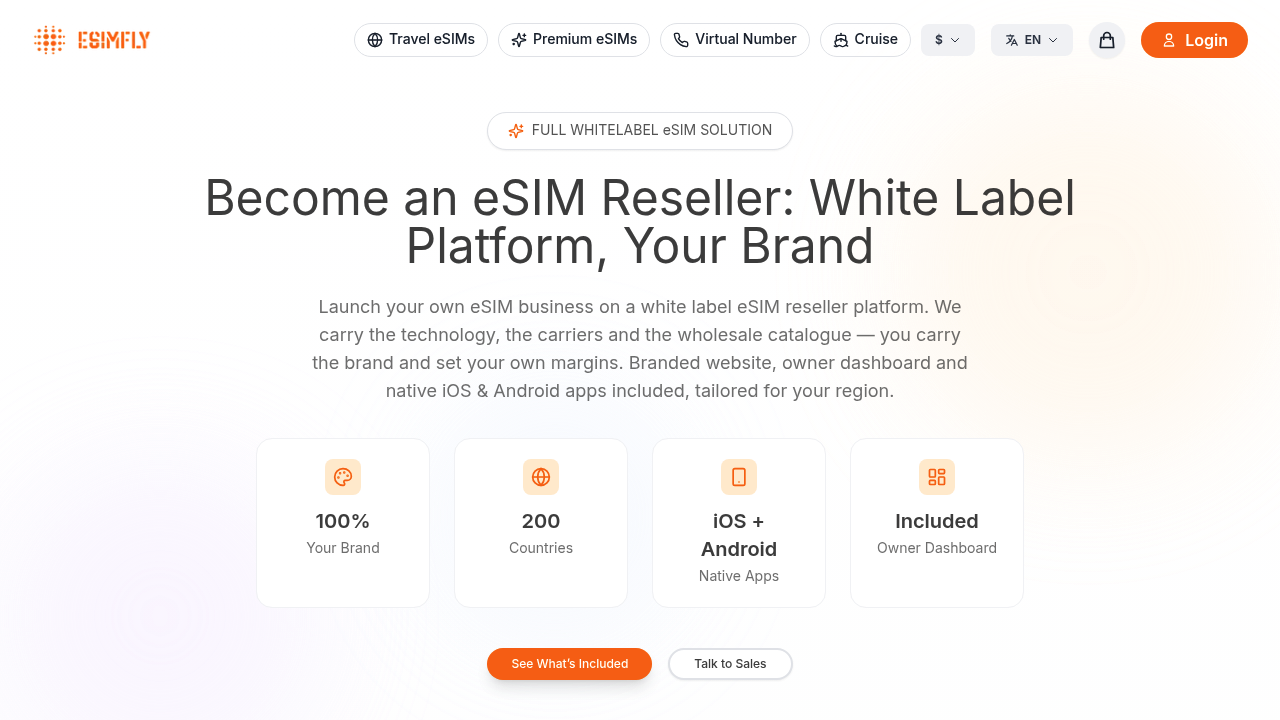
eSIMfly provides a branded eSIM shop, native iOS and Android apps and a Business API. An owner dashboard manages customers, orders, pricing and team permissions, while checkout uses the partner’s Stripe or local gateway.
Best-fit niches: Travel agencies, booking platforms, phone retailers and telecom resellers.
White label capabilities: Your domain, logo and colours; branded owner dashboard; apps in your developer accounts; webhooks and local currency options.
13. Hubby eSIM
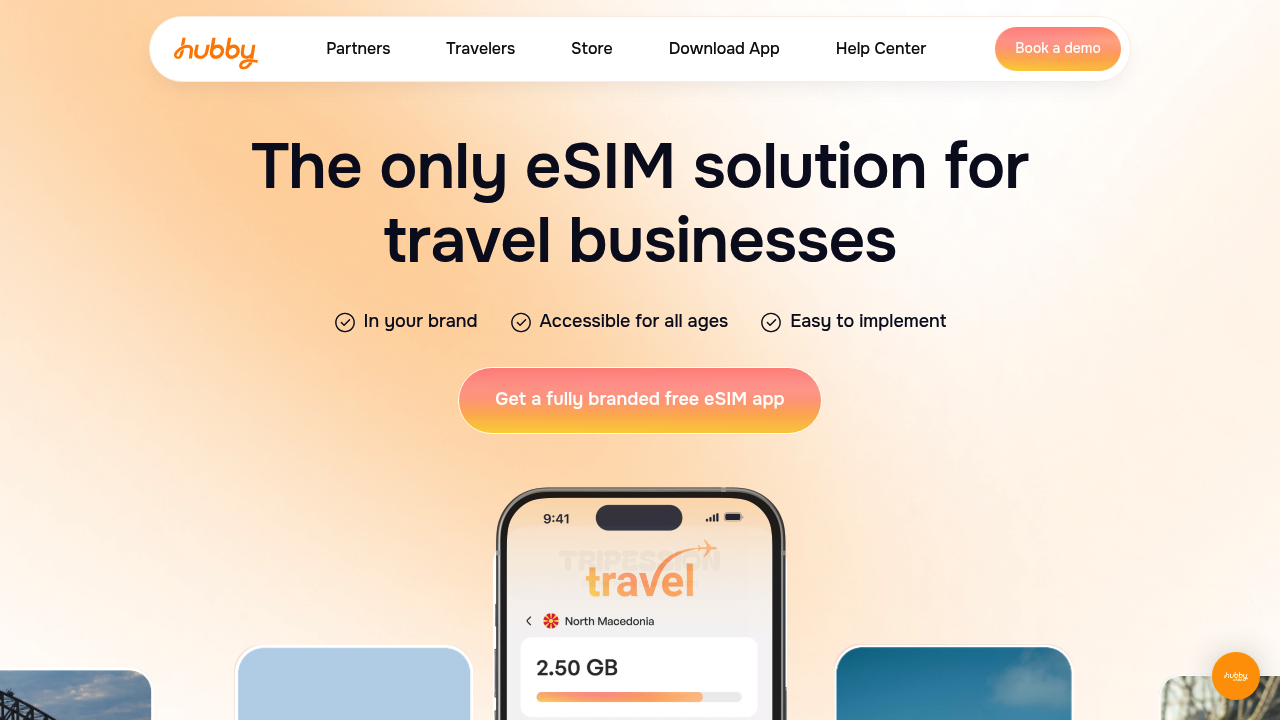
Hubby eSIM provides travel connectivity for businesses gifting or upselling mobile data. Partners can show branded pages inside their app using a WebView, or use the Partner API, with booking and sub-brand settings.
Best-fit niches: Tour operators, travel agents, airlines, cruise lines and hotels.
White label capabilities: Branded traveller app, embedded pages and emails; separate sub-brand assets, language settings and booking-related webhooks.
14. BNESIM
BNESIM offers branded connectivity and distributor programmes. Partners can customise the design and prices, manage resale through a distributor dashboard or integrate connectivity through the API Partner model.
Best-fit niches: Telecom resellers, travel agencies, retailers and digital service providers.
White label capabilities: Custom design and pricing, a branded mobile experience such as Kaspersky eSIM Store, and API integration.
15. Roam Communication
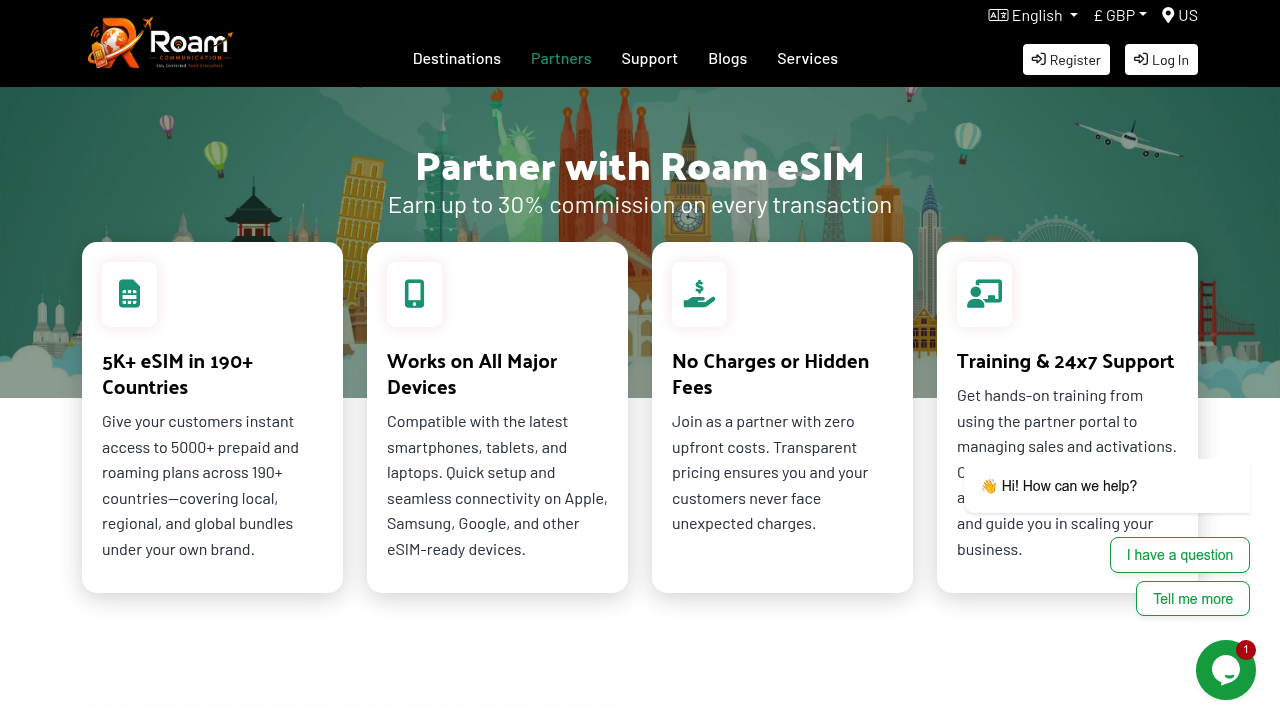
Roam Communication provides a partner-branded eSIM store and management portal. Partners manage sales, customers and promotions, set end-user prices and connect a website or app through API access after onboarding.
Best-fit niches: Travel agents, airport and mobile shops, OTAs and corporate travel managers.
White label capabilities: Your domain, logo, colours and fonts; partner pricing controls and API-based sales and usage integration.
16. Boxo
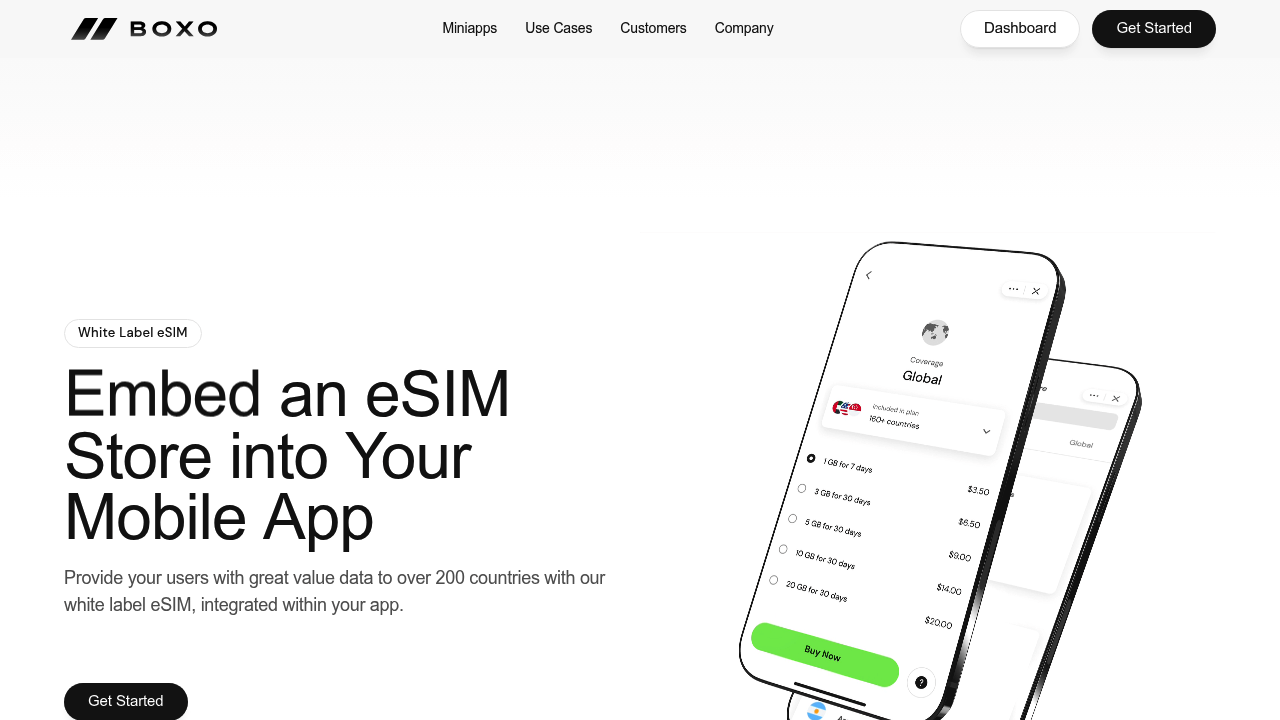
Boxo embeds an eSIM miniapp inside an existing mobile app. Customers use the host app’s login and payment system, while an admin dashboard manages packages, orders, usage and customer support.
Best-fit niches: Travel, finance, lifestyle and residential super-app operators.
White label capabilities: Host-app logo, colours and login; integrated checkout, SDK embedding and order/eSIM lifecycle webhooks.
17. XIPO Connect
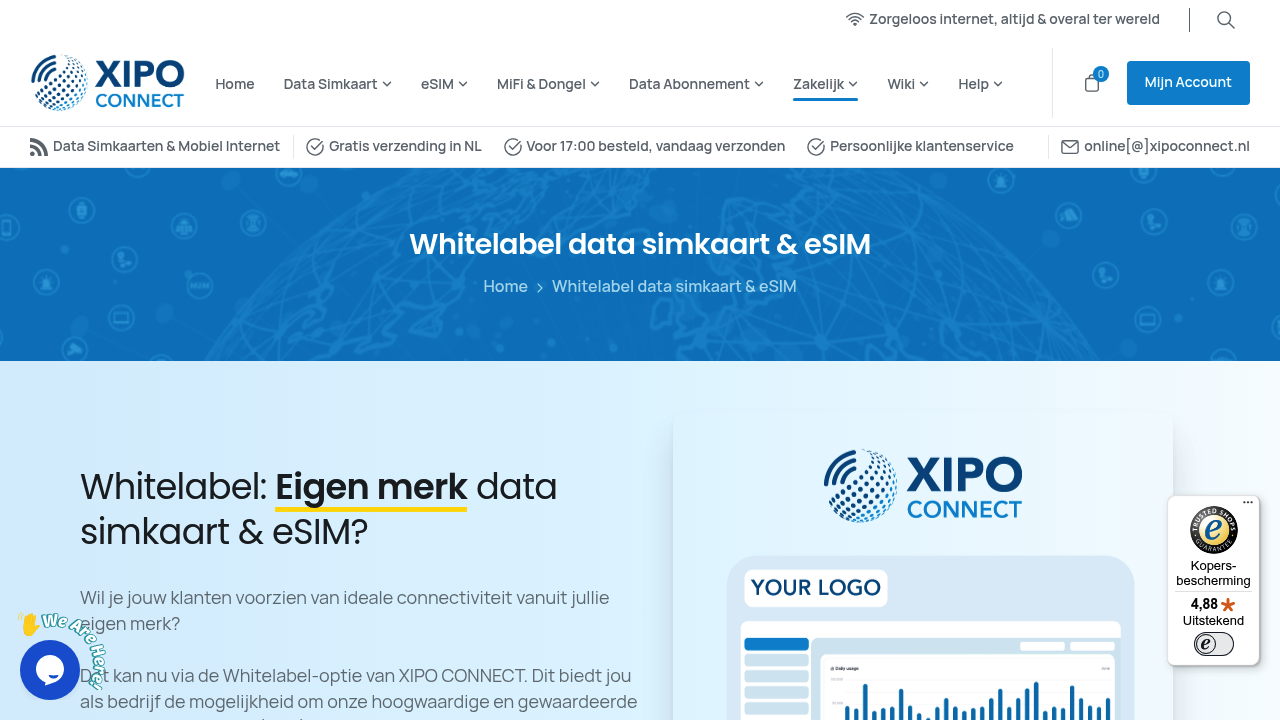
XIPO Connect supplies data SIMs and eSIMs sold under the partner’s business name, with a customer portal for top-ups and connection management. The partner sets prices and runs customer service while XIPO supplies the software and connectivity arrangements.
Best-fit niches: Connectivity sellers, resellers, IoT providers and travel brands in Europe.
White label capabilities: Your logo, house style, URL and customer login, with usage and top-up management under your brand.
18. Telna
Telna supplies mobile data for businesses to resell to travellers or use in services for devices. Partners can run branded consumer apps and webstores, use its API and management tools, and administer companies and sub-companies in a hierarchy.
Best-fit niches: Mobile operators, connectivity providers, travel brands and IoT integrators.
White label capabilities: Branded apps, storefronts, management screens and support pages; pricing controls, billing tools and provisioning webhooks.
19. SimBlox
SimBlox is BetterM2M’s eSIM platform for selling or embedding connectivity. Partners can run a storefront, publish branded iOS and Android apps under their developer accounts, or embed purchasing through the mobile SDK and REST API.
Best-fit niches: Travel brands, telecom resellers, MVNOs and software platforms.
White label capabilities: Your domain, logo, colours and delivery emails; own Stripe connection, app support centre and multi-tenant reseller portal.
20. Tourist eSIM
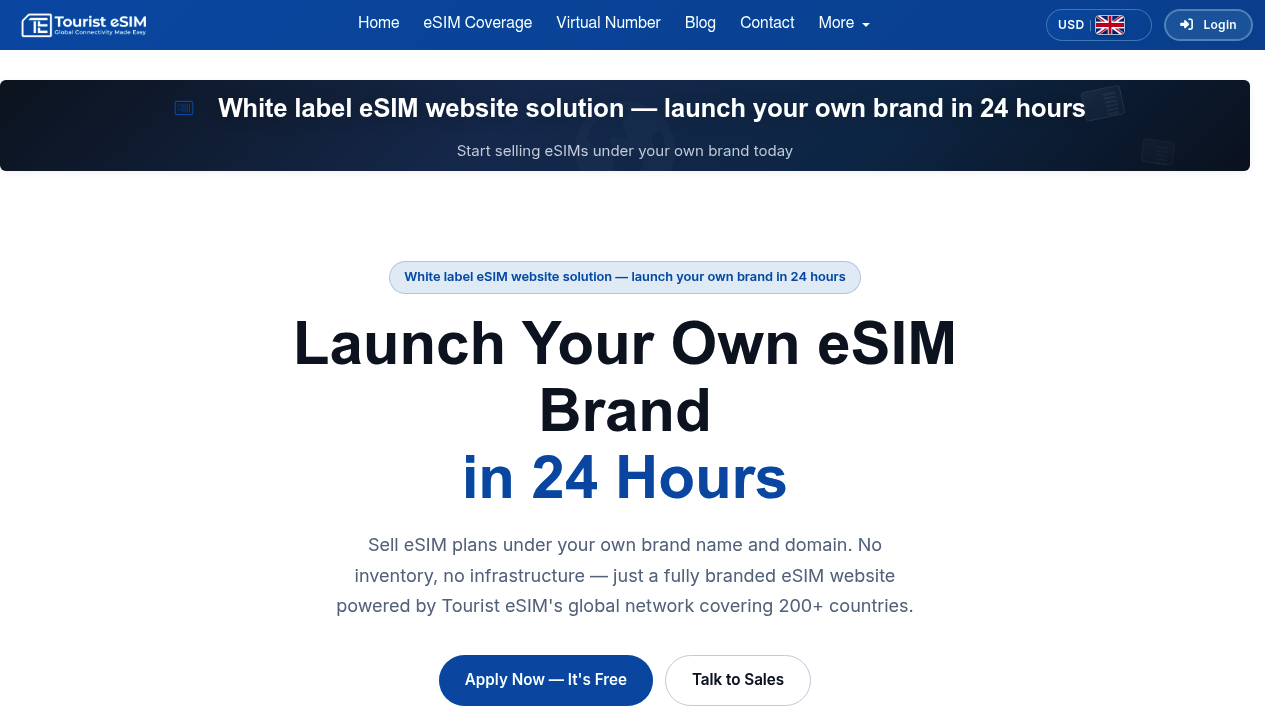
Tourist eSIM provides a hosted store and Partner API for selling travel data plans. Partners control retail prices, connect their own Stripe or PayPal gateways, and deliver order confirmations and eSIM details under their brand.
Best-fit niches: Travel agencies, OTAs, airlines, hospitality businesses and telecom start-ups.
White label capabilities: Your domain, logo, colours and emails; API webhooks and official PHP, Node.js and Python SDKs.
21. Zendit
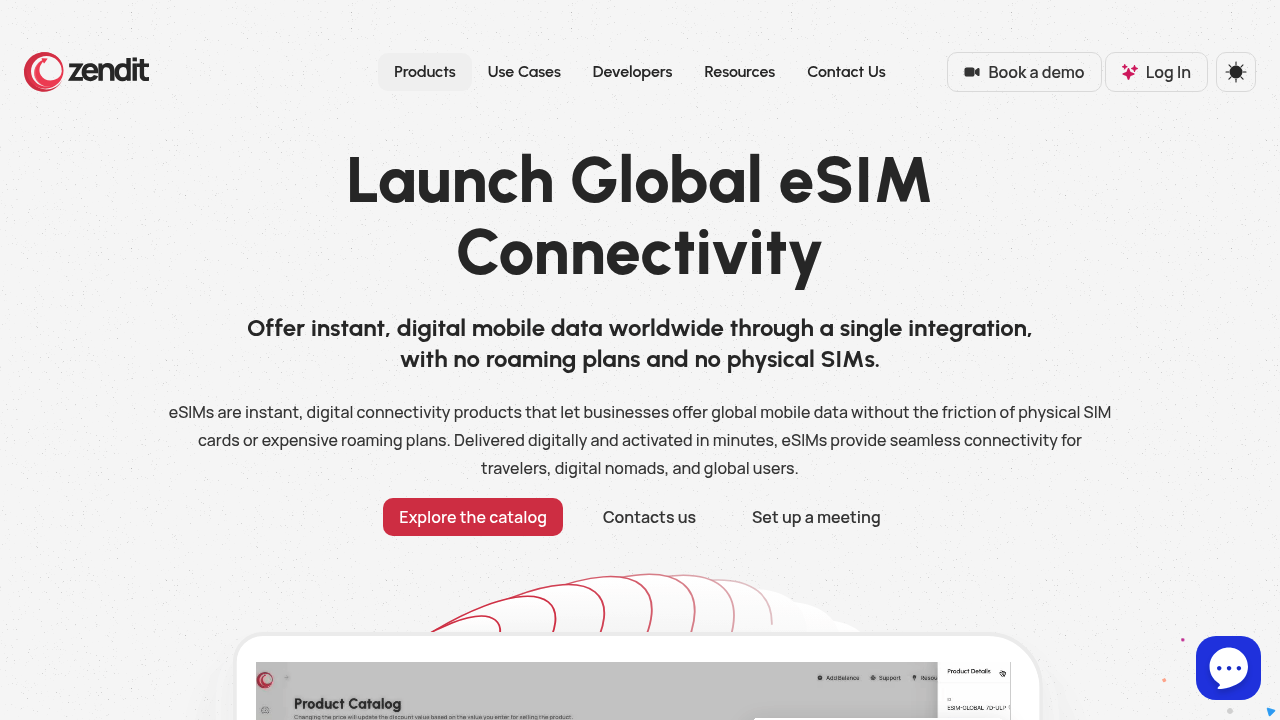
Zendit provides an embeddable eSIM storefront for an existing website or app. The partner keeps the merchant account and chooses the catalogue and retail prices, while Zendit provides the eSIM.
Best-fit niches: Fintechs, wallets, banks, booking platforms and marketplaces.
White label capabilities: Your logo, colours and fonts; configurable embedded purchase screens, transaction webhooks and supported currency options.
22. ZIM Connections
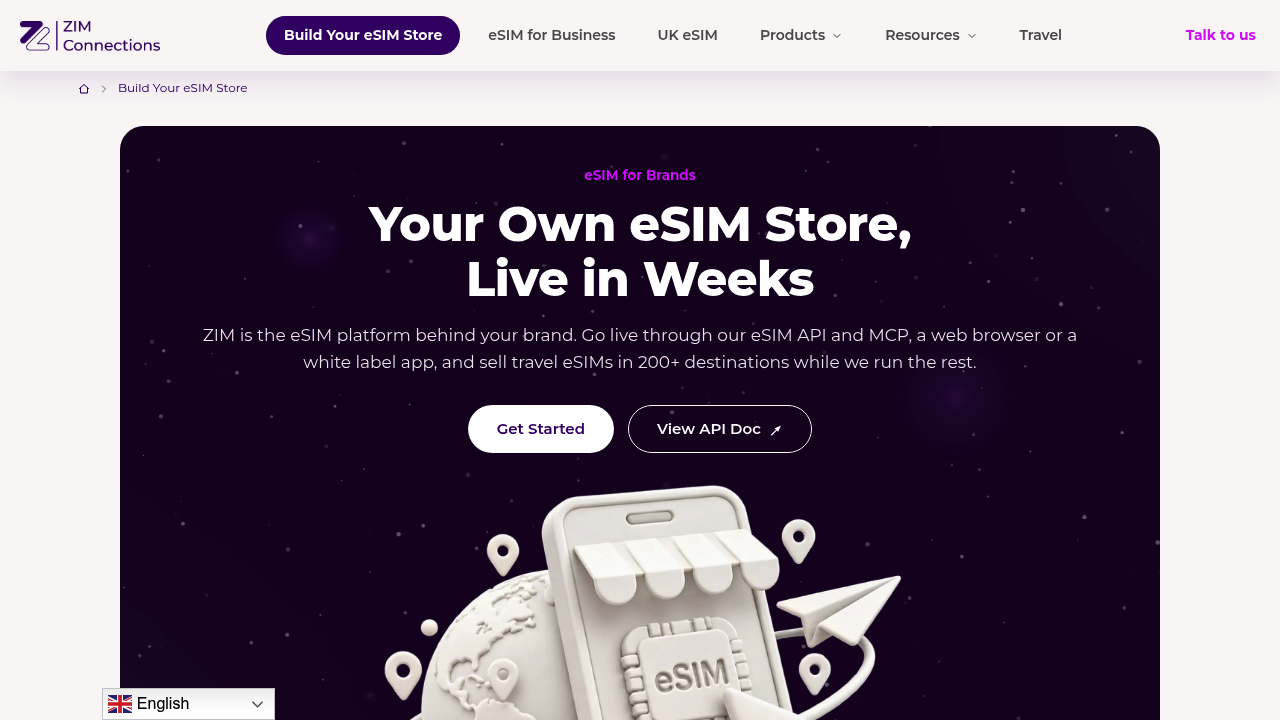
ZIM Connections offers hosted web stores, native mobile apps and API integration for travel connectivity. A Partner Dashboard tracks orders, activations, usage, revenue and margins, while its API supports subscriptions and top-ups.
Best-fit niches: Travel brands, mobile operators, fintechs, transport providers and product teams.
White label capabilities: Your domain and branded app; retail prices and promotions, local languages/currencies, webhooks, with native mobile SDKs available on request.
23. ConnectedYou
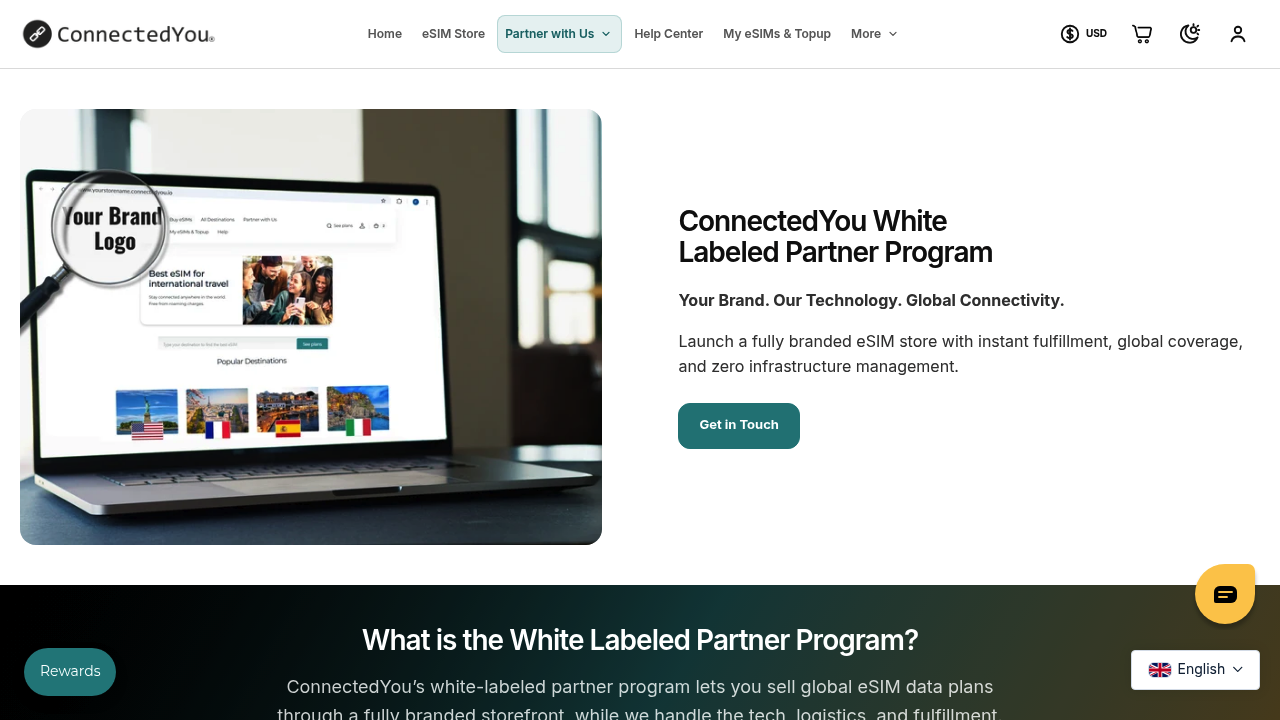
ConnectedYou provides a managed branded store for global, regional and country-specific data plans, with top-ups, order management and sales analytics. Its programme targets large businesses with potential for at least 10,000 orders a month.
Best-fit niches: Large travel businesses, leading travel agencies and airlines.
White label capabilities: Your domain, logo and colours; retail price and margin controls, language choices and currency presentation.
24. eSIM.tech
eSIM.tech supplies a REST API for a storefront and checkout built by the buyer. It returns activation details for QR-code delivery and provides notifications for activation, usage thresholds and low balances.
Best-fit niches: Travel and telecom businesses, SaaS builders and solution integrators.
White label capabilities: Buyer-built interface and retail packages, provider branding removal, API provisioning and lifecycle webhooks.
25. Firsty
Firsty supplies travel eSIM data through an API that partners build into their own product, with their own brand and prices. Partners can instead embed its hosted web app, where users who are already signed in to the partner’s product choose and pay for a plan without a second sign-up.
Best-fit niches: Travel apps, banks and crypto wallets adding branded data to their app.
White label capabilities: Your brand on the interface, checkout and eSIM; your own pricing; support answered in your brand; install links, QR codes and eSIM and usage webhooks.
White Label eSIM Reseller Margins and Unit Economics
A reseller’s margin is the gap between the supplier’s price and the customer’s price, less the costs of each sale. MegaEsim sells to resellers at 12% to 20% below its own catalogue prices, with the discount rising with monthly volume. Card fees come out of that gap: Stripe’s standard US pricing is 2.9% plus 30¢ per successful domestic card payment, with an extra 1.5% for international cards.
Figure 1 follows one sale from the supplier’s reseller calculator: a plan with a $1.75 catalogue price, sold for $3.50. It shows what is left as profit after the supplier cost and the card fee.
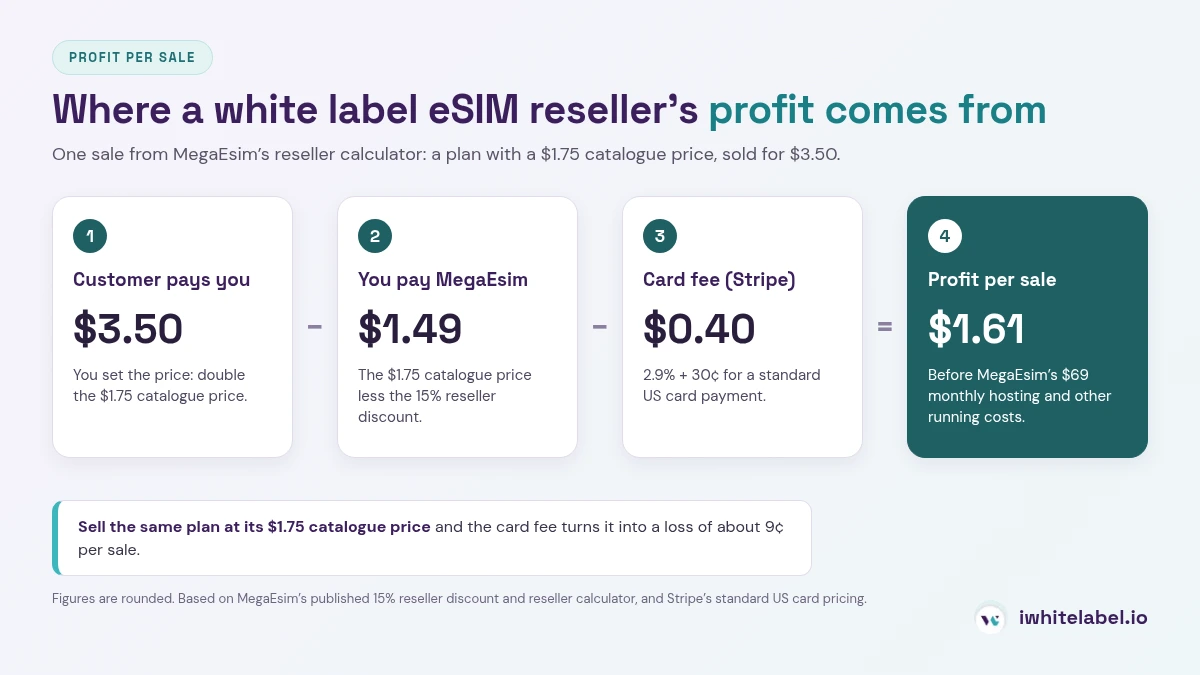
Figure 1: Profit on one $3.50 sale of a plan with a $1.75 catalogue price, after the 15% supplier discount and a standard US card fee.
Table 3 applies the same 15% tier to other plan prices, both at the supplier’s catalogue price and at double that price.
Table 3: Profit per sale with MegaEsim, using its published 15% reseller discount, the $1.75 average plan and $3.50 selling price from its reseller calculator, and Stripe’s standard US card fee of 2.9% + 30¢. Profit is gross profit per sale, before MegaEsim’s $69 monthly hosting charge and other running costs.
| Plan’s catalogue price | You pay MegaEsim (15% off) | Profit per sale if you charge the catalogue price | Profit per sale if you charge double |
|---|---|---|---|
| $1.75 (the calculator’s average plan) | $1.49 | −$0.09 (a loss) | $1.61 on a $3.50 sale |
| $3.00 | $2.55 | $0.06 | $2.98 on a $6.00 sale |
| $10.00 | $8.50 | $0.91 | $10.62 on a $20.00 sale |
| $30.00 | $25.50 | $3.33 | $32.46 on a $60.00 sale |
At catalogue prices the profit is tiny: about 6¢ on a $3 plan. Profit comes from charging more than the catalogue price and from selling larger plans.
The fixed 30¢ in the card fee is why small plans earn so little: it takes 12.9% of a $3 sale but only 3.9% of a $30 sale. The supplier’s margin guide shows the same pattern with a larger 30% discount: about $0.51 kept on a $3 plan and $7.83 on a $30 plan, before refunds. An international card adds 1.5% to the fee, which raises it from $0.59 to $0.74 on a $10 plan.
Payment risk stays with the reseller. As noted in How a White Label eSIM Business Works, a chargeback does not reverse the wholesale purchase, and the same terms say a downloaded eSIM cannot be refunded and plans with a phone number cannot be cancelled once ordered.
eSIM.tech suggests a 30% to 40% gross margin for price-sensitive destinations such as Europe, the USA and Turkey, and says local eSIMs with real phone numbers can support margins of 50% to 70%. Its reseller guide also says that automating top-ups with usage notifications typically adds 20% to 30% to revenue per customer. These are the supplier’s pricing suggestions, not guaranteed results.
The figures point to these pricing choices:
Do not make small plans the main product at catalogue price. At a 15% discount, a $3 plan makes about 6¢ and the $1.75 average plan loses about 9¢ once the card fee is paid.
Lead with larger and regional bundles. A $30 plan makes $3.33 at catalogue price, and the margin guide recommends regional plans for trips covering several countries.
Price above the supplier’s catalogue where the market allows. The $3.50 sale in Figure 1 makes $1.61, more than a $10 plan sold at catalogue price.
Offer top-ups to existing customers, in larger amounts rather than small ones. Each top-up is a separate payment and pays the fixed card fee again.
Price plans with local phone numbers to cover the fact that they cannot be refunded or cancelled once ordered.
Conclusion
The 25 white label eSIM providers covered here serve several kinds of business: phone retailers, banking and travel apps, tour operators, creators, loyalty programmes and connectivity providers. Their products range from complete branded shops to app components and software connections for developers.
The differences extend beyond appearance. Some offerings include separate reseller accounts, customer billing or a connection to the buyer’s own payment account. Others supply the data service and developer tools while the buyer builds the customer-facing software.
Frequently Asked Questions
eSIMfly supplies phone retailers with a branded shop, customer and order management, and retail-price controls. Zendit supplies embedded storefronts for banks, wallets and loyalty programmes. Hubby eSIM supports airlines, booking platforms, tour operators and agencies with data sold as an extra or included with a booking. SimBlox supports creators with branded shops and embedded store options. Telna supplies connectivity businesses with company and sub-company accounts and tools for reselling mobile data.
Costs differ by provider. eSIM Access says its service is free of charge, with no minimum order. BNESIM needs no setup for its distributor model, where you add credit and start selling, but charges €40,000 to set up its fully managed white label service and €2,000 a month to maintain it. DROAM’s platform plans that include white label branding start at €299 a month plus €0.09 for each active eSIM.
MegaEsim charges $399 once for a branded shop, or $997 with iOS and Android apps, plus $69 a month for hosting. You also buy each plan from a prepaid wallet, with a minimum top-up of $50.
You earn the difference between what the customer pays you and what you pay the supplier. Here is a worked example using that supplier’s charges and its reseller calculator. You sell 250 plans a month at $3.50 each, and each plan costs you about $1.49 after the 15% reseller discount. That brings in $875 and costs about $372 in plans and $69 in hosting, leaving about $434. Card fees at Stripe’s standard US rate take about $100 more, leaving about $334 a month before advertising, support, taxes and other costs. Figure 1 breaks down one of these sales, and Table 3 shows the profit per sale at other plan prices.
eSIMPal’s public revenue record listed $29,621 in total revenue in November 2026 and states that revenue is verified through Stripe. In a first-hand Reddit account, its founder said that sending users from his existing international-calling service to the eSIM shop brought two or three buyers a day. In October 2026, MeSIM’s founder reported about US$420 in revenue over two days and wrote: “Cheap pricing alone isn't enough. Customers still need to trust an unfamiliar brand.” These are sales figures, not take-home profit after data purchases and running costs.
Tourist eSIM supplies a Partner API, webhooks and SDKs for PHP, Node.js and Python, so software can place orders and receive event updates. SimBlox provides a mobile SDK for adding an eSIM store inside an existing app. eSIM Access also publishes an MCP server, where MCP means Model Context Protocol: it lets a compatible AI assistant use the supplier’s tools. Its MCP integration guide documents catalogue searches, orders, usage lookups, top-ups and support diagnostics, with account authorisation and separate permissions for actions that change the service.
The chip that stores eSIM profiles is called the eUICC. The GSMA publishes two main standards for it: SGP.22 for consumer devices, where the person using the phone installs a profile by scanning a QR code or following a link, and SGP.32 for the Internet of Things. The GSMA describes the IoT standard as designed for devices with limited network access or limited user interfaces, where a remote manager downloads, enables, disables and deletes profiles instead of a person. Trackers, sensors and other devices without a screen fall into this group.
Before buying connectivity for such devices, an IoT reseller needs the device maker to confirm in writing which specification the module supports. The device also needs approval for the networks it will use. PTCRB, the certification programme set up by North American network operators, certifies IoT devices built around an approved cellular module. AT&T’s device certification also requires each IoT device to be identified, either by its own type allocation code (the first eight digits of the IMEI) or by uploading its IMEI numbers. The written confirmation should therefore cover the module’s certifications and any operator approvals for the target networks as well as the eSIM specification.
1GLOBAL offers an eSIM IoT Manager that it describes as fully compliant with SGP.32 v1.1. DROAM says it is building its platform and SIM management for IoT integrators around SGP.32.
Telecom rules are specific to the country and the service supplied. In the UK, Ofcom’s General Conditions use general authorisation rather than individual telecom-service licences, with obligations applying to the relevant category of communications provider. This is a UK example, not worldwide permission to sell mobile services. GSMA security accreditation for eSIM infrastructure is not a reseller licence.
Secure delivery of an eSIM and protection of customer records are separate responsibilities. Under UK GDPR, the ICO defines a controller as the organisation deciding why and how personal data is used; a supplier processing it only on that organisation’s behalf is a processor. Controllers have data-protection duties, while processors also need appropriate security measures and a binding contract with the controller. A white label arrangement does not automatically make the supplier solely responsible for customer data.
ConnectedYou supplies country-specific, regional and global data plans. Provisioning means supplying the SIM details needed to connect the device, rather than sending a physical card. eSIM.tech supplies installation details through its API and sends activation, usage and low-balance notifications. A top-up can add data, extend the plan’s duration or do both, depending on the product; ZIM Connections supports subscriptions and top-ups through its API, with tutorials, FAQs and live support inside the branded app. Limitflex includes installation guides, FAQs and 24/7 support with its managed store.
No. Support depends on the exact model, its regional version and any network lock, and many buyers do not know whether their own phone qualifies. In a 2025 YouGov survey for BICS, 33% of consumers in the US, UK and China said they knew what an eSIM was and 42% were unsure whether their phone had one. Several suppliers’ refund rules exclude incompatible or carrier-locked phones, so a plan sold for the wrong device can leave the seller with the cost.
A device check before payment prevents most of these sales. Limitflex runs automated device-compatibility checks before purchase in its white label stores. Hubby eSIM includes a device-compatibility endpoint in its partner API. Keepgo’s API returns an up-to-date list of eSIM-enabled devices for partners to show on their own platform. eSIM Access publishes a device support list.
For customers who want to check for themselves, Apple’s official eSIM requirements list supported iPhones and explain that using two different carriers requires an unlocked phone. Samsung’s official compatibility page lists supported Galaxy models and regional exceptions.
The reseller handles it. MegaEsim’s reseller terms, for example, say the reseller owns the customer relationship, including billing, questions and support, and that the supplier will not contact the reseller’s customers. The usual causes are a code that has already been used, a phone that is carrier-locked or does not support eSIM, and no stable internet connection during the download. Telling customers to install at home over Wi-Fi before they travel avoids the last problem, because the profile downloads over the internet and cannot be installed without a connection.
Some suppliers make installation easier. eSIM Access supports one-tap install links as well as QR codes and manual entry. Apple’s install link works on iOS 17.4 and later. The Android version needs Android 10 or later with current Google Mobile Services. Hubby eSIM sends notifications when an eSIM is installed or removed, and its travel agent platform tracks installations, so the seller can see which customers have not installed yet.
Rules for deleted profiles differ between suppliers. MegaEsim allows the same QR code to be reinstalled on the same device up to ten times. Tourist eSIM states that its eSIMs cannot be reinstalled once deleted and does not refund locked or incompatible phones. Under MegaEsim’s terms, a profile that has never been downloaded can usually be cancelled, a downloaded one cannot be refunded, and plans with a phone number cannot be cancelled once ordered.
Data-only plans are the main product, and a phone number is an add-on. eSIM.tech calls data-only plans the standard and local numbers the extra that sets a seller apart. MegaEsim sells plans with a phone number as a separate plan type. 1GLOBAL offers branded domestic plans with a local number, data, texts and calls in 10 countries. Bitcall sells internet calls, billed per second, and SMS separately from its travel eSIMs. Firsty’s API offers SMS and voice plans as well as data, and it sells Belgian phone numbers. A customer’s home line stays separate: Apple’s travel guidance warns that leaving it on alongside a travel eSIM can still incur roaming fees.